
Novel polymeric compositions
a polymer composition and composition technology, applied in the field of new polymer materials, can solve the problems of affecting the viscosity of polymers, affecting and prone to brittleness of polymers, and achieves the effects of promoting water solubility/dispersibility of polymers, facilitating delivery, and facilitating the solubility/dispersibility of polymers
- Summary
- Abstract
- Description
- Claims
- Application Information
AI Technical Summary
Benefits of technology
Problems solved by technology
Method used
Image

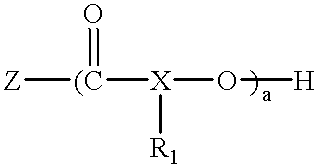
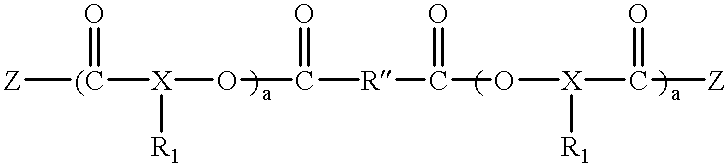

Examples
example 1
Synthesis of [MPEG 750-d,l]LA412-HDI
[0210] The synthesis consisted of two consecutive stages, namely the diblock synthesis and the consequent di-diblock formation.
[0211] 1. Diblock Synthesis
[0212] 80 gr. of poly(ethylene glycol) methyl ether of molecular weight 750 (MPEG 750), was dried under vacuum at 100+ C. for 1 hour, under constant stirring. 32.26 gr. of (d,l)lactide were then added, corresponding to an LA:PEG molar ratio 4:1, including an excess of 5%. Catalyst (stannous 2-ethyl hexanoate) was added at a molar ratio of {fraction (1 / 400)} of the amount of added lacitide, i.e. 0.3 gr. The reaction was carried out in a sealed flask, under a dry nitrogen-saturated atmosphere, for two hours at 145.degree. C.
[0213] 2. Di-blockformation
[0214] The diblock obtained in the first step was reacted with 17.92 gr. of hexamethylene diisocyanate (HDI) (at a molar ratio of 1:2) in a three-necked flask for 1 hour under mechanical stirring and dry nitrogen atmosphere, at 85.degree. C. The materi...
example 2
Synthesis of [MPEG 750-d,lLA8]2-HDI
[0215] Same as in EXAMPLE 1, except for the use of 64.51 gr. of (d,l)lactide, corresponding to an LA:PEG molar ratio of 8:1, and 0.43 gr. of catalyst, in the first stage of the synthesis.
[0216] The material is a water-soluable viscous liquid, at room temperature.
example 3
Synthesis of [MPEG 750-d,lLA12]2-HDI
[0217] Same as EXAMPLE 1, except for the use of 96.77 gr. of (d,l)lactide corresponding to an LA:PEG molar ratio of 8:1 and 0.68 gr. of catalyst, in the first stage of the synthesis.
[0218] The material is a water-insoluable viscous liquid, which does not flow at room temperature.
PUM
| Property | Measurement | Unit |
|---|---|---|
| weight % | aaaaa | aaaaa |
| temperature | aaaaa | aaaaa |
| molar ratio | aaaaa | aaaaa |
Abstract
Description
Claims
Application Information
 Login to View More