
Nonoriented stiff packaging film with superior tear properties
a packaging film, non-oriented technology, applied in the direction of packaging foodstuffs, packaged goods types, synthetic resin layered products, etc., can solve the problems of high film breakdown risk, inefficient and costly production process, and biaxial orientation production process, and achieve good tearability and stiffness
- Summary
- Abstract
- Description
- Claims
- Application Information
AI Technical Summary
Benefits of technology
Problems solved by technology
Method used
Image

Examples
examples
[0045] The examples tested have compositions identified in Tables A-F below. In the compositions of the examples identified below, hcPP is nucleated highly crystalline homopolymer polypropylene with a melt flow of 40 g / 10 minutes, sold under the tradename Fina EOD-9601. In the examples below, polypropylene refers to standard homopolymer polypropylene with a melt flow of 8.8 g / 10 min, sold under the tradename Union Carbide DX5E766. The antiblock identified in the tables below is a mixture of 20% antiblock in low density polyethylene, sold under the tradename Ampacet 10126. The nucleating agent identified below is a plastics additive of hydrogenated hydrocarbon resin and polyolefins, sold under the tradename Plastolyn 2539 (“Plastolyn”). The erucamide slip is 5% erucamide slip in low density polyethylene, sold under the tradename Ampacet 10090. Additional resins used in the following examples are specified below. As used below, “Milliken” refers to a sorbitol nucleating agent in rando...
examples 1-4
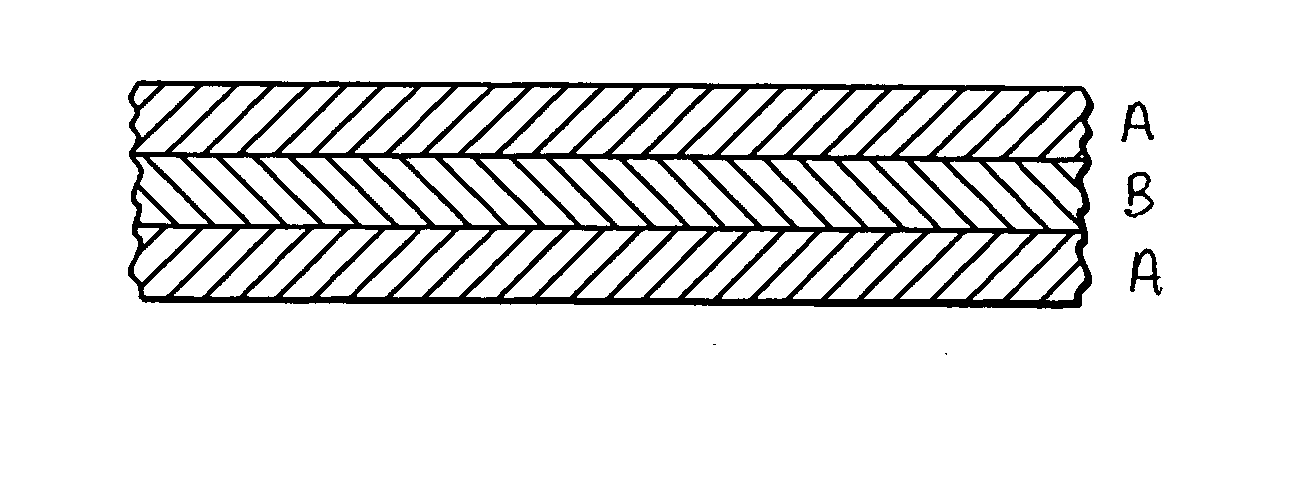
[0046] Examples 1-4 were three layer films, with an A / B / A construction with corresponding thicknesses as identified below in Table A.
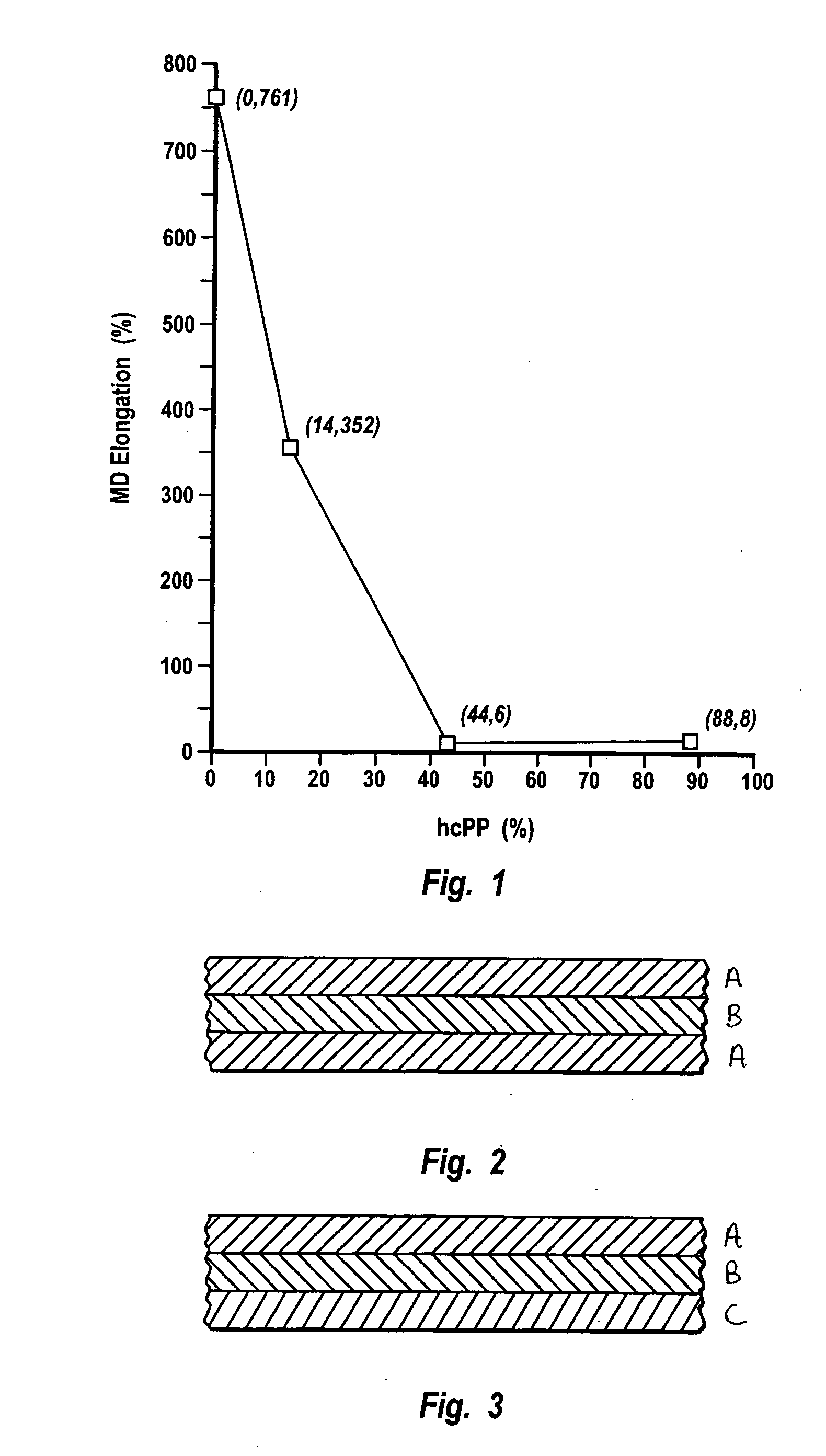
TABLE AA / B / ATotal %ThicknessesA LayerB LayerhcPPExample 110% / 80% / 10%94% polypropylene98% polypropylene 0% 2% antiblock 2% nucleating agent 2% nucleating agent 2% erucamide slipExample 2 25 / 50 / 2514% hcPP14% hcPP14% 2% antiblock84% polypropylene 2% nucleating agent 2% nucleating agent 2% erucamide slipExample 317.5 / 65 / 17.594% polypropylene68% hcPP44.2% 2% antiblock30% polypropylene 2% nucleating agent 2% nucleating agent 2% erucamide slipExample 4 25 / 50 / 2578% hcPP98% hcPP88%16% polypropylene 2% nucleating agent 2% antiblock 2% nucleating agent 2% erucamide slip
[0047] Four sample films, Examples 1-4, were prepared with the compositions identified above and tested for several physical properties, listed in Table B.
TABLE BASTMPROPERTYTEST #UNITSExample 1Example 2Example 3Example 4% hcPP01444.288GaugeD 2103Mils1.421.431.221.43M.D. ElongationD 882%761...
examples 5-6
[0049] A sample film of the composition listed above in Table 1 for Example 3 was prepared and compared with Examples 5 and 6. The composition of Examples 5 and 6 was identical to Example 3, except for the hcPP and nucleating agent used. The hcPP included in Examples 5 and 6 was a hcPP with a melt flow of 20 g / 10 minutes. The nucleating agent was Milliken nucleating agent. Examples 3 and 5-6 were three layer films, represented by the construction A / B / A with corresponding thicknesses of 17.5 / 65 / 17.5. The physical properties of Examples 3 and 5-6 were tested and are shown in Table C.
TABLE CASTMPROPERTYTEST #UNITSExample 3Example 5Example 6Resin Melt Flow402020GaugeD 2103Mils1.341.401.51M.D. ElongationD 882%9353225M.D. Elong. @D 882%777YieldM.D. Trouser TearD 1938Grams536799M.D. Strip / GaugeD 2103Mils1.381.411.46M.D. SecantD 882Psi245,800215,321203,876ModulusT.D. ElongationD 882%856T.D. Elong. @ YieldD 882%756T.D. Trouser TearD 1938Grams154165166T.D. Strip / GaugeD 2103Mils1.361.401.47T...
PUM
| Property | Measurement | Unit |
|---|---|---|
| elongation | aaaaa | aaaaa |
| elongation | aaaaa | aaaaa |
| elongation | aaaaa | aaaaa |
Abstract
Description
Claims
Application Information
 Login to View More