
Polymer film and preparation method of polymer solution
a polymer film and solution technology, applied in the field of polymer film and polymer solution preparation, can solve the problems of large image display device demand and limitation of control method, and achieve the effect of reducing pressur
- Summary
- Abstract
- Description
- Claims
- Application Information
AI Technical Summary
Benefits of technology
Problems solved by technology
Method used
Image

Examples
example 1
[0119] (Experiment 1)
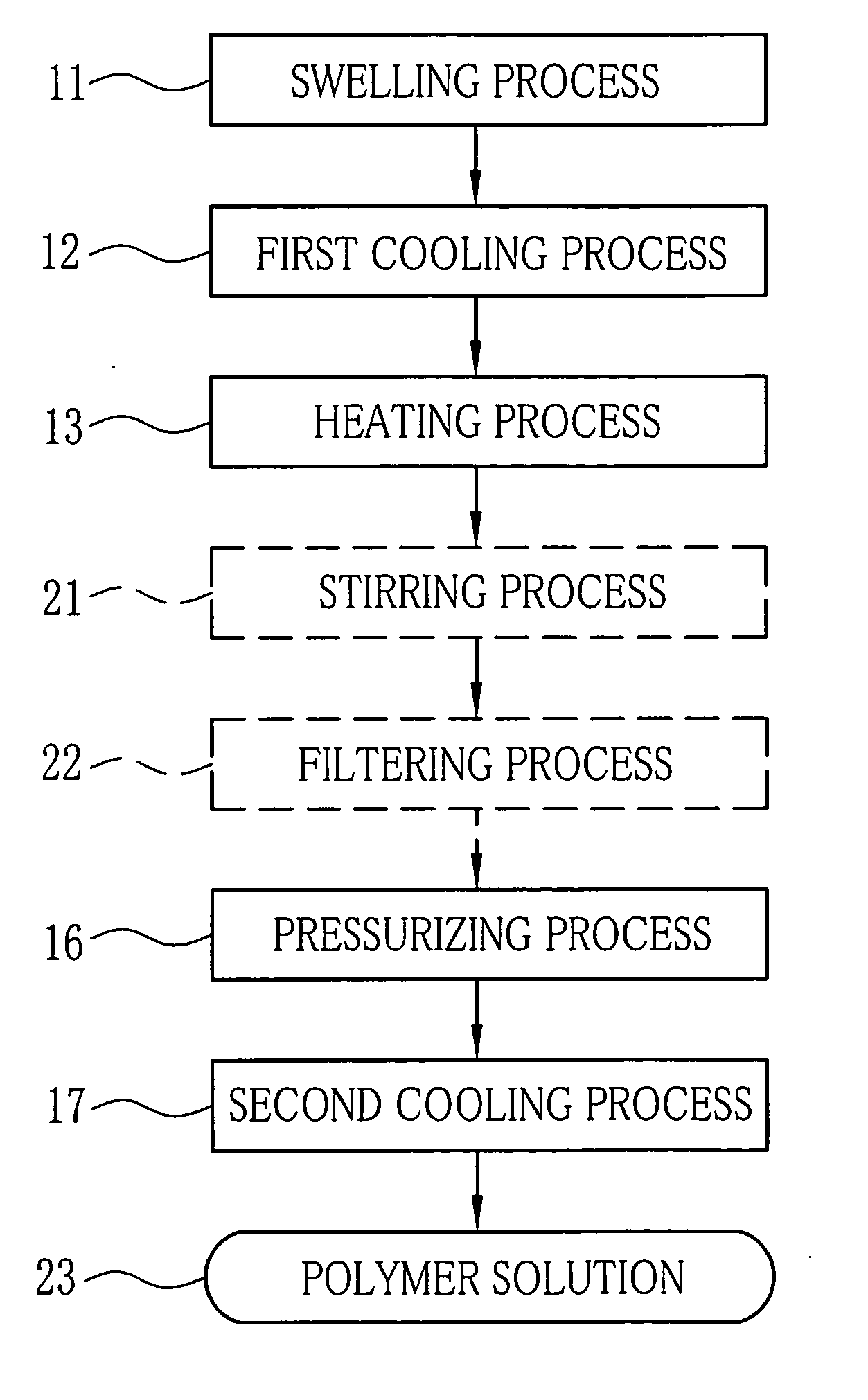
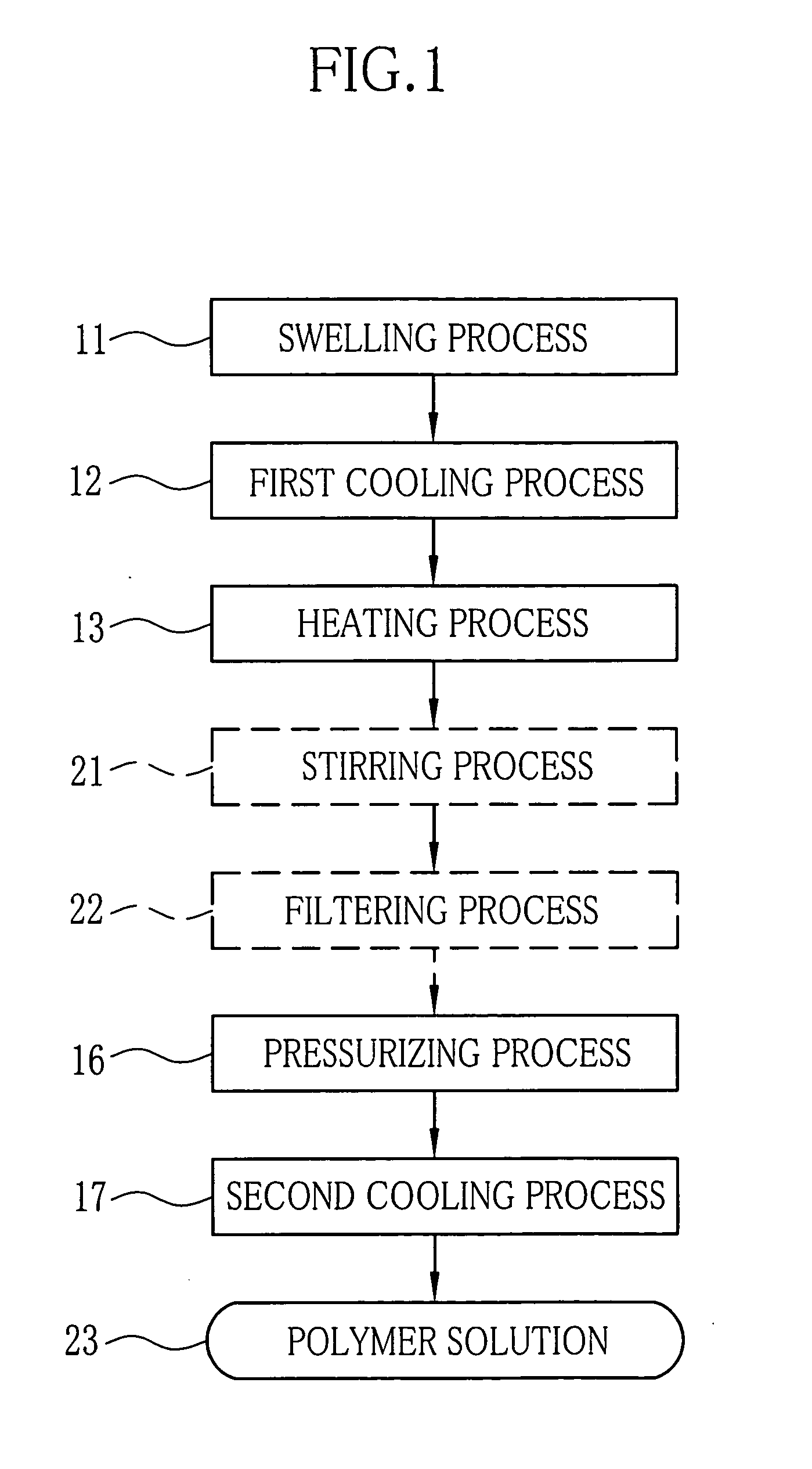
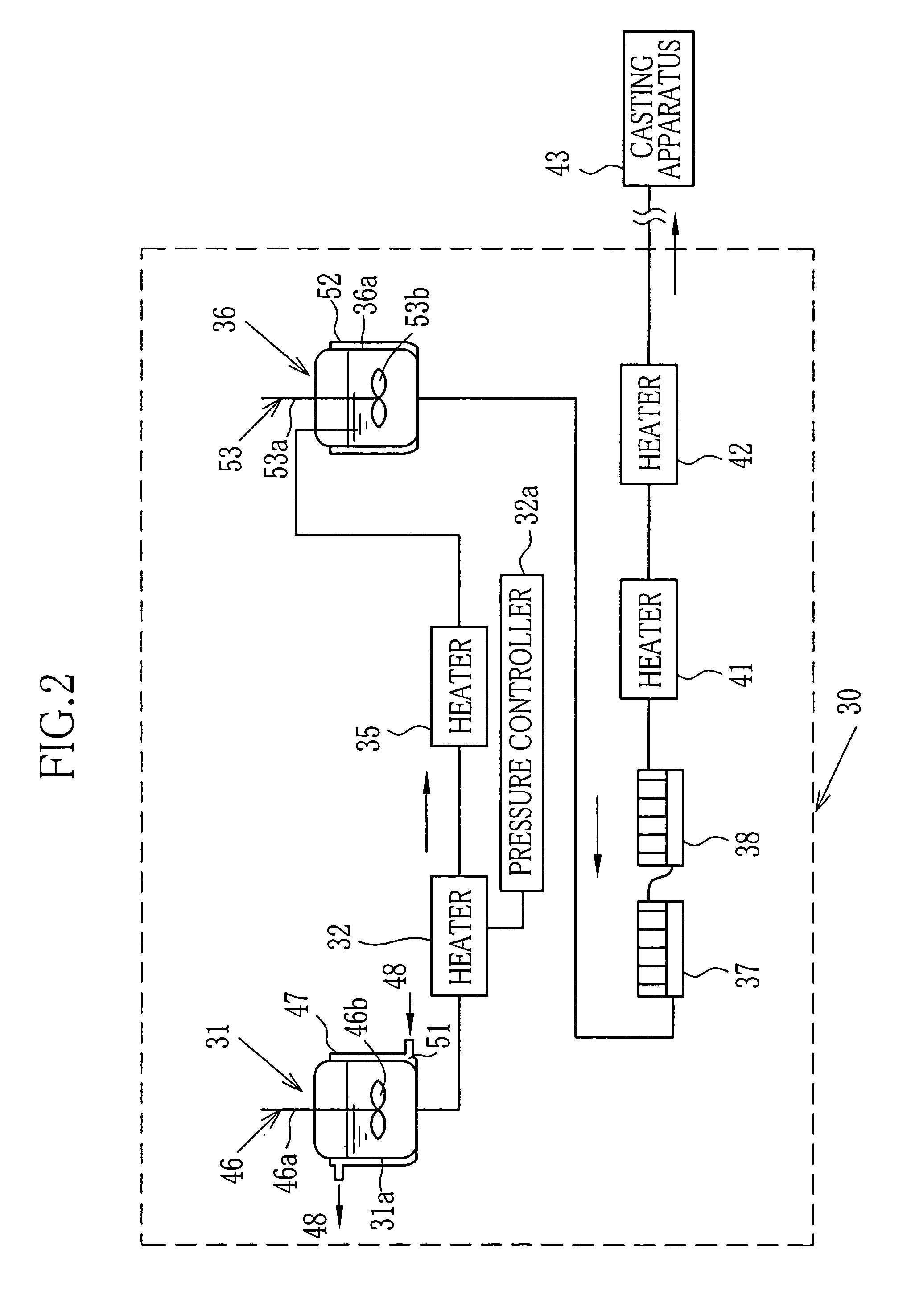
[0120] The polymer solution was prepared with use of the solution preparation apparatus 30 in FIG. 2 in the processes shown in FIG. 1. The detail of the preparation was as follows. The stainless first tank 31 whose capacity was 400 litter was supplied with the solvent below at the following mixture ratio. The polymer A was added little by little, and several sorts of the additives of the following mixture ratio were added. Thus the mixture of them was obtained such that the total weight of the mixture might be 200 kg. Thereafter, the mixture was stirred.
[0121] The stirring was made in the first tank 31 such that at first the haring speed was 15 m / sec and the sharing force was 5×10⁵N / m2. Then stirring was made for 30 minutes such the haring speed was 1 m / sec and the sharing force was 1×10⁵N / m2. The temperature at the start of stirring was 25° C., and the cooling water whose temperature was controlled to a predetermined value was used as the heat transfer medium...
example 2
[0158] In Example 2, the polyvinyl alcohol film (produced by Kuraray Co. Ltd) having 75 μm thickness was dipped in an aqueous solution at 25° C., while the aqueous solution contains 0.3 g / litter iodine and 18.0 g / litter potassium iodide. Thereafter the film was tensed in an aqueous solution at 50° C., while this aqueous solution contains 80 g / litter boric acid and 30 g / litter potassium iodide. Thus the film becomes five times larger to the polarized film. The cellulose acetate film obtained in Example 1 was adhered to the polarized film with the adhesive agent, and thereafter they are dried for 30 minutes in thermostatic chamber in which the temperature of air was kept at 80° C. Note that the adhesive agent was a 4% aqueous solution of polyvinyl alcohol (trade name; PVA-117H, produced by Kuraray Co. Ltd.).
[0159] According to the obtained polarizing filter, a parallel transmittance Yp and a crossed transmittance Yc in the visible range was obtained with a spectrophotometer, and the ...
example 3
[0161] The films obtained in Examples 1-10 of Example 1 were used as the birefringence filter, whose estimation was made. The film was cut to film sheets of a predetermined size, and the Re and Rth of each film sheet were measured at predetermined points. Further, the film sheets were heat-treated at 100° C. for 24 hours, and then the variation of the Re and Rth thereafter were measured.
[0162] The fluctuations of the Re and Rth of the obtained film sheets were ±2 nm. The changes of the Re and Rth between before and after the heat treatment were in the range of ±5 nm. Accordingly the film obtained in the present invention was used adequately to the birefringence filter.
PUM
| Property | Measurement | Unit |
|---|---|---|
| temperature | aaaaa | aaaaa |
| temperature | aaaaa | aaaaa |
| temperature | aaaaa | aaaaa |
Abstract
Description
Claims
Application Information
 Login to View More