
Ratcheting one-way clutch having rockers actuated by centrifugal force
a centrifugal force, one-way clutch technology, applied in the field of clutches, can solve the problems of excessive internal backlash, limited torque transmitting capacity, and large amount of machining of powered metal components, so as to prevent chafing and wear, and increase structural strength and stiffness to carry engagement loads
- Summary
- Abstract
- Description
- Claims
- Application Information
AI Technical Summary
Benefits of technology
Problems solved by technology
Method used
Image

Examples
Embodiment Construction
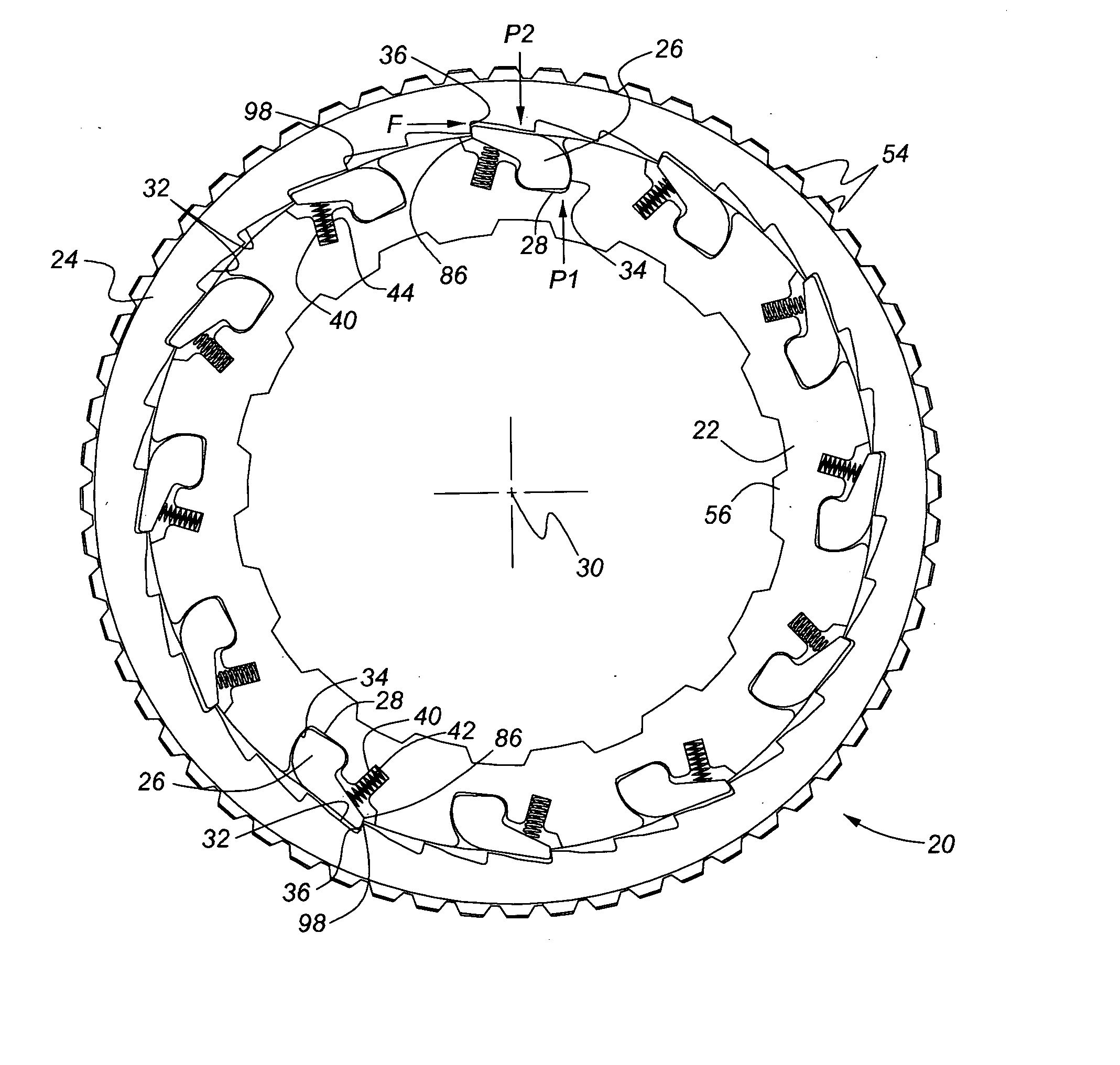
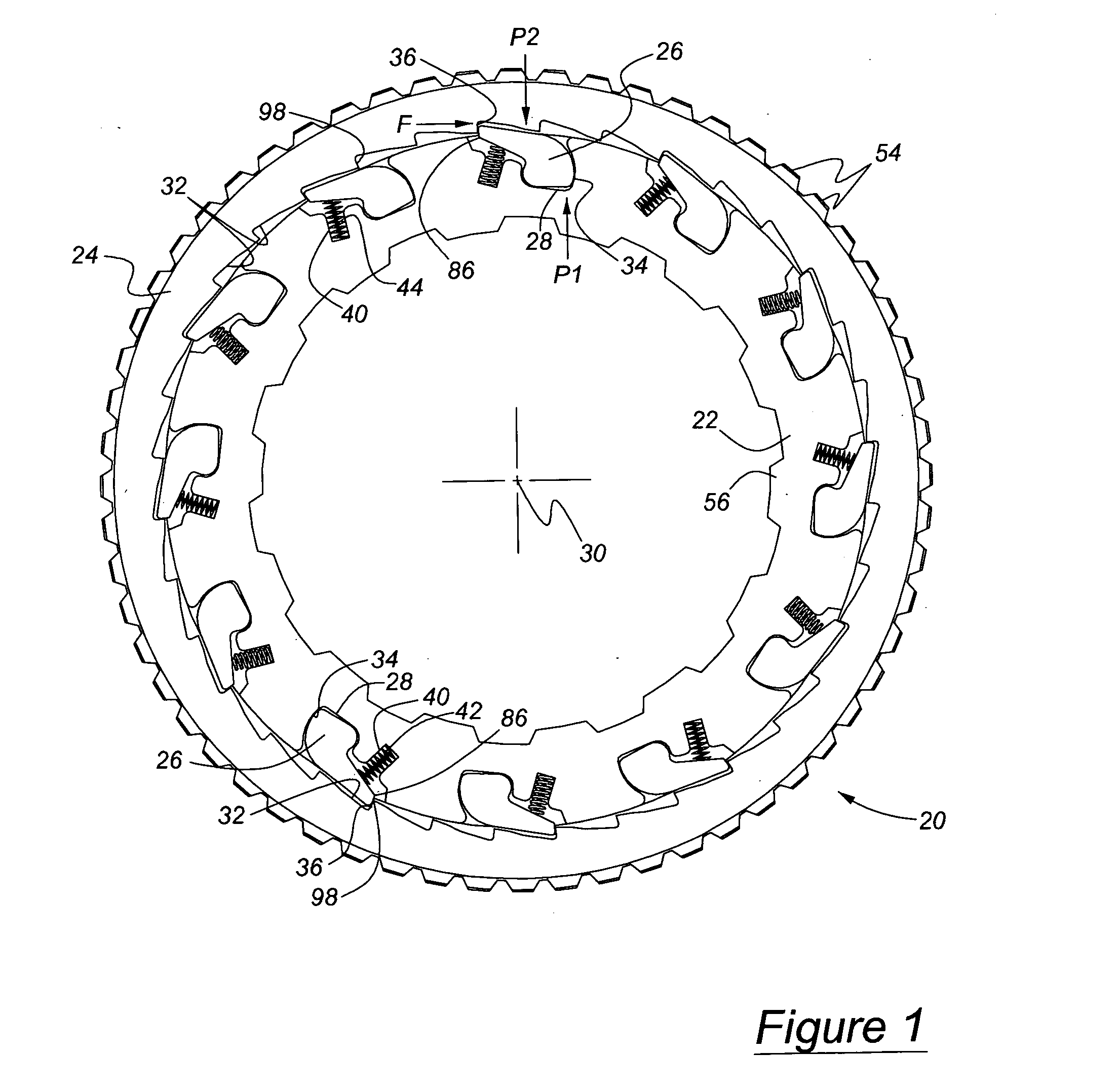
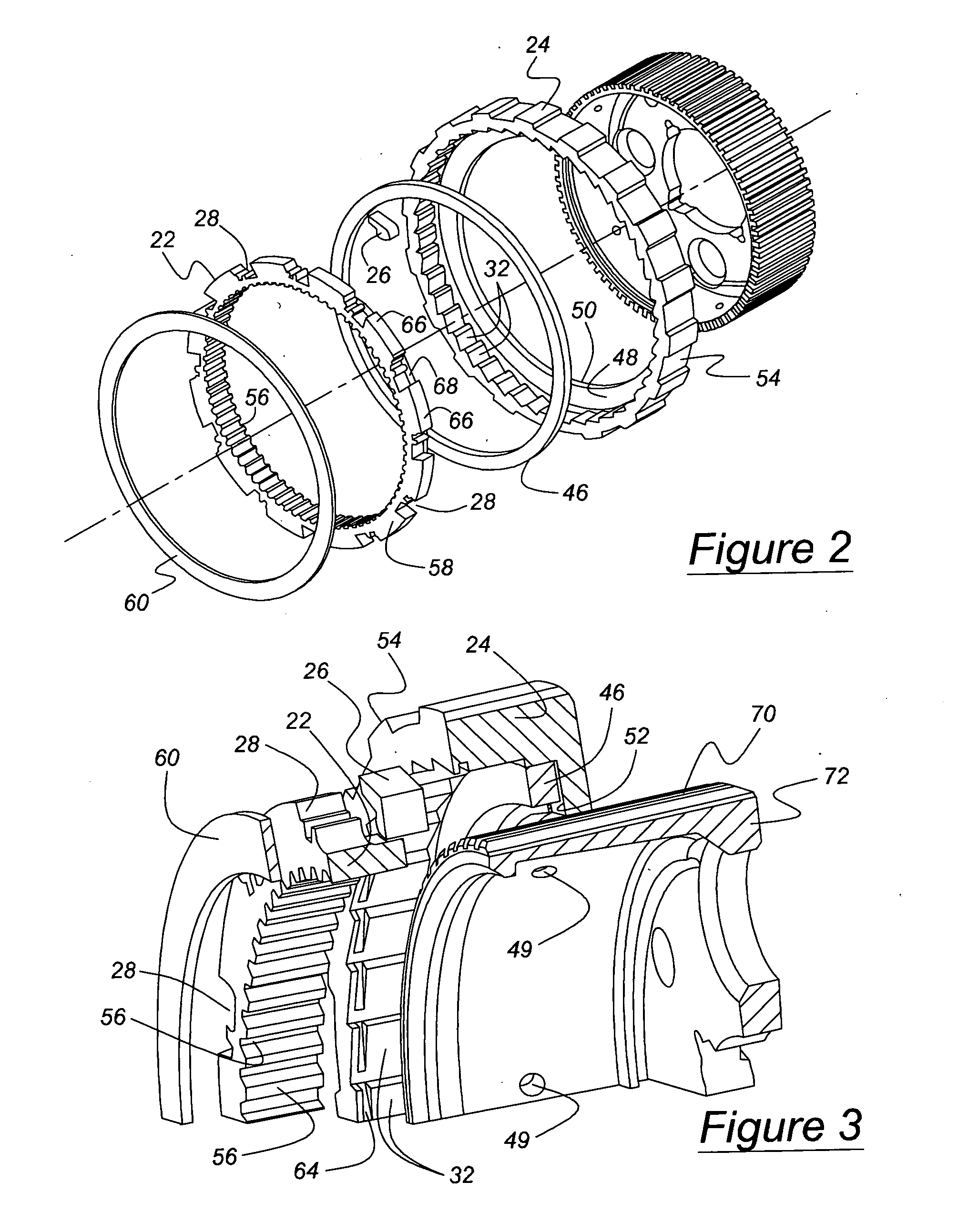
[0053] Referring now to the drawings, there is illustrated in FIG. 1 a one-way clutch assembly 20 in accordance with the present invention. The clutch assembly 20 includes an inner race or rocker plate 22, an outer race or cam plate 24, and a plurality of rockers 26, each rocker being located in a pocket 28 formed in the inner race 22 and angularly spaced mutually about a central axis 30. The inner periphery of the outer race 24 is formed with a plurality of cams or notches 32 angularly spaced mutually about axis 30. There are twelve rockers 26 and pockets 28 and thirty-six notches 32 in the clutch illustrated in FIG. 1.
[0054] When the inner race 22 rotates clockwise faster than the outer race 24, each rocker 26 pivots counterclockwise in its pocket 28 away from engagement with the notches 32 due to contact of the rockers with the inner radial surface of the outer race. This allows the inner race 22 to rotate freely clockwise about axis 30 relative to the outer race 24. When the in...
PUM
 Login to View More
 Abstract
Description
Claims
Application Information
 Login to View More