
Thermally developable materials with backside conductive layer
- Summary
- Abstract
- Description
- Claims
- Application Information
AI Technical Summary
Benefits of technology
Problems solved by technology
Method used
Image

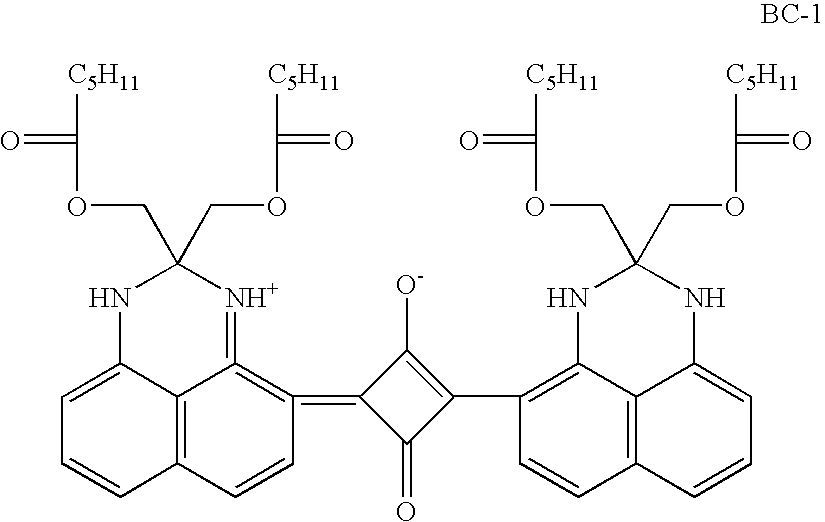
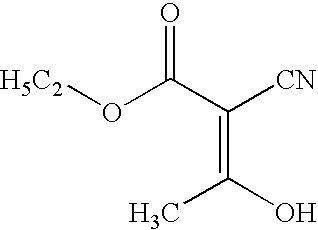

Examples
example 1
Photothermographic Materials with Improved Conductive Efficiency
[0259] Photothermographic materials were prepared containing buried backside antistatic layers. The ratio of non-acicular zinc antimonate [CELNAX® CX-Z 641M (ZnSb2O6)] to binder was varied. A control sample was also prepared containing a ratio of binder to non-acicular zinc antimonate as described in U.S. Pat. No. 6,689,546 (noted above).
Buried Backside Conductive Layer Formulation:
[0260] A buried backside conductive layer formulation was prepared by mixing the following materials:
Solution A:VITEL ® PE-2700B LMW(see TABLE I below)CAB 381-20(see TABLE I below)MEK1,269 gSolution B:CELNAX ® CX-Z641M(see TABLE I below)(containing 60% non-acicular zinc antimonatesolids in methanol)MEK 120 g
Solution A: VITEL ® PE-2700B LMW and CAB 381-20 were dissolved in 1.269 Kg of MEK.
Solution B: CELNAX ® CX-Z641M non-acicular zinc antimonate was placed in a second reaction vessel, stirring was begun and 120 g of MEK was added.
[02...
example 2
Effect Of Binder to CELNAX® Non-Acicular Zinc Antimonate Ratio on Adhesion to the Support
[0272] The following Example demonstrates the effect of the binder to CELNAX® non-acicular zinc antimonate ratio on adhesion of the backside conductive layer and backside topcoat layer to the support.
Buried Backside Conductive Layer Formulation:
[0273] A buried backside conductive layer formulation was prepared by mixing the following materials:
CELNAX ® CX-Z641M(see TABLE III below)(containing 60% non-acicular zinc antimonatesolids in methanol)MEK(see TABLE III below)VITEL ® PE-2700B LMW(see TABLE III below)CAB 381-20(see TABLE III below)
Backside Topcoat Formulation:
[0274] A backside topcoat formulation was prepared by mixing the following materials:
MEK88.9 weight %CAB 381-2010.7 weight %SYLOID ® 74X60000.28 weight %Antihalation Dye BC-10.14 weight %
[0275] The buried backside conductive layer formulation and backside topcoat formulations were simultaneously coated onto one side of a 7 m...
example 3
Effect of Mixing Shear on Resistivity
[0277] When production quantities of materials are prepared, the speed required for efficient mixing often results in shear conditions that are different from those involved for the preparation of laboratory quantities. As a result, the materials so produced can have properties different from those of laboratory-prepared samples. The following example demonstrates the effect of high shear mixing on the resistivity of the resulting backside layer.
[0278] Conductive backside coating formulations were prepared as described in Example 2 containing various ratios of binder to non-acicular zinc antimonate [CELNAX®, (ZnSb2O6)].
[0279] Formulations were coated before and after being subjected to high shear homogenization. Homogenization was carried for one pass at 8,000 psi using a Model 15 MR Laboratory Homogenizer manufactured by APV Gaulin, Inc. (Everett, Mass.). A control sample was also prepared containing a ratio of binder to non-acicular zinc ant...
PUM
| Property | Measurement | Unit |
|---|---|---|
| Temperature | aaaaa | aaaaa |
| Length | aaaaa | aaaaa |
| Percent by mass | aaaaa | aaaaa |
Abstract
Description
Claims
Application Information
 Login to View More