Methods and apparatus for electrophoretic mobility determination using phase light scattering analysis

a phase light scattering and electrophoretic technology, applied in the field of electrophoretic mobility determination, can solve the problems of (usually irreversible) agglomeration, inaccurate and/or ineffective, and frequency shift method limitation

a phase light scattering and electrophoretic technology, applied in the field of electrophoretic mobility determination, can solve the problems of (usually irreversible) agglomeration, inaccurate and/or ineffective, and frequency shift method limitation

US20060114467A1Active Publication Date: 2006-06-01ENTEGRIS INC

Image

Smart Image Click on the blue labels to locate them in the text.
Viewing Examples
Smart Image
  • Methods and apparatus for electrophoretic mobility determination using phase light scattering analysis
  • Methods and apparatus for electrophoretic mobility determination using phase light scattering analysis
  • Methods and apparatus for electrophoretic mobility determination using phase light scattering analysis

Examples

Experimental program
Comparison scheme
Effect test

Embodiment Construction

[0025] Various aspects will now be described in connection with exemplary embodiments, including certain aspects described in terms of steps that can be performed by elements of a computer system. For example, it will be recognized that in each of the embodiments, computations and analyses can be performed by specialized circuits or circuitry, by program instructions being executed by one or more processors, or by a combination of both. Thus, the various aspects can be embodied in many different forms, and all such forms are contemplated to be within the scope of what is described.

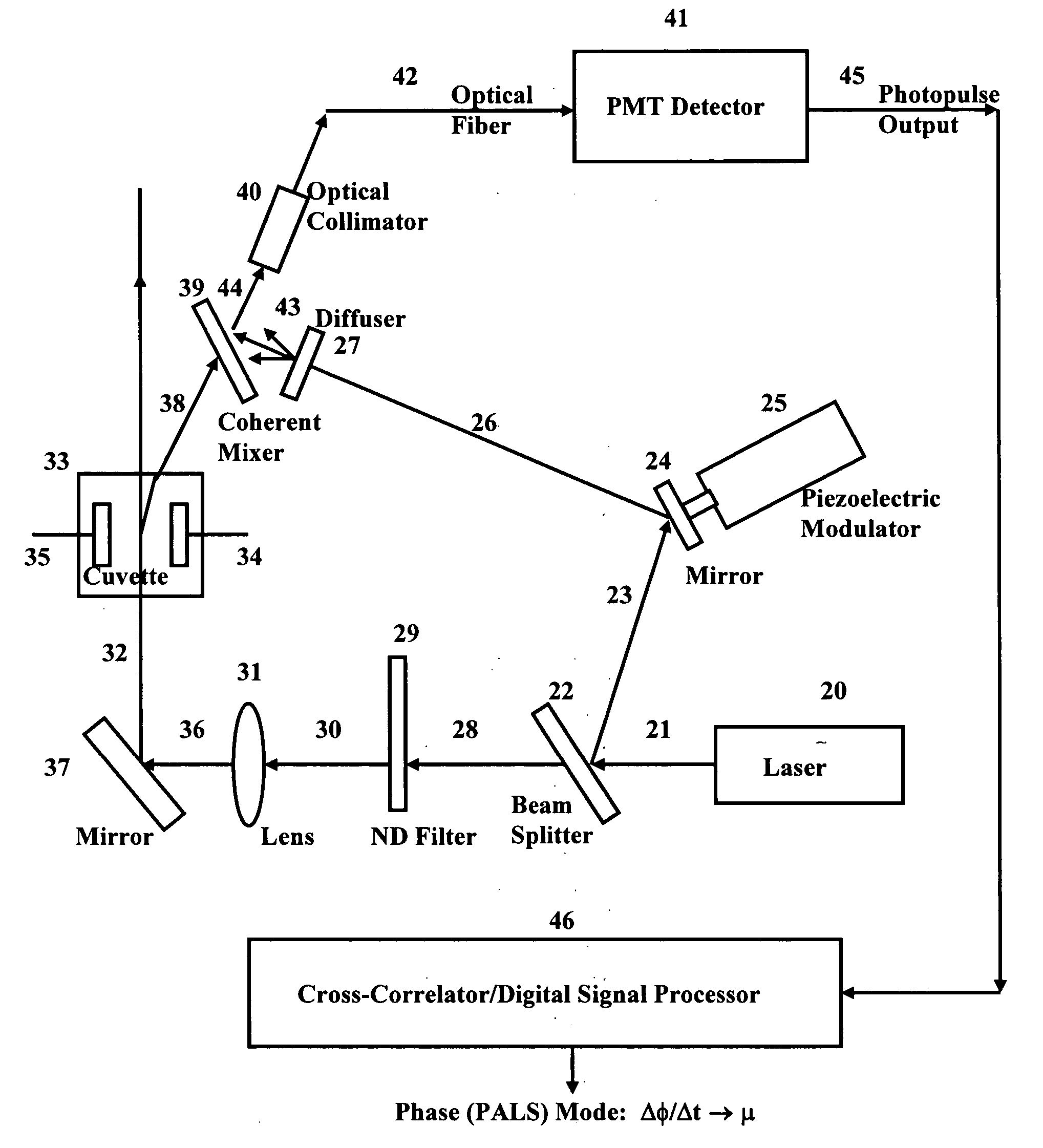
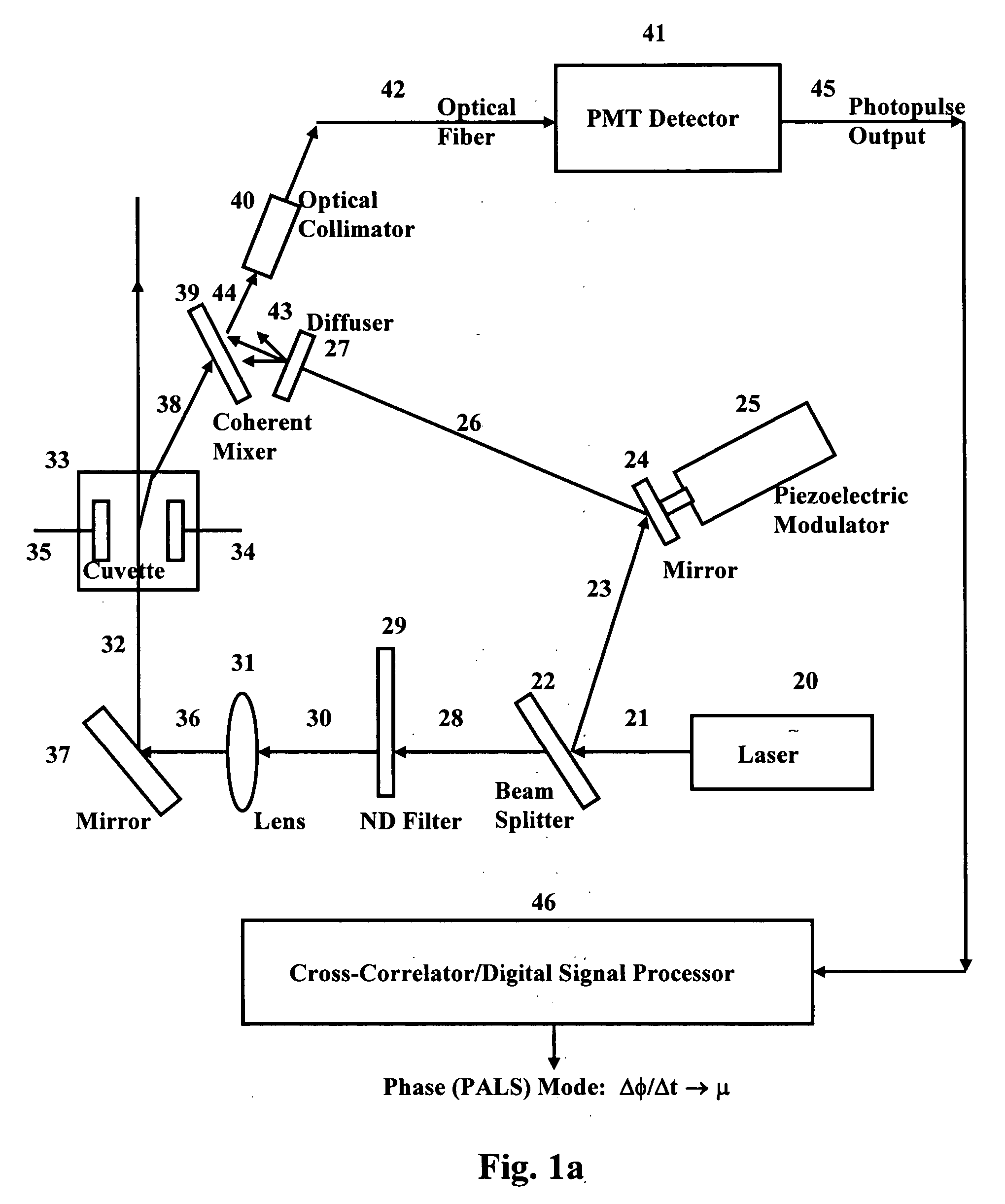
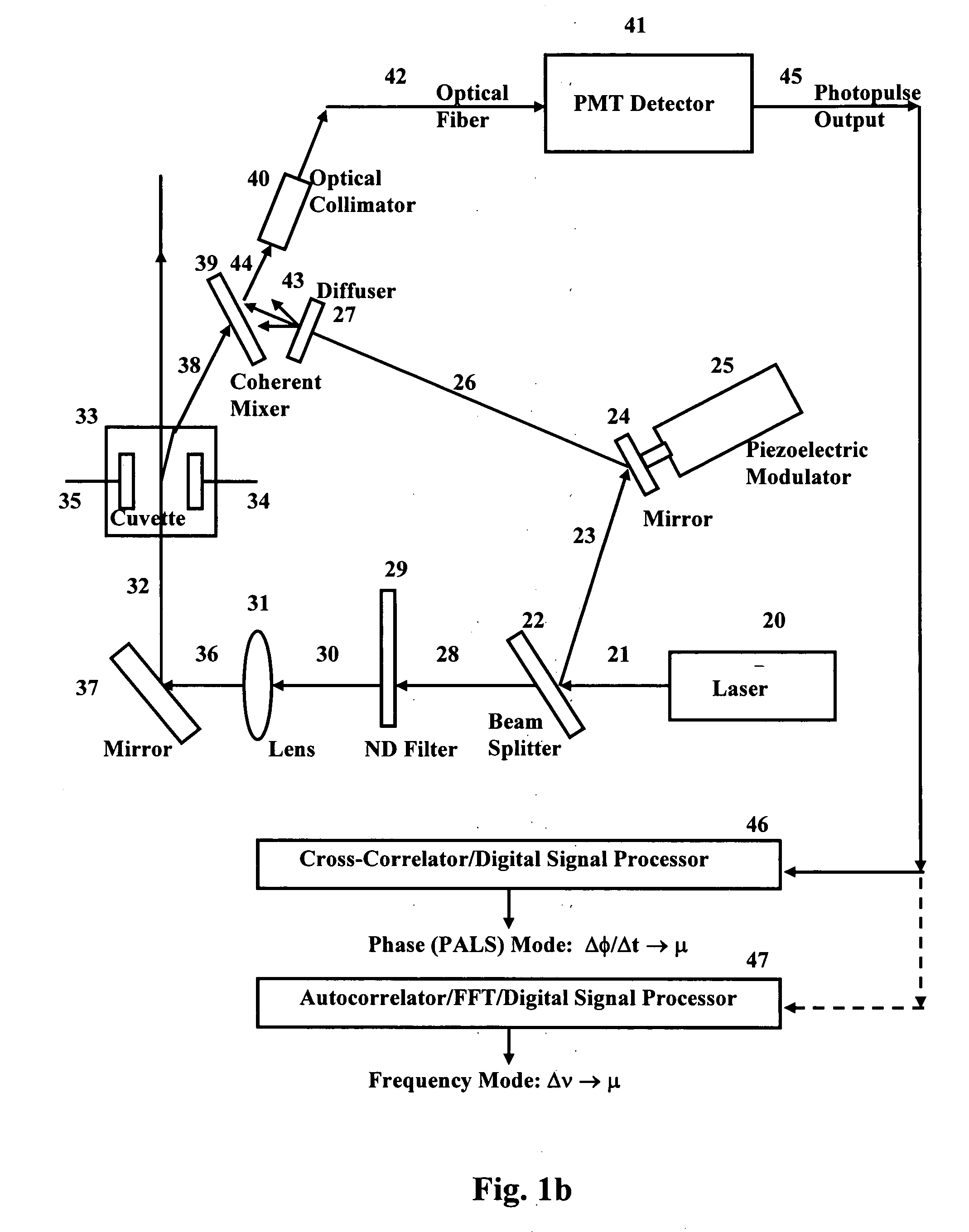
[0026] In an exemplary embodiment, a particle moving under the influence of an applied electric field and illuminated by an incident laser light wave gives rise to a scattered light wave that is shifted in phase with respect to the incident wave. The extent of the phase shift depends on the angle of scattering, θ, and the velocity of the particle, v, which in turn depends on its electrophoretic mobility, ...

the structure of the environmentally friendly knitted fabric provided by the present invention; figure 2 Flow chart of the yarn wrapping machine for environmentally friendly knitted fabrics and storage devices; image 3 Is the parameter map of the yarn covering machine
Login to View More

PUM

No PUM Login to View More

Abstract

An apparatus and method are disclosed for determining electrophoretic mobility using scattering light phase analysis comprising emitting a laser light along a path and transmitting a first portion of the laser light and reflecting a second portion of the laser light. The apparatus and method can also comprise deflecting one of the first and second portions of the laser in response to a drive signal, holding a sample to receive at least one of the first and second portions of the laser light under an electric field and output a composite light wave, outputting a photopulse signal based on the composite light wave, and measuring the electrophoretic mobility of the sample based on a phase shift analysis using cross-correlation of the photopulse signal with the drive signal.

Description

BACKGROUND FIELD [0001] Phase light scattering analysis is disclosed for electrophoretic mobility determination, which involves passing a directed laser beam, or pair of laser beams, to a particulate matter in colloidal suspension under an electric field. BACKGROUND INFORMATION [0002] A wide variety of products include small particles, e.g., ranging mostly from 0.1 to 10 micrometers (microns, or μm) in size, that are suspended in a liquid. In many cases the liquid medium used to suspend the particles is predominantly water, usually containing added chemical components, including freely diffusing positive and negative ions. In cases where the particles are small enough to remain in suspension indefinitely, without naturally sedimenting, such systems are usually referred to as “colloidal” suspensions, or simply as “colloids”. [0003] In the case of aqueous suspensions, the physical mechanism most often responsible for keeping the particles effectively in indefinite suspension—i.e., sta...

Claims

the structure of the environmentally friendly knitted fabric provided by the present invention; figure 2 Flow chart of the yarn wrapping machine for environmentally friendly knitted fabrics and storage devices; image 3 Is the parameter map of the yarn covering machine
Login to View More

Application Information

Patent Timeline
01 Jun 2006
Publication
US20060114467A1
IPC
G01B9/02
CPC
G01N21/51; G01N27/44721
Inventors
NICOLI, DAVID; CHANG, YU-JAIN