
Reflection type terahertz spectrometer and spectrometric method
a terahertz spectrometer and spectrometer technology, applied in the direction of optical radiation measurement, polarisation spectroscopy, instruments, etc., can solve the problems of phase shift error, sample limited to solids, liquids, amorphous living organisms or the like cannot be measured,
- Summary
- Abstract
- Description
- Claims
- Application Information
AI Technical Summary
Benefits of technology
Problems solved by technology
Method used
Image

Examples
first preferred embodiment
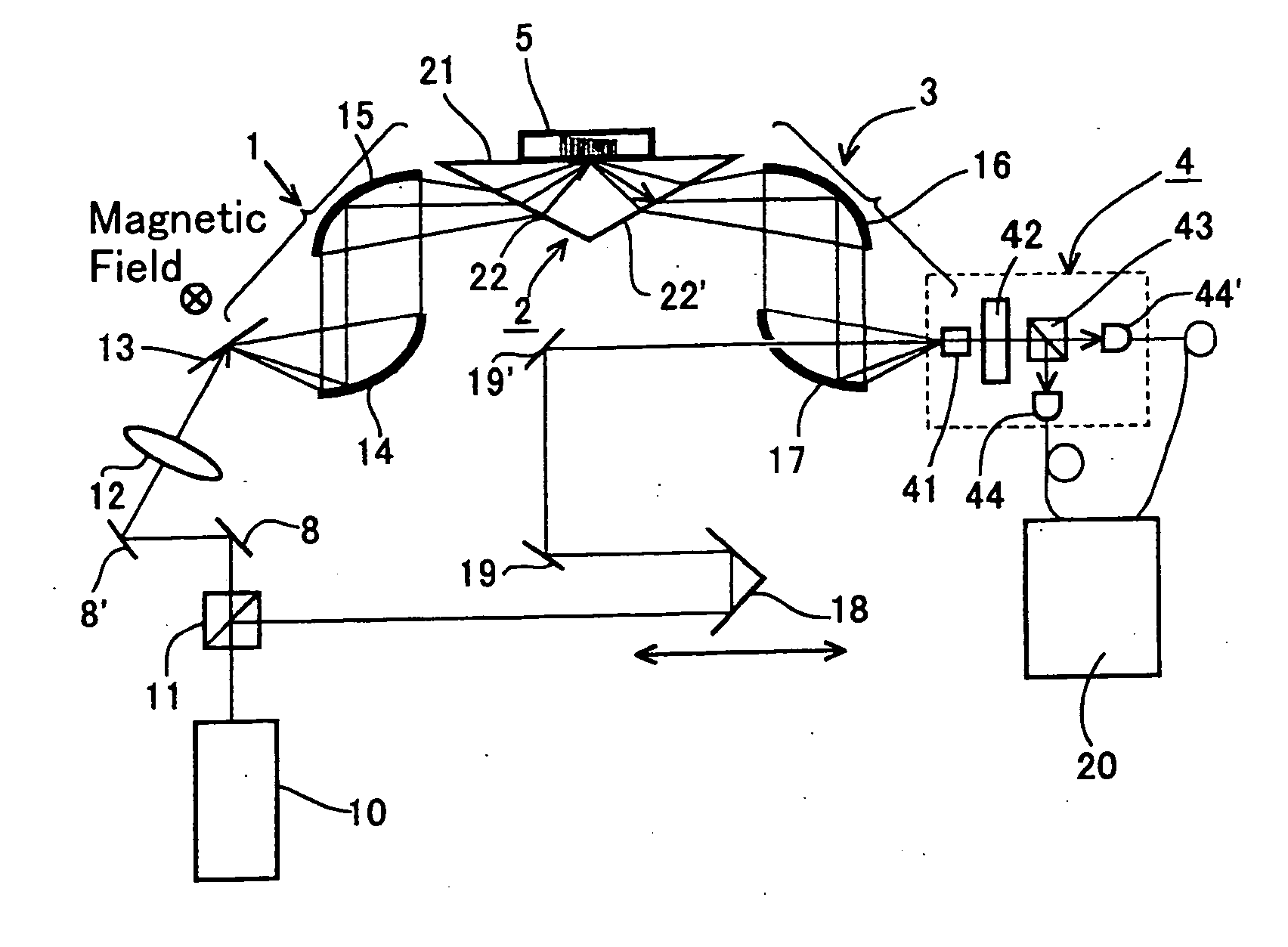
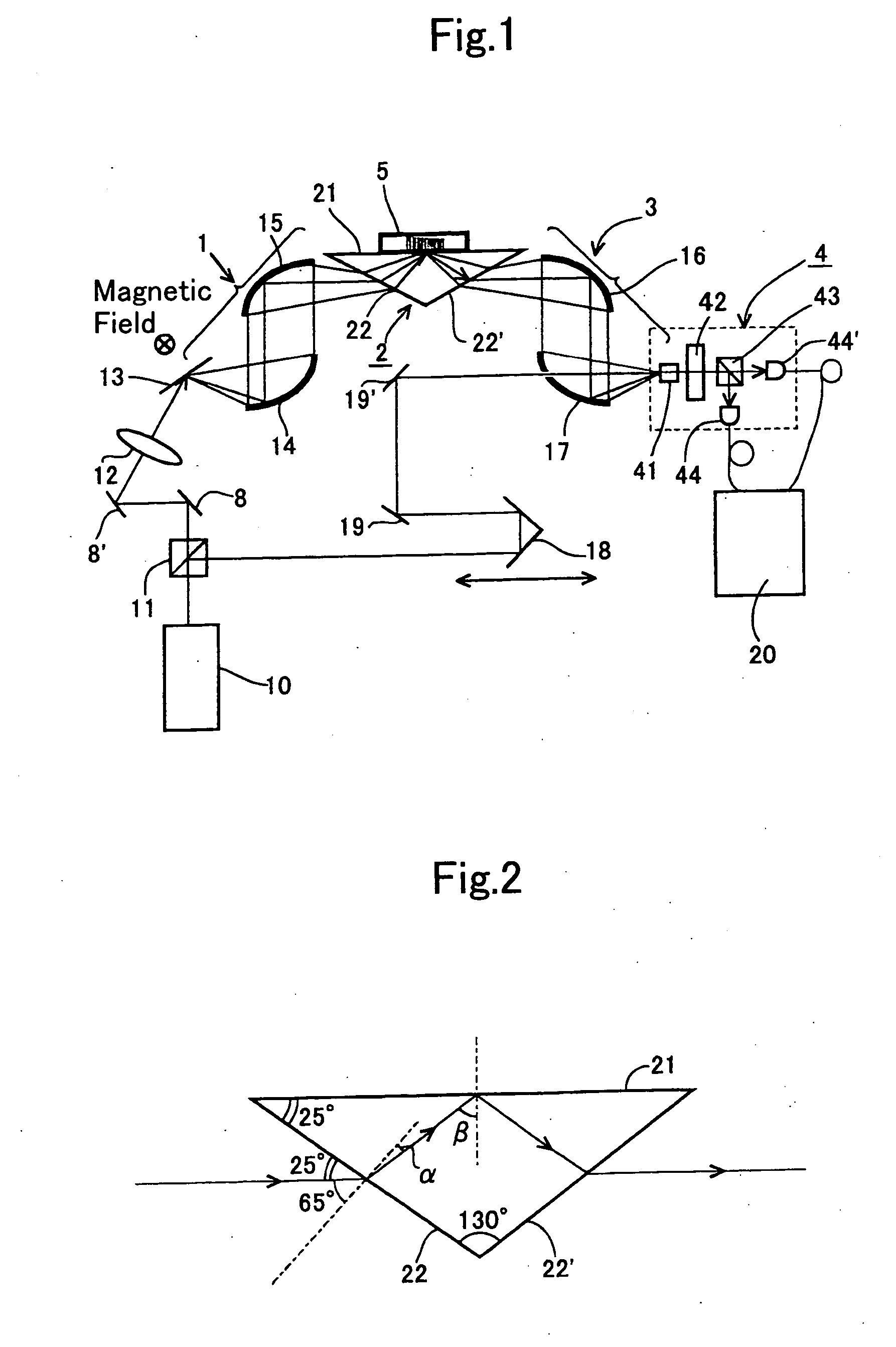
[0039]FIG. 1 is a schematic view showing the structure of a reflection-type terahertz spectrometer according to a preferred embodiment of the present invention.
[0040] The spectrometer of this preferred embodiment comprises an input optical path 1 through which terahertz waves from a terahertz wave generating means 13 are propagated, an irradiating means 2 which irradiates a sample 5 with the terahertz waves propagated through the input optical path 1, an output optical path through which terahertz waves having exiting from the irradiating means 2 are propagated, and a detecting means 4 which receives and detects the terahertz waves propagated through the output optical path 3.
[0041] The terahertz wave generating means 13 is a bulk semiconductor InAs in which ultrashort light pulses with a wavelength of 800 nm, a pulse width of 100 fs, a repetition of 80 MHz from a femtosecond laser light source 10 are split in half by a polarization beam splitter 11, bent by bend mirrors 8, 8′ and...
second preferred embodiment
[0047]FIG. 5 is a schematic diagram showing the structure of the reflection-type terahertz spectrometer according to a second embodiment of the present invention. Although the spectrometer of the first preferred embodiment was affected by absorption by atmospheric H2O, the spectrometer of the second preferred embodiment is constructed so as not to be affected by absorption by H2O. Hence, the spectrometer of the second preferred embodiment comprises a housing 6 which isolates the input optical path 1, the irradiating means 2 and the output optical path 3 of the first preferred embodiment (shown in FIG. 1) from the outside. In FIG. 5, the same constitutional elements as those of the first preferred embodiment are denoted by the same reference numerals as those of FIG. 1 and repetition of description is omitted.
[0048] The housing 6 comprises an opening 61, windows 62, 62′, a gas inlet valve 63 and a gas exhaust valve 64, and the opening 61 is sealed with the planar interface 21 of the...
third preferred embodiment
[0049]FIG. 6 is a schematic diagram showing the structure of a reflection-type terahertz spectrometer according to a third preferred embodiment of the present invention. The spectrometer of this preferred embodiment is constructed so as to be capable of observing an absorption spectrum by plasma, longitudinal phonons in a semiconductor, etc. Hence, the spectrometer of this preferred embodiment comprises a polarizer 7, which is a polarization control means, on the input optical path 1 of the first preferred embodiment (shown in FIG. 1). In FIG. 6, the same constitutional elements as those of the first preferred embodiment are denoted by the same reference numerals as those of FIG. 1 and repetition of description is omitted.
[0050] A compound semiconductor GaAs was used as a sample 5. First the terahertz waves which were p-polarized by controlling the polarizer 7 were made incident on the side 22 of the prism 2 and a spectrum was measured. Next, the terahertz waves which were s-polari...
PUM
 Login to View More
 Abstract
Description
Claims
Application Information
 Login to View More