[0011]As has been depicted above, one objective of the present invention is to provide a method and an arrangement, which allow time savings in fitting sessions. In particular, a method for maintaining a hearing device and a system for maintaining a hearing device shall be provided.
[0026]After detecting that said forthcoming event is to be expected, the user and / or his hearing system is identified and said identification data are obtained. Preferably, also this step is carried out automatically, since this way, time can be saved and manual actions and the occurrence of mistakes can be reduced. Said identification data can comprise, e.g., the specific user's name or
client number, or the model and serial number of the at least one specific device. Preferably, said identification data are unique with respect to each user or each hearing device respectively, since this way, mix-ups and mistakes can be avoided.
[0027]Then, said data related to a multitude of users and / or to a multitude of hearing systems is accessed, and by means of said identification data, said data related to said specific user and / or to said specific hearing system are obtained. This is preferably carried out automatically, too, since this way, time can be saved and manual actions and mistakes can be reduced. The retrieved device data or user data can be for instance the specific user's audiological data or other data related to the hearing of the user, the type of battery suitable for said specific hearing system or the specific user's name.
[0045]A preferred way of detecting the physical presence of said at least one specific device makes use of the fact, that nowadays many hearing device are provided with
wireless network capabilities, which are typically used for communicating within a hearing system comprising, in addition to one hearing device, another hearing device and / or a
remote control, or for receiving audio signals from a remote
microphone. Hearing devices with
wireless network capabilities are known in the art, e.g., in the field of hearing-aid devices. The use of said
wireless network capabilities for
proximity sensing has the
advantage, that it can be realized with existing technology. Near the entrance of the hearing care professional's office, means for establishing a
wireless network can be foreseen, and said detection of said indication indicative of said forthcoming interaction can be accomplished by recognizing that the hearing system connects to said
wireless network, wherein already the connection of only one device of the hearing system to the
wireless network means a connection of the hearing system to the wireless network. The identification of the specific user and / or specific hearing system may also be accomplished by means of said wireless network.
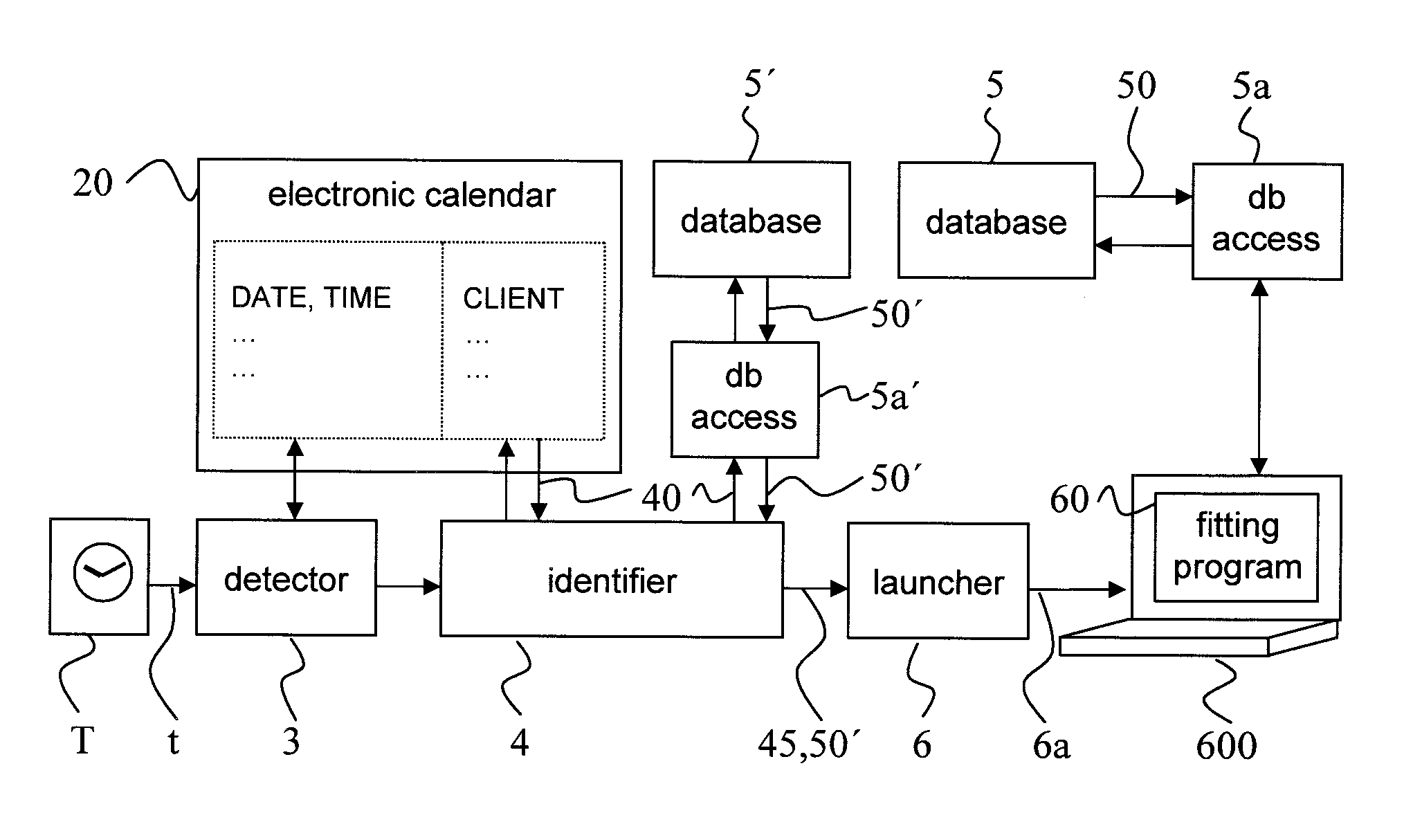
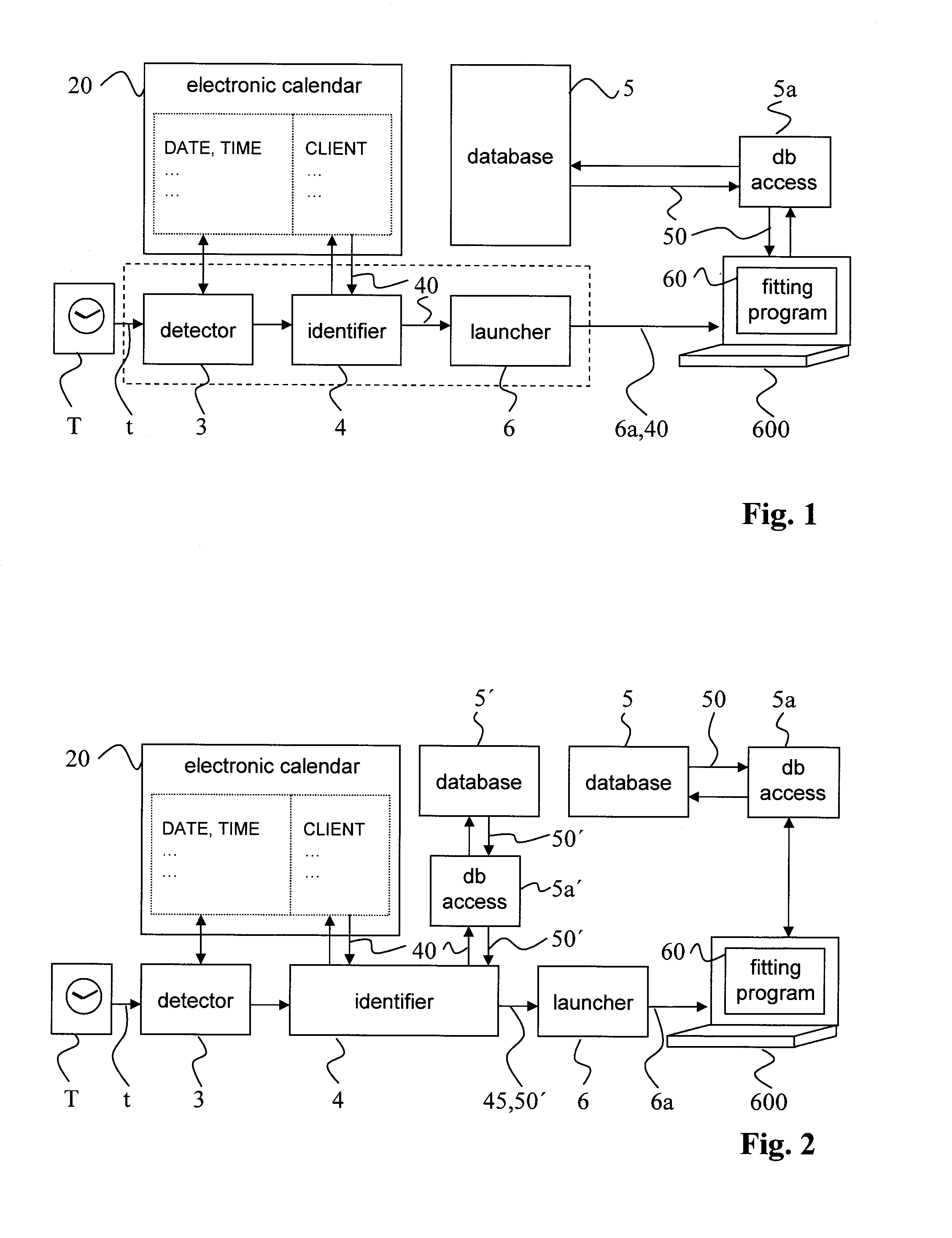
[0049]As has been indicated before, it usually takes a considerable amount of time to launch a fitting program suitable for a specific hearing system. Instead of manually launching the fitting program, the invention allows to do this before the fitting session has started, even in an automated fashion. After it has been detected that there will be an interaction with the user, in particular a fitting session, the suitable program can be launched. When the specific user and the hearing care professional will have entered the
examination room, in which the computer with the fitting program is located, the appropriate fitting
software will already be running, and no time is wasted by manually launching the program while said specific user and said hearing care professional have to wait for the launching process to finish.
[0055]It is possible to carry out all steps of the described methods automatically. This allows for a full
automation and corresponding time savings.


 Login to View More
  Login to View More