Polyolefin compositions, articles made therefrom and methods for preparing the same
Inactive Publication Date: 2010-03-04
DOW GLOBAL TECH LLC
View PDF32 Cites 17 Cited by
Summary
Abstract
Description
Claims
Application Information
AI Technical Summary
This helps you quickly interpret patents by identifying the three key elements:
Problems solved by technology
Method used
Benefits of technology
Benefits of technology
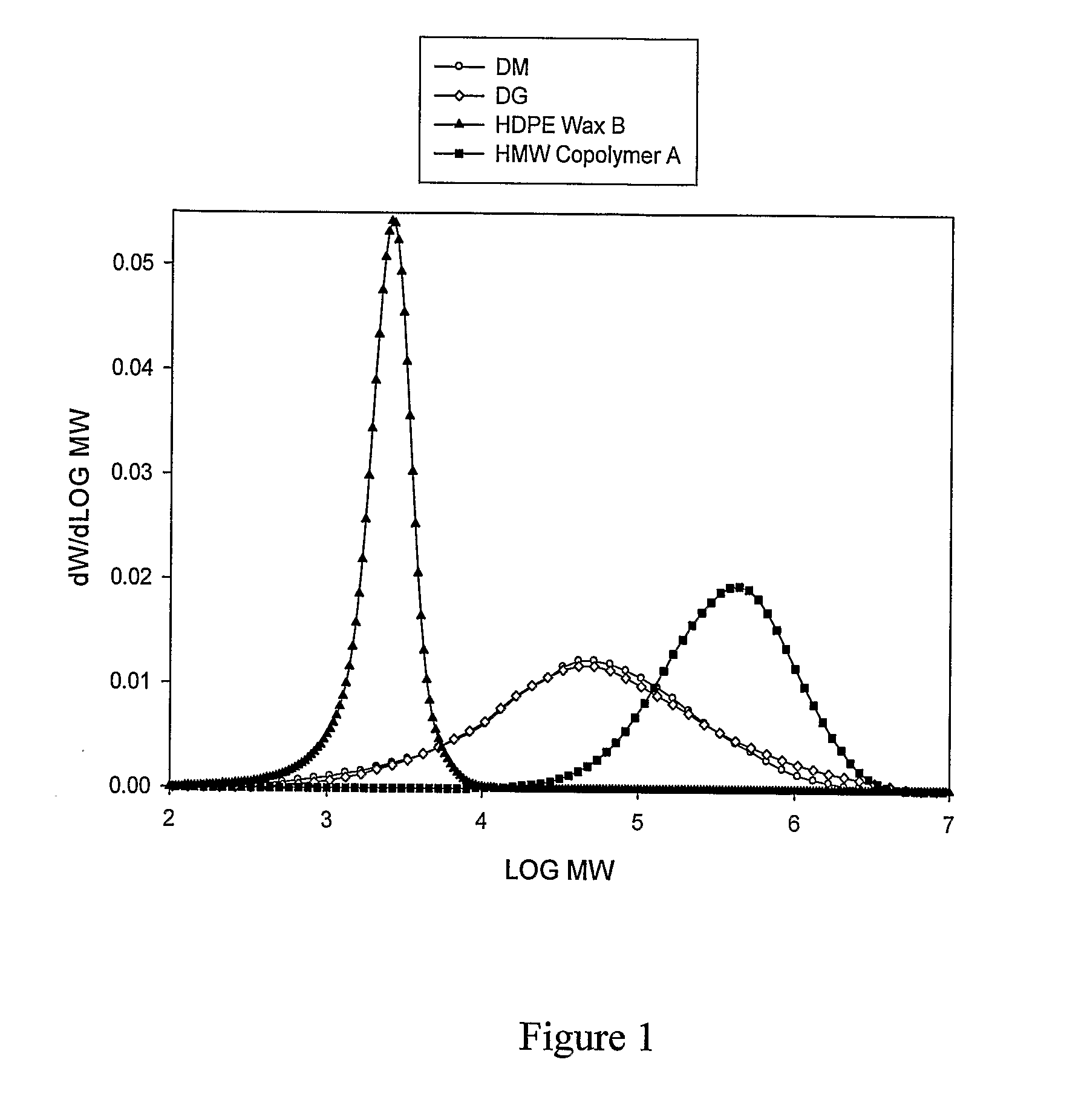
[0018]A modification in a base resin structure has been found that results in both low resin swelling and increased ESCR. Further modifications in the base resin also increase resin density. Such modification is achieved by selectively increasing the high molecular weight tail (as determined by Gel Permeation Chromatography, GPC) of the resin. For example, by blending a high molecular weight ethylene-based polymer, which has a narrow molecular weight distribution, into a base polymer consisting of a high density ethylene-based polymer, with a broad molecular weight distribution, the swell characteristics of the final resin can be maintained or decreased. It is also possible to design resins with specific properties by adjusting the amount of high molecular weight polymer and / or adjusting the comonomer content of one or more components of the resin blend. The compositions of the invention are contrary to conventional compositions that show an increase in final resin swell characteristics upon the addition of certain types of high molecular weight components. Inventive blends that have been solution blended show a good balance of stiffness, ESCR and swell.
Problems solved by technology
A modification in a base resin structure has been found that results in both low resin swelling and increased ESCR.
Method used
the structure of the environmentally friendly knitted fabric provided by the present invention; figure 2 Flow chart of the yarn wrapping machine for environmentally friendly knitted fabrics and storage devices; image 3 Is the parameter map of the yarn covering machine
View more
Image
Smart Image Click on the blue labels to locate them in the text.
Viewing Examples
Smart Image
Click on the blue label to locate the original text in one second.
Reading with bidirectional positioning of images and text.
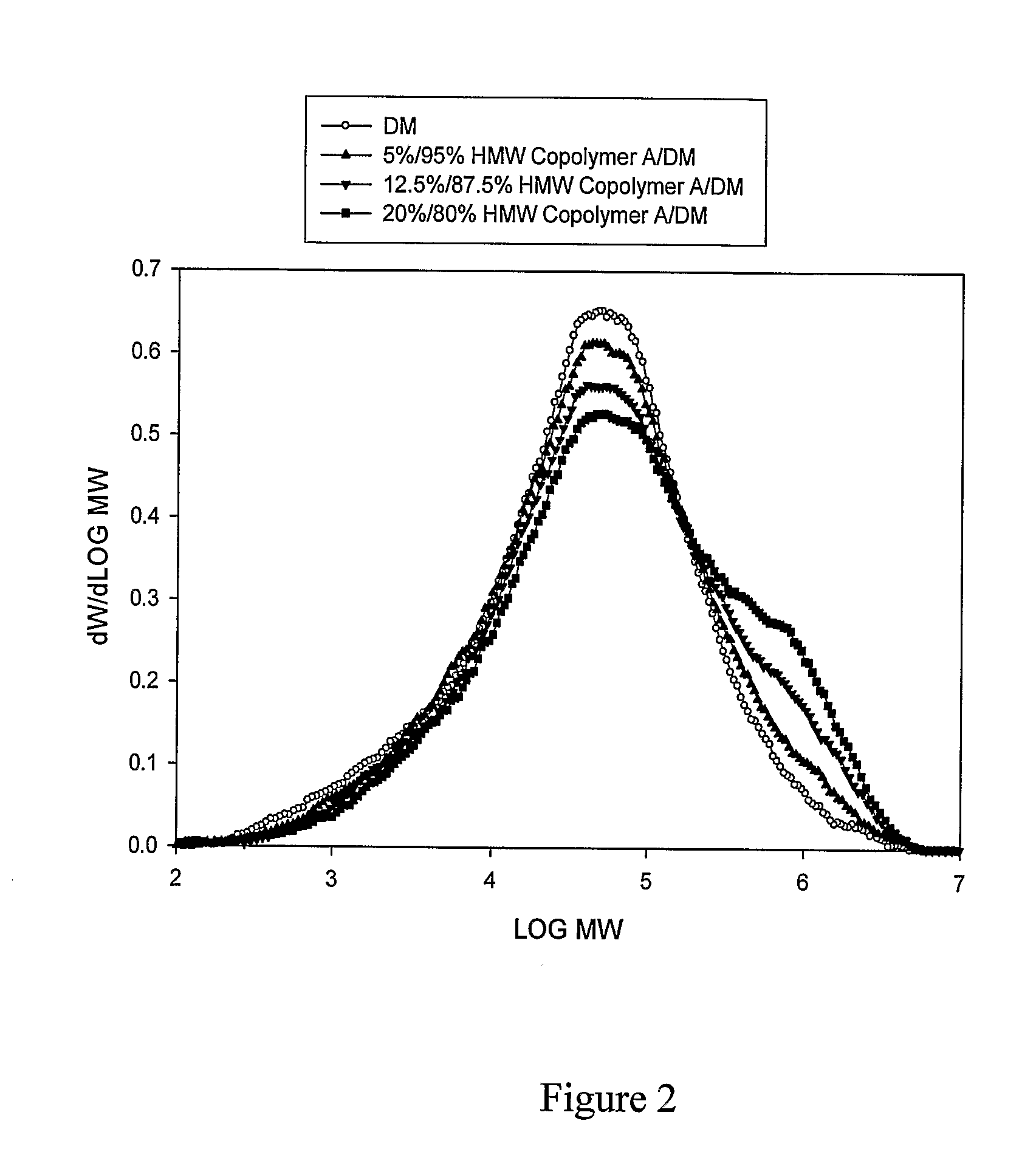
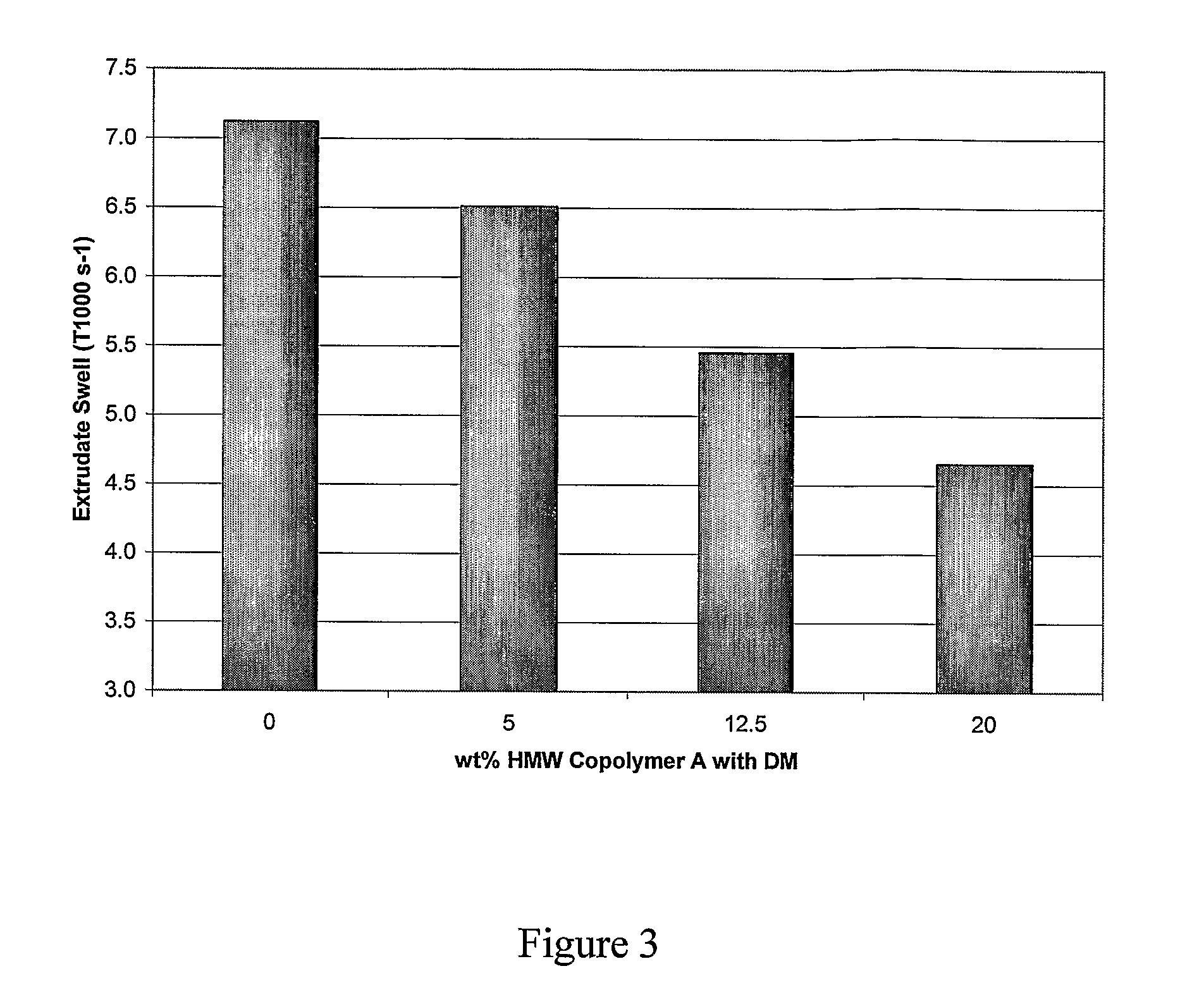
[0263]The GPC profiles of the compositions are shown in FIG. 2. The weight average molecular weight increased and the density decreased, with increased amount of HMW Copolymer A, as shown in Table 2. Swell analysis by the “extrudate swell method” also showed a decrease in extrudate swell with increasing amounts of this high molecular weight copolymer, as also shown in Table 2. This result is unexpected, and opposite of the trend observed in Experiment 3, as discussed below. Extrudate swell results are also depicted in FIG. 3.
[0265]The GPC profiles of the compositions are shown in FIG. 4. With increased amount of HDPE Wax B, the density increased, as shown in Table 3. Extrudate swell increased slightly with the increase in the amount of wax, as also shown in Table 3.
experiment 3
of Resin DM with Resin DG
[0266]Resin compositions are listed in Table 4, below.
[0267]The GPC profiles of the blends are shown in FIG. 5. Both the weight average molecular weight and swell increased with increasing amounts of Resin DG, as shown in Table 4. Swell analysis by the “extrudate swell method” also showed an increase in extrudate swell with increasing amounts of Resin DG, as shown in Table 4. This result is in accordance with conventional observations.
the structure of the environmentally friendly knitted fabric provided by the present invention; figure 2 Flow chart of the yarn wrapping machine for environmentally friendly knitted fabrics and storage devices; image 3 Is the parameter map of the yarn covering machine
Login to View More
PUM
Property
Measurement
Unit
Fraction
aaaaa
aaaaa
Time
aaaaa
aaaaa
Percent by mass
aaaaa
aaaaa
Login to View More
Abstract
The invention provides compositions for blow molding applications and other applications, where such compositions comprise a high densityethylenepolymer and a high molecular weight ethylenepolymer. In these compositions, the high densityethylenepolymer has a density greater than the density of the high molecular weight ethylene polymer, and the high molecular weight ethylene polymer has a weight average molecular weight greater than the weight average molecular weight of the high density ethylene polymer, and in addition, the high density ethylene polymer has a density from 0.94 g / cm3 to 0.98 g / cm3, and a molecular weight distribution, Mw / Mn, greater than 8, and the high molecular weight ethylene polymer has a weight average molecular weight greater than 200,000 g / mole, and a molecular weight ratio, Mz / Mw, less than 5.
Description
REFERENCE TO PRIOR APPLICATION[0001]This application claims the benefit of Provisional Application No. 60 / 711,283, filed on Aug. 24, 2005, incorporated herein, in its entirety, by reference.BACKGROUND OF THE INVENTION[0002]The invention relates to ethylene polymer compositions for the fabrication of high density ethylene polymer products, such as blow molded single and multi-layer bottles and containers, fabricated and molded fittings and accessories, and other high density polyethylene (HDPE) products. The compositions provide enhanced processing properties, such as reduced bottle weights (as it relates to a decrease in extrudate or die swell), and enhanced physical properties, such as improved environmental stresscrack resistance, while maintaining high bottle top-load bearing capacity.[0003]Blow molding products, such as household and industrial containers (for example, plastic food bottles for milk, juice, and water; chemical bottles for detergent and motor oil; and heavy-duty ...
Claims
the structure of the environmentally friendly knitted fabric provided by the present invention; figure 2 Flow chart of the yarn wrapping machine for environmentally friendly knitted fabrics and storage devices; image 3 Is the parameter map of the yarn covering machine
Login to View More
Application Information
Patent Timeline
Application Date:The date an application was filed.
Publication Date:The date a patent or application was officially published.
First Publication Date:The earliest publication date of a patent with the same application number.
Issue Date:Publication date of the patent grant document.
PCT Entry Date:The Entry date of PCT National Phase.
Estimated Expiry Date:The statutory expiry date of a patent right according to the Patent Law, and it is the longest term of protection that the patent right can achieve without the termination of the patent right due to other reasons(Term extension factor has been taken into account ).
Invalid Date:Actual expiry date is based on effective date or publication date of legal transaction data of invalid patent.


 Login to View More