
CELP Post-processing for Music Signals
a post-processing and music signal technology, applied in the field of speech/audio coding, can solve the problems of limited post-processing, high-pass filtering, adaptive post-filtering, etc., and achieve the effect of improving the perceptual quality of the output of the algorithm
- Summary
- Abstract
- Description
- Claims
- Application Information
AI Technical Summary
Benefits of technology
Problems solved by technology
Method used
Image

Examples
Embodiment Construction
[0065]The making and using of embodiments are discussed in detail below. It should be appreciated, however, that the present invention provides many applicable inventive concepts that may be embodied in a wide variety of specific contexts. The specific embodiments discussed are merely illustrative of specific ways to make and use the invention, and do not limit the scope of the invention.
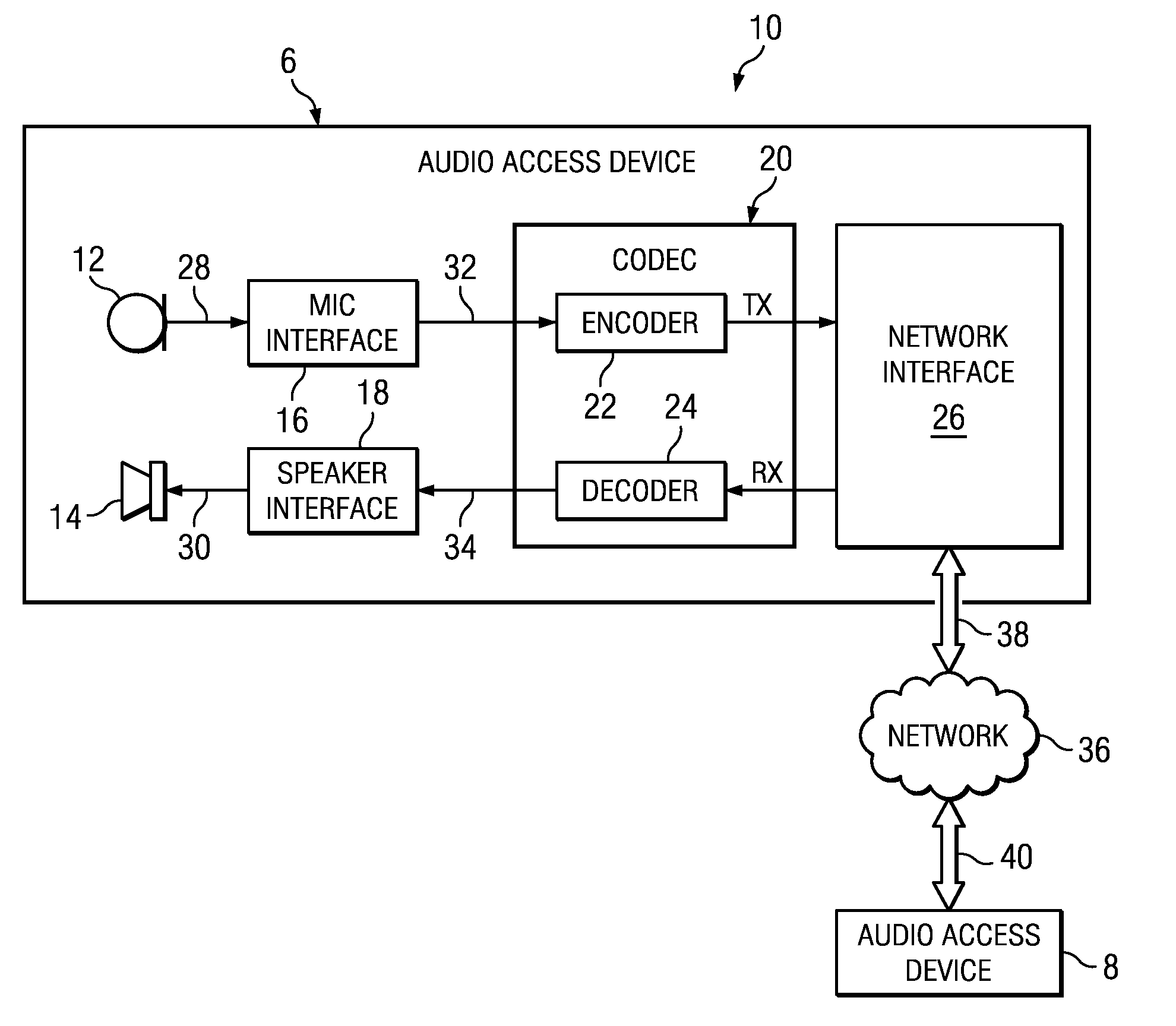
[0066]The present invention will be described with respect to embodiments in a specific context, namely a system and method for performing audio coding for telecommunication systems. Embodiments of this invention may also be applied to systems and methods that utilize speech and audio transform coding.
[0067]The CELP algorithm is a very popular technology that has been used in various ITU-T, MPEG, 3GPP, and 3GPP2 standards. CELP is primarily used to encode speech signal by using specific human voice characteristics or a human vocal voice production model. Most CELP codecs work well for normal speech ...
PUM
 Login to View More
 Abstract
Description
Claims
Application Information
 Login to View More