Continuous Color Grading Technique

a color grading and color technology, applied in the field of continuous color grading technique, can solve problems such as the inability to provide a consistent frame of referen

US20100158366A1Inactive Publication Date: 2010-06-24THOMSON LICENSING SA
19 Cites 8 Cited by

Patent Information

Authority / Receiving Office
US · United States
Current Assignee / Owner
Publication Date
2010-06-24
Estimated Expiration
Not applicable · inactive patent

Smart Images

  • Figure 1
    Figure 1
  • Figure 2
    Figure 2
  • Figure 3
    Figure 3
Patent Text Reader

Abstract

The continuity of at least one image characteristic, such as color, is maintained through image creation, processing and distribution by correlating that characteristic to a frame of reference. During a first processing operation such as image capture, an initial image decision list is generated indicative of at least a one change in at least one characteristic of an image adjusted during that operation. At the completion of that operation, the image is transformed to emulate a film print that serves as the reference for subsequent operations. In this way, the initial image decision list can be modified to further adjust the at least one characteristic of the image using the emulated film print during a second image processing operation.
Need to check novelty before this filing date? Find Prior Art

Description

CROSS-REFERENCE TO RELATED APPLICATIONS

[0001] This application claims priority under 35 119(e) to U.S. Provisional Patent Application Ser. No. 60 / 773,807, filed Feb. 15, 2006, the teachings of which are incorporated herein.TECHNICAL FIELD

[0002] This invention relates to a technique for maintaining the consistency of at least one image parameter, such as color, during different phases of producing an audio-visual program, such as a movies or television show.BACKGROUND ART

[0003] Providers of audio-visual programs, such as movies, and television shows generally follow a well known workflow to create, process, and distribute such audio-visual programs to viewers. The process of creating content generally entails the capture of visual images and audio (although in some instances, the audio gets added and / or modified after image capture). Traditionally, motion picture film cameras have been used to capture visual images. While film cameras often remain the device of choice, digital video cam...

Examples

Embodiment Construction

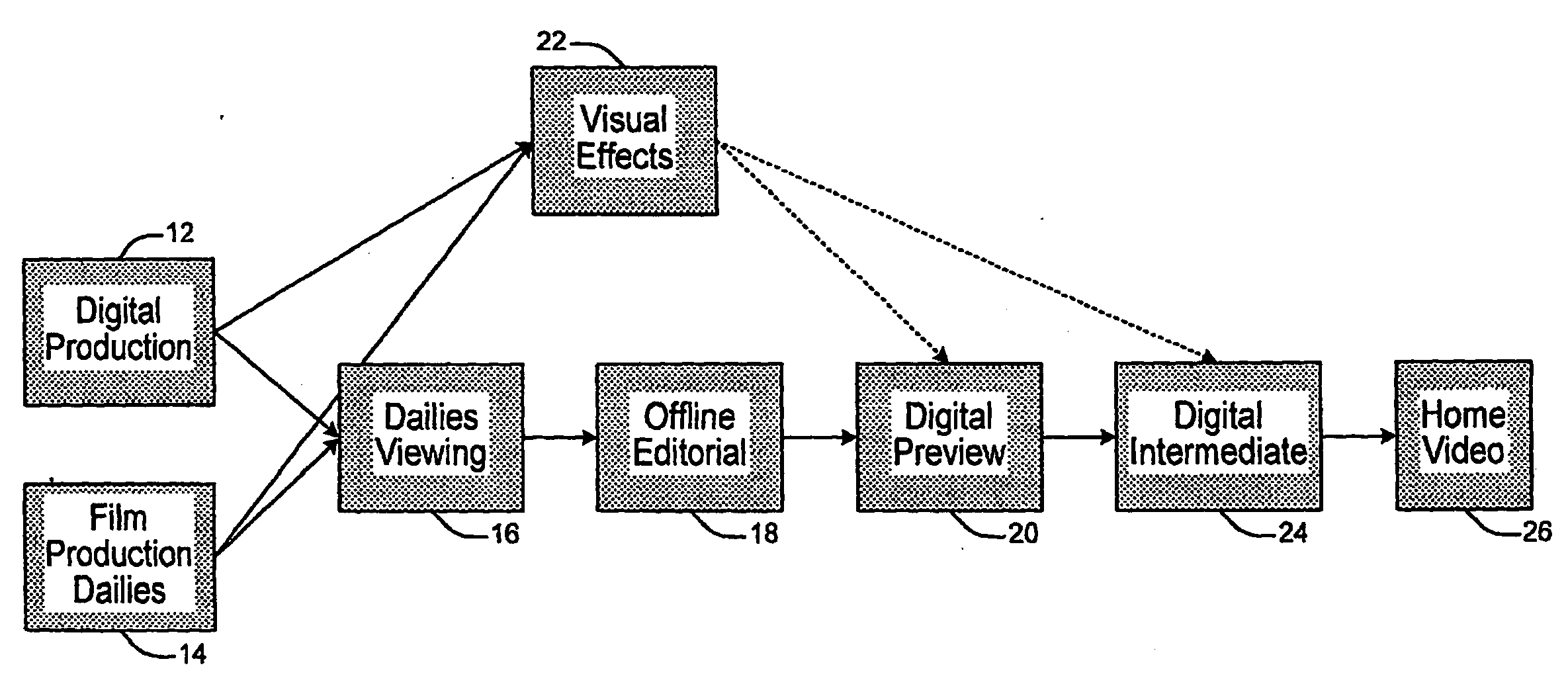
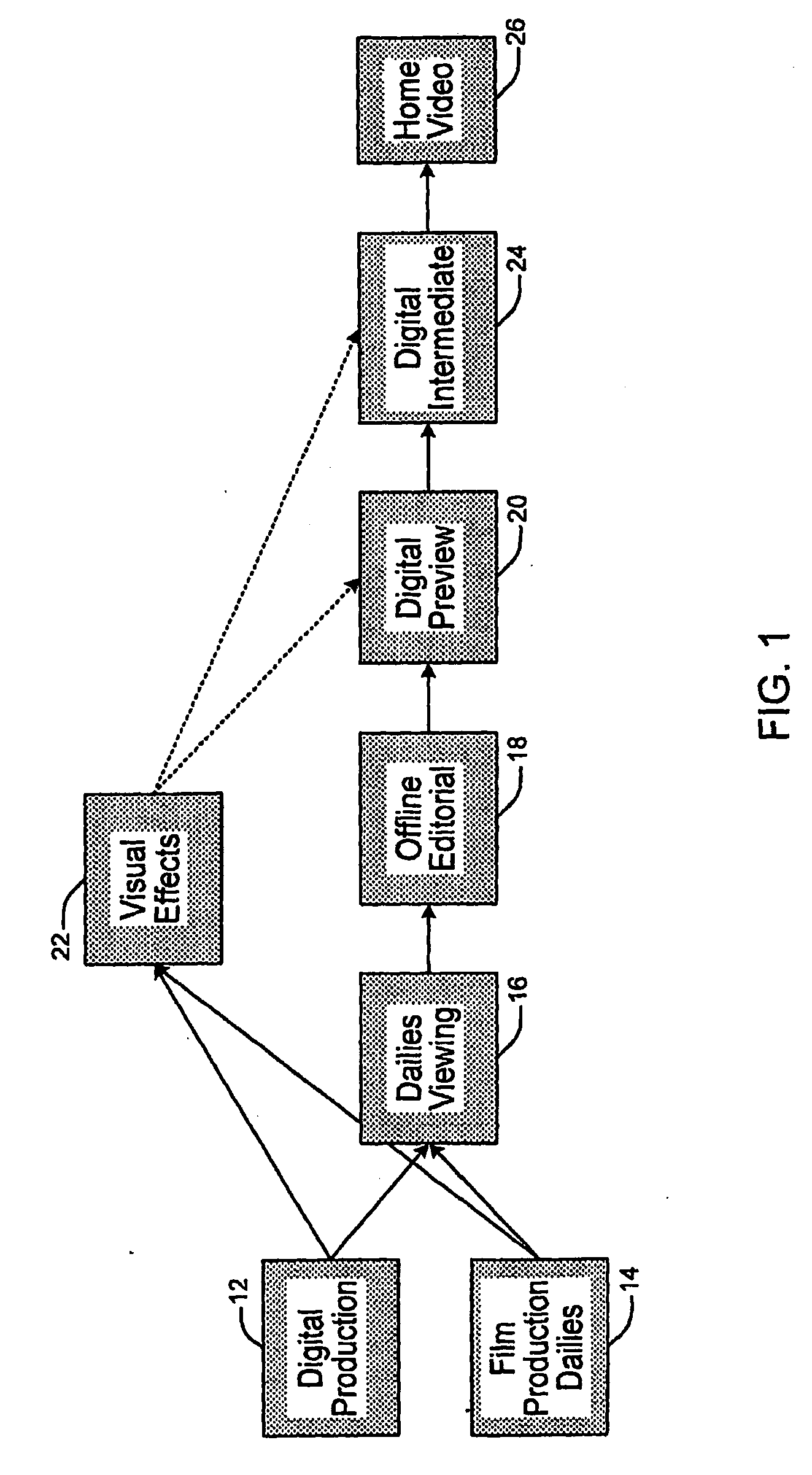
[0018]FIG. 1 depicts the elements in a workflow 10 associated with the production of an audio-visual work in accordance with a preferred embodiment of the present principles. Illustratively in FIG. 1, the audio-visual program takes the form of a pre-recorded digital versatile disc (DVD), some times referred to as a digital video disk, containing at least one feature presentation such as a movie or television show. Alternatively, or in addition to the pre-recorded DVD, the audio-visual program could take the form of a movie in either digital or analog form for theatrical presentation.

[0019]The workflow 10 commences with content creation (e.g., image capture) by making use of one or more digital image capture devices (e.g., Thomson Grass Valley Viper film stream cameras) during digital production in step 12. Image capture also can occur during by making use of one or more film cameras during film production in step 14. (Indeed both digital production and film production could occur in...