[0013]The various embodiments of the present invention allow a first mechanism, such as a motor, to be quickly and easily coupled to and decoupled from a second mechanism such as a pump or generator. Further, embodiments of the present invention allow a rotatable member (e.g., a shaft) of a first mechanism to be quickly and easily connected to or disconnected from a rotatable member (e.g., a shaft) of a second mechanism. When the rotatable member of a motor is connected to the rotatable member of a pump or generator, rotation of the motor's rotatable member can impart rotational motion to the rotatable member of the pump or generator. In this fashion the motor powers the pump or generator.
[0014]Embodiments of the present invention can be used with a pump /
motor system and allow the user to quickly remove an old pump and install a new pump. Such embodiments allow a user to quickly and easily unlock and separate a motor from a pump. Such embodiments also allow a user to replace the pump by placing a new pump onto a loading area and pushing the pump into place along a track or as constrained by a linkage so as to maintain accurate alignment of the respective shafts. As the user does this, the rail or linkage guides the pump accurately into the desired position where it is joined to the motor and can be locked in place.
[0015]Embodiments of the present invention allow for a “dirty” set of pumps to be removed, and a “clean” set of pumps replaced relatively quickly. The dirty set of pumps can then be cleaned for later reuse at the company's convenience, at a separate
cleaning station without undue interruption in the operation of a
production line.
[0016]Embodiments of the present invention provide a pump /
motor system allowing the pump to be quickly removed from the entire
system. Since minimal adjustment is needed for aligning the rotatable members (e.g., the shafts), the pump can be quickly reattached.
[0017]Embodiments of the present invention provide a tapered press-fit
coupling. The tapered press-fit
coupling is split into two pieces, which allows the remaining half of the coupling to be attached to the pump and half and of the coupling to be attached to the motor. When the two pieces are pressed together they provide alignment and frictional connection which allows the motor to drive the pump. Such embodiments provide a simple
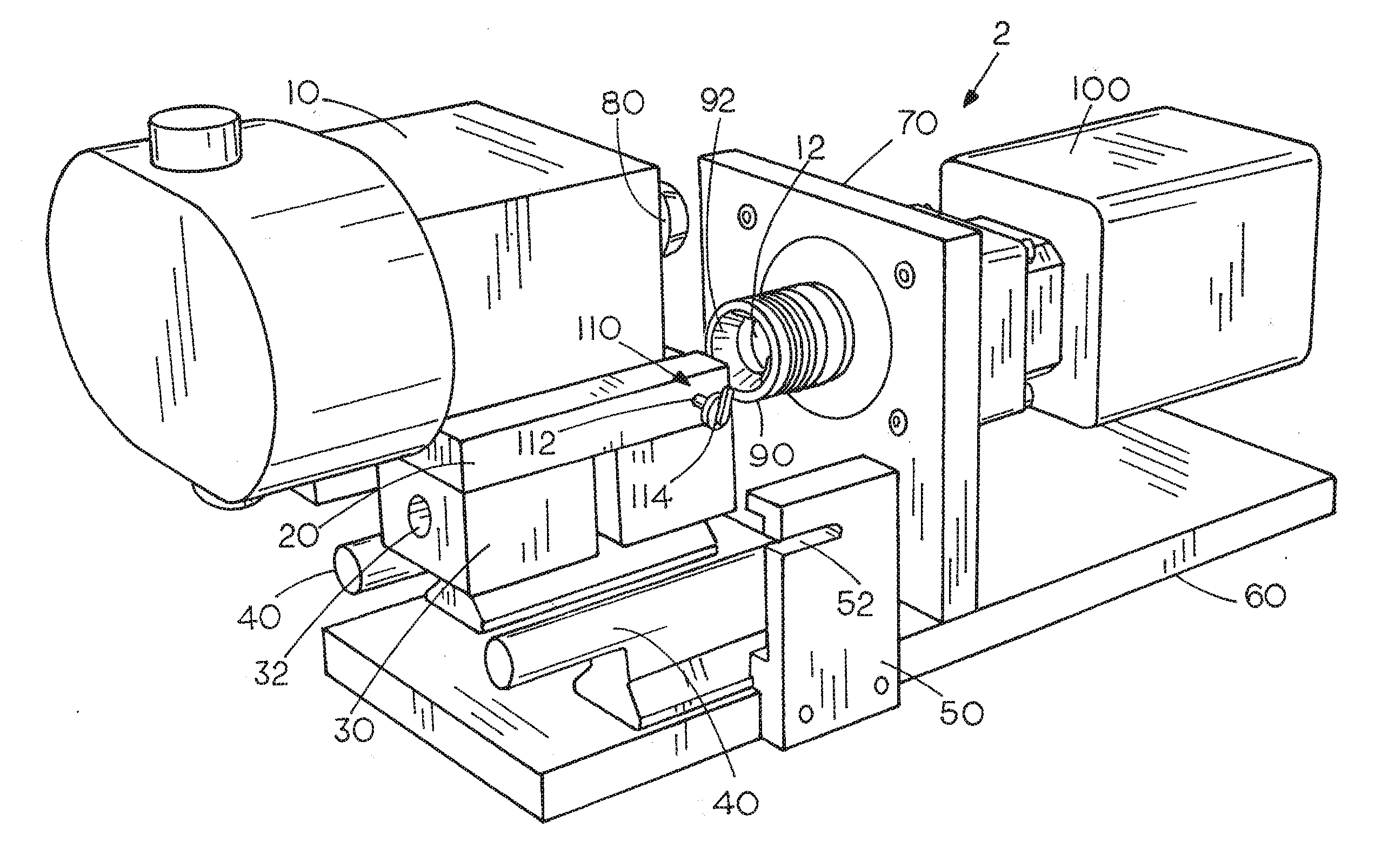
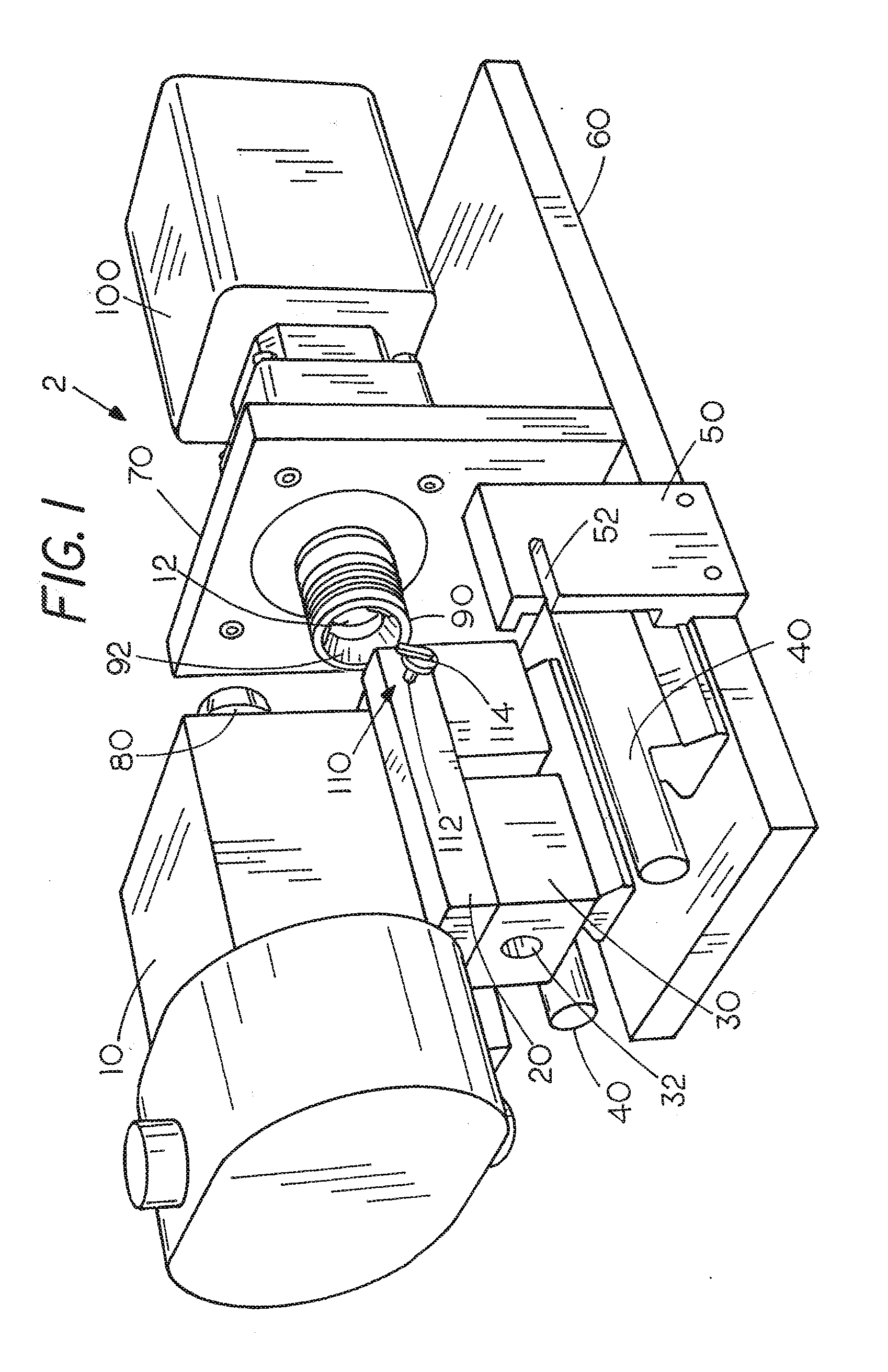
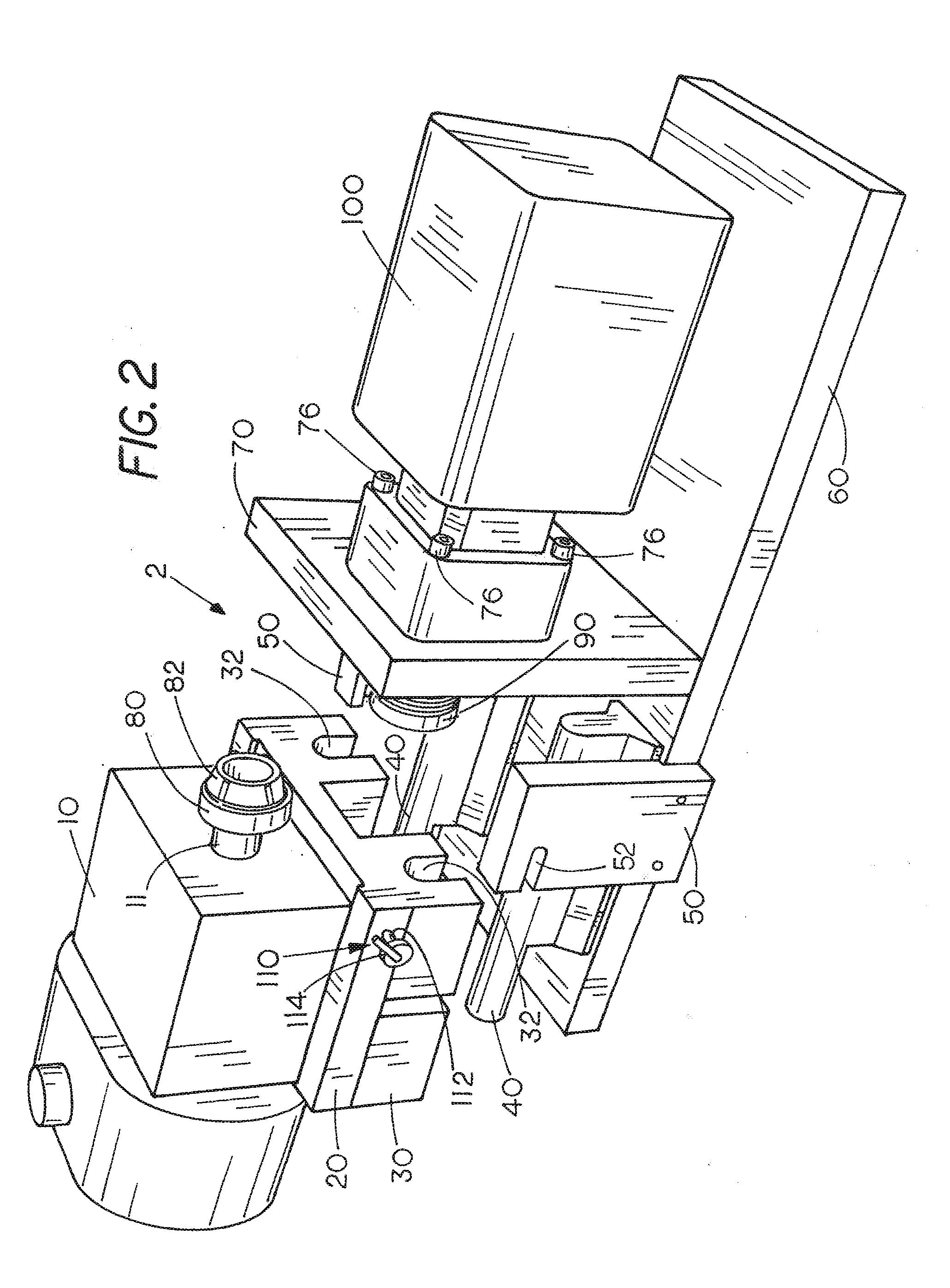
locking mechanism to ensure the two pieces of the press-fit coupling to stay connected while the pump and motor are being used. More specifically, the various embodiments of the present invention provide, among other things, (a) a base; (b) a bracket secured to the base and coupled to a first mechanism (e.g., a motor) to support the first mechanism in a
fixed position relative to the base, the first mechanism having a first rotatable member (e.g., a shaft); (c) a first engagement member (e.g., a track or arm of a linkage) on the base; and (d) an
assembly comprising a second engagement member (e.g., a bearing or another arm of a linkage) and a second mechanism (e.g., a pump or generator) having a second rotatable member. The second engagement member is operatively coupled to the first engagement member to guide the
assembly as it is moved between a first position in which the second rotatable member is not attached to the first rotatable member and second position in which the second rotatable member and the first rotatable member are joined together. The various embodiments of the present invention also provide a lock having a locked position temporarily securing the
assembly in the second position and an unlocked position permitting movement of the assembly between the first position and the second position.
[0018]By way of example, the lock may include one or more locking means for locking the second mechanism in the second position. The locking means may, for example, include at least one plate secured to the base. Each plate has an elongate slot surrounded by an engagement surface. Such a locking means may also include at least one locking bolt having a shank which extends through the slot in the plate and a head. The head has an unlocked position which allows the second mechanism to move and a locked position in which the head engages the engagement surface to
restrict movement of the second mechanism. When such embodiments of the present invention are employed, the second mechanism (e.g., a pump or generator) can easily be removed by loosening the locking bolt(s), moving the assembly including the second mechanism back toward the first position, and then detaching the assembly from the first engagement member.


 Login to View More
  Login to View More