Multiplexer and Modulation Arrangements for Multi-Carrier Optical Modems

a multi-carrier optical modem and modulation arrangement technology, applied in multiplex communication, electrical apparatus, wavelength-division multiplex systems, etc., can solve the problems of high rate modulation formats, inefficient use of optical fiber bandwidth or spectrum, and a higher rate of modulation

a multi-carrier optical modem and modulation arrangement technology, applied in multiplex communication, electrical apparatus, wavelength-division multiplex systems, etc., can solve the problems of high rate modulation formats, inefficient use of optical fiber bandwidth or spectrum, and a higher rate of modulation

US20120251120A1Active Publication Date: 2012-10-04INFINERA CORP

Image

Smart Image Click on the blue labels to locate them in the text.
Viewing Examples
Smart Image
  • Multiplexer and Modulation Arrangements for Multi-Carrier Optical Modems
  • Multiplexer and Modulation Arrangements for Multi-Carrier Optical Modems
  • Multiplexer and Modulation Arrangements for Multi-Carrier Optical Modems

Examples

Experimental program
Comparison scheme
Effect test

Embodiment Construction

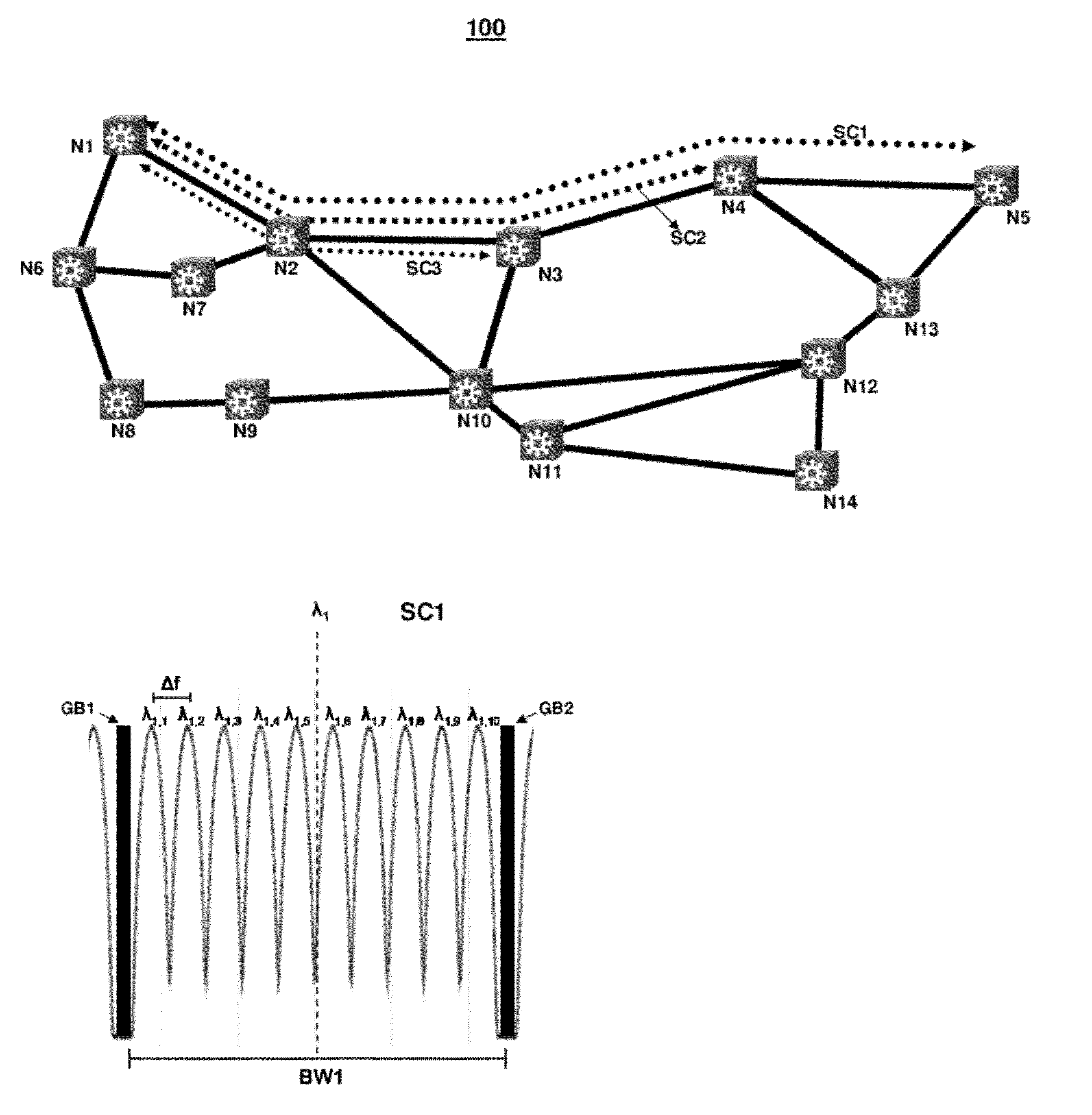
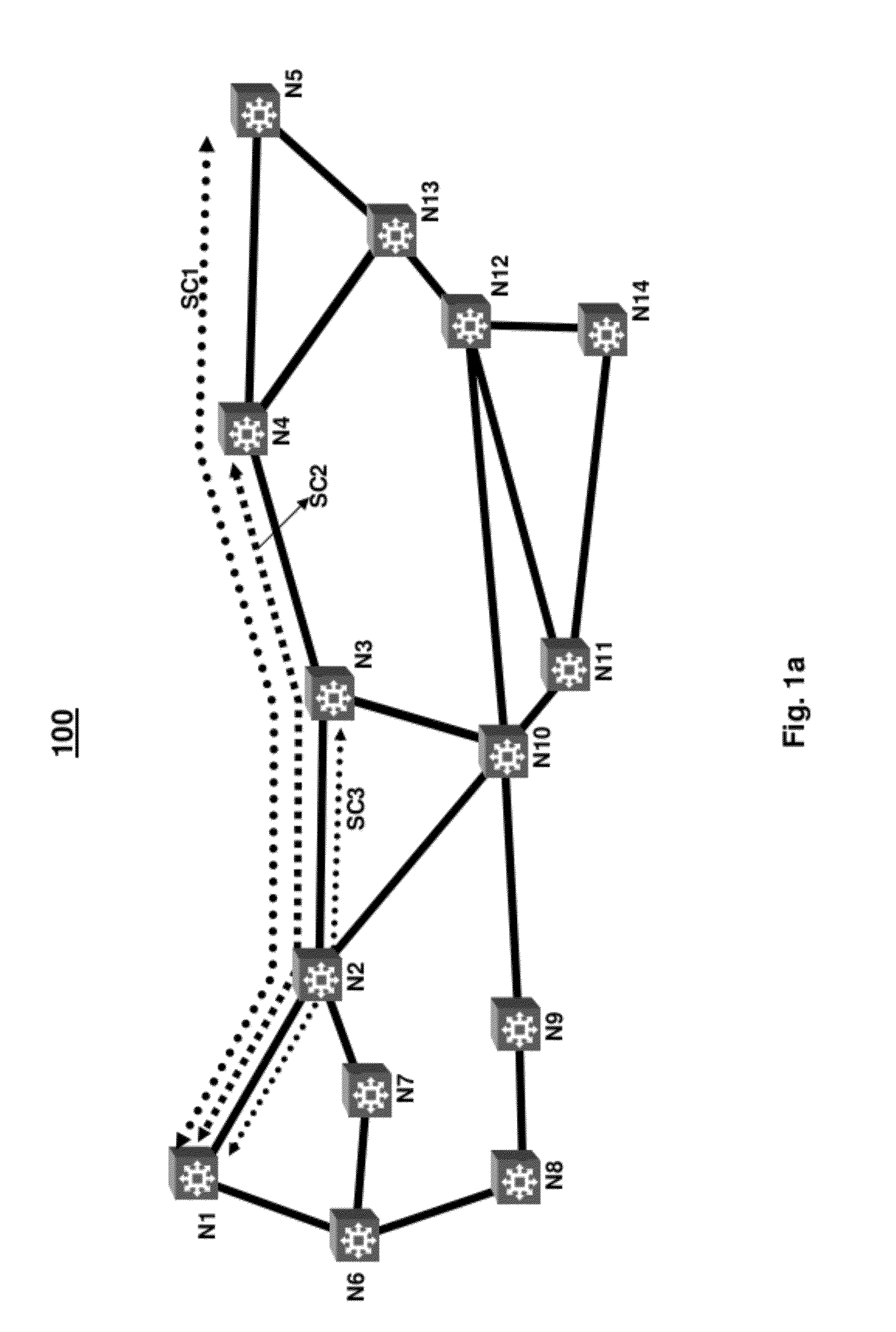
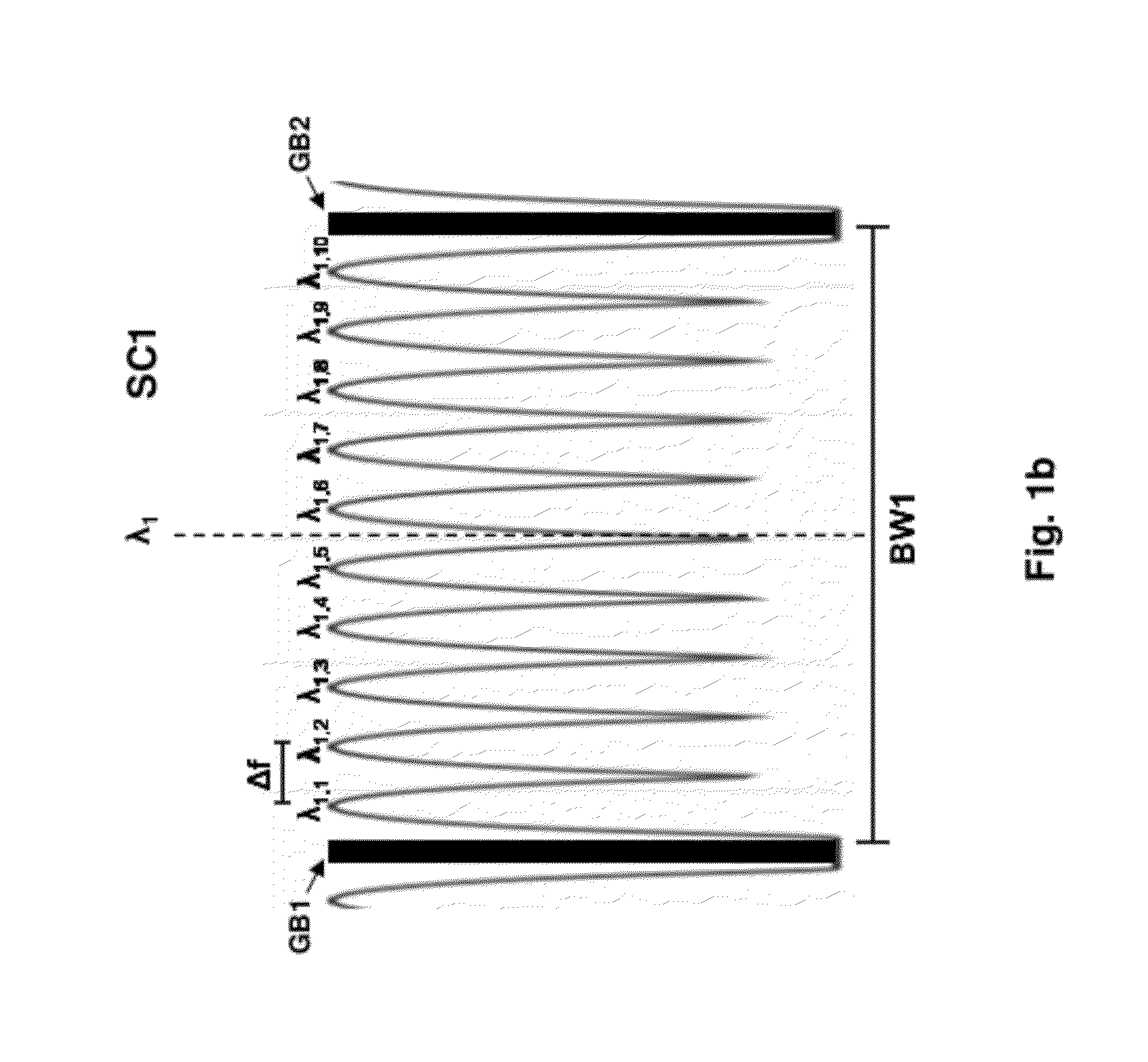
[0023]Consistent with the present disclosure, data, in digital form, is received by a transmit node of an optical communication system, and converted to an analog signal by a digital-to-analog converter (DAC) to drive a modulator. The modulator, in turn, modulates light at one of a plurality of minimally spaced wavelengths in accordance with the received data and a specified modulation format. The plurality of minimally spaced wavelengths or carriers are grouped together with a multiplexer or combiner, for example, to form a superchannel. A plurality of superchannels are then multiplexed and transmitted over an optical communication path to a receive node. At the receive node, the multiplexed superchannels are demultiplexed by an optical demultiplexer and provided to a plurality of corresponding demodulators. The demultiplexed superchannels, or carriers, may then be intradyned in a known manner by combining them with light from a plurality of local oscillators tuned to each of the m...

the structure of the environmentally friendly knitted fabric provided by the present invention; figure 2 Flow chart of the yarn wrapping machine for environmentally friendly knitted fabrics and storage devices; image 3 Is the parameter map of the yarn covering machine
Login to View More

PUM

No PUM Login to View More

Abstract

Consistent with the present disclosure, data, in digital form, is received by a transmit node of an optical communication system, and converted to an analog signal by a digital-to-analog converter (DAC) to drive a modulator. The modulator, in turn, modulates light at one of a plurality of wavelengths in accordance with the received data forming a plurality of corresponding carriers. The carriers are modulated according to one of a plurality of modulation formats and then optically combined to form a superchannel of a constant maximum capacity, for example. Accordingly, the number of carriers and the bit rate for each carrier remain constant for each modulation format to realize a constant maximum capacity. The superchannel is then transmitted over an optical communication path to a receive node. At the receive node, the superchannel is optically demultiplexed from a plurality of other superchannels. The plurality of carriers of the superchannel are then supplied to a photodetector circuit, which receives additional light at one of the optical signal carrier wavelengths from a local oscillator laser. An analog-to-digital converter (ADC) is provided in the receive node to convert the electrical signals output from the photodetector into digital form. The output from the ADC is then filtered in the electrical domain, such that optical demultiplexing of the carriers is unnecessary.

Description

BACKGROUND OF THE DISCLOSURE[0001]Wavelength division multiplexed (WDM) optical communication systems are known in which multiple optical signals or channels, each having a different wavelength, are combined onto an optical fiber. Such systems typically include a laser associated with each wavelength, a modulator configured to modulate the optical signal output from the laser, and an optical combiner to combine each of the modulated optical signals. Such components are typically provided at a transmit end of the WDM optical communication system to transmit the optical signals onto the optical fiber. At a receive end of the WDM optical communication system, the optical signals are often separated and converted to corresponding electrical signals that are then processed further.[0002]Known WDM optical communication systems are capable of multiplexing 40 channels at 100 GHz spacing or 80 channels at 50 GHz spacing. These WDM optical communication systems occupy an overall bandwidth of ...

Claims

the structure of the environmentally friendly knitted fabric provided by the present invention; figure 2 Flow chart of the yarn wrapping machine for environmentally friendly knitted fabrics and storage devices; image 3 Is the parameter map of the yarn covering machine
Login to View More

Application Information

Patent Timeline
04 Oct 2012
Publication
US20120251120A1
IPC
H04J14/02
CPC
H04B10/506; H04B10/675; H04J14/0212; H04J14/06; H04J14/0256; H04J14/026; H04J14/0213; H04B10/5161
Inventors
MCNICOL, JOHN D.; WU, KUANG-TSAN