
Efficient Technique for Optimal Re-Use of Hardware In the Implementation of Instructions Used in Viterbi, Turbo and LPDC Decoders
a technology of lpdc decoding and optimization technique, applied in the field of forward error correction, can solve the problems of high resource consumption of the lpdc algorithm and latency of computer arithmetic, and achieve the effect of improving the efficiency of lpdc decoding
- Summary
- Abstract
- Description
- Claims
- Application Information
AI Technical Summary
Benefits of technology
Problems solved by technology
Method used
Image

Examples
Embodiment Construction
[0027]R4ACS / R4ACD instructions used for implementing Viterbi decoding involve the following arithmetic computation:
R=max4*(a1+b1+c1,a2+b2−c2,a3−b3+c3,a4−b4−c4) (13)
[0028]T2MAX / T4MAX Instructions used for Turbo decoders involve instructions requiring the following arithmetic computation:
R=max4*(x1+y1+z1,x2+y2+z2,x3+y3+z3,x4+y4+z4) (14)
where: each of the terms compared can be N bits wide in general.
[0029]The following are the main issues in merging the two classes of instructions; merging the computation of summation terms (a2+b2−c2), (x2+y2+z2), (a3−b3+c3) and (x3+y3+z3); implementing an efficient method of computing for (a4−b4−c4); and merging this computation with (x4+y4+z4).
[0030]The present invention solves both of these issues and successfully merges the two classes of instructions. Furthermore, our invention optimizes the hardware required by both classes of instructions by efficiently employing carry save arithmetic.
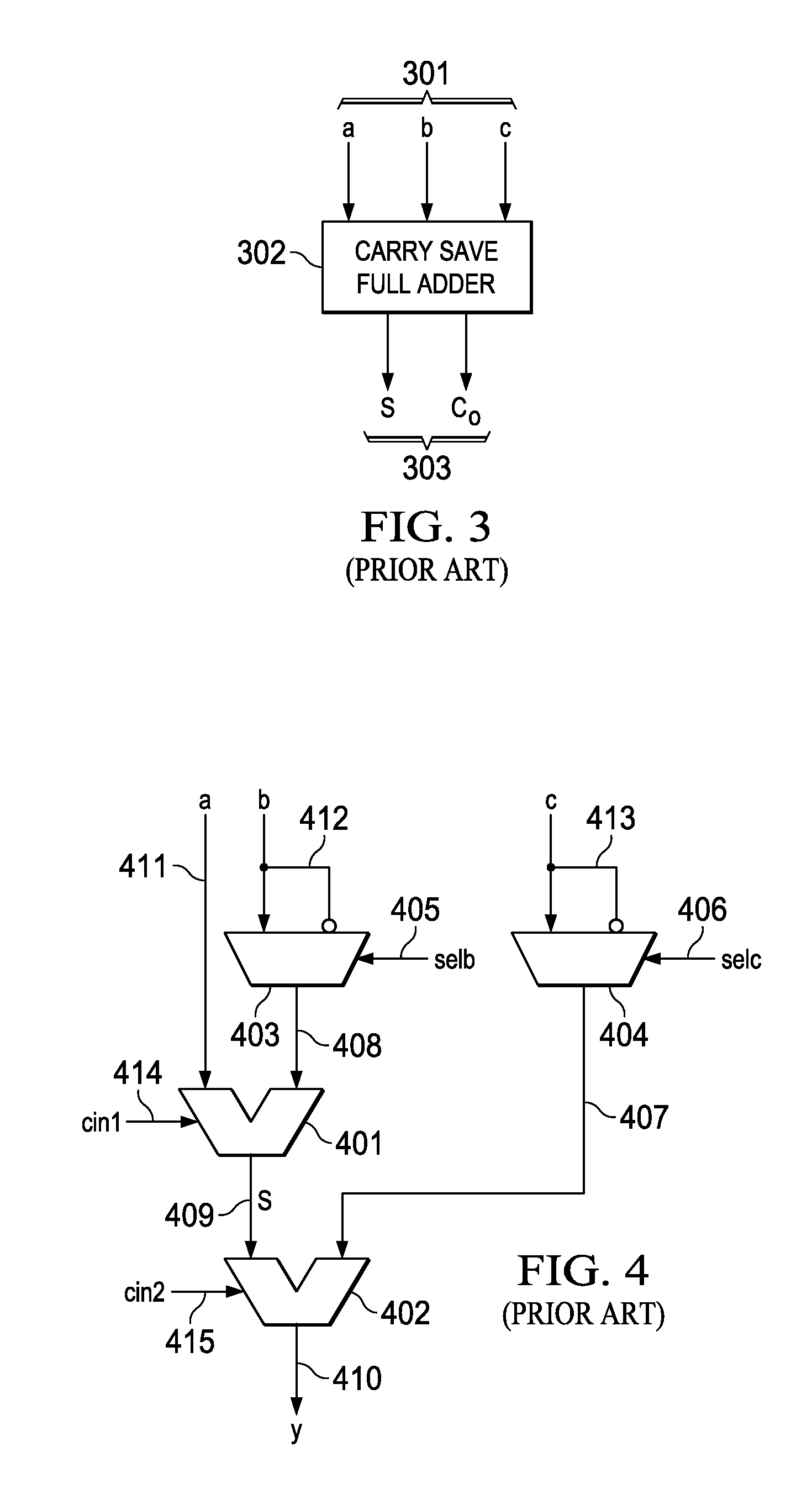
[0031]FIG. 4 illustrates the general approach for computing...
PUM
 Login to View More
 Abstract
Description
Claims
Application Information
 Login to View More