Healthcare administration method for complex case and disease management

US20140164005A1Active Publication Date: 2014-06-12ADVANCED HEALTHCARE SYST
7 Cites 27 Cited by

Patent Information

Authority / Receiving Office
US · United States
Current Assignee / Owner
Publication Date
2014-06-12

Smart Images

  • Figure 1
    Figure 1
  • Figure 2
    Figure 2
  • Figure 3
    Figure 3
Patent Text Reader

Abstract

The present invention discloses substantially more efficient and effective methods for delivering healthcare whereby patient care can be coordinated effectively and efficiently through changes in different physical settings and levels of care. Coordinated care helps ensure that patients seeking healthcare, and in particular chronically ill patients, with comorbidities get timely care to avoid unnecessary ER visits and admissions. Through risk and disease stratification, member profiling, inter disciplinary team follow-up and patient education, the methods of the present invention are operative to effectively allocate available resources, formulate and execute individualized care plans and successfully manage high risk members.
Need to check novelty before this filing date? Find Prior Art

Description

CROSS-REFERENCE TO RELATED APPLICATIONS

[0001] The present application is a continuation of U.S. patent application Ser. No. 13 / 712,741, filed Dec. 12, 2012, entitled HEALTHCARE ADMINISTRATION METHOD FOR COMPLEX CASE AND DISEASE MANAGEMENT, all of the teachings of which are expressly incorporated herein by reference.STATEMENT RE: FEDERALLY SPONSORED RESEARCH / DEVELOPMENT

[0002] Not ApplicableBACKGROUND

[0003] The main causes for health care spending waste are overtreatment of patients, the failure to coordinate care, and the administrative complexity of the health care system. In this regard, healthcare is typically administered in a piecemeal fashion via a process that is typically initiated by a patient's self-assessment or self-diagnosis. Depending on the individual patient's judgment, the patient will typically seek treatment at a traditional “brick and mortar” facility, whether it be a doctor's office, clinic, hospital / emergency room, or the like. Alternatively, the patient may forego...

Examples

Embodiment Construction

[0049]The detailed description set forth below is intended as a description of the presently preferred embodiment of the invention, and is not intended to represent the only form in which the present invention may be implemented or performed. The description sets forth the functions and sequences of steps for practicing the invention for performing novel methods of healthcare administration. It is to be understood, however, that the same or equivalent functions and sequences may be accomplished by different embodiments and that they are also intended to be encompassed within the scope of the invention.

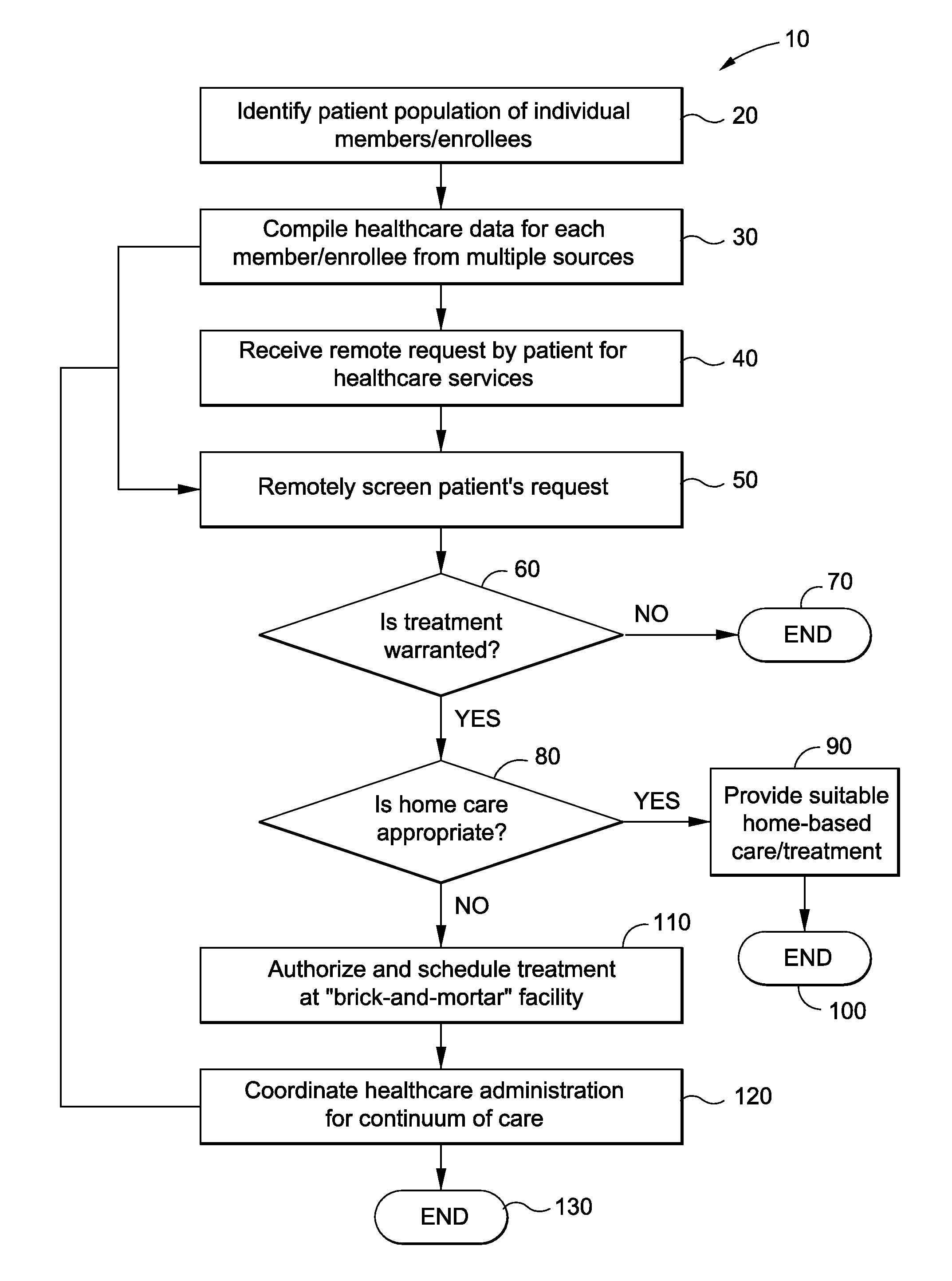
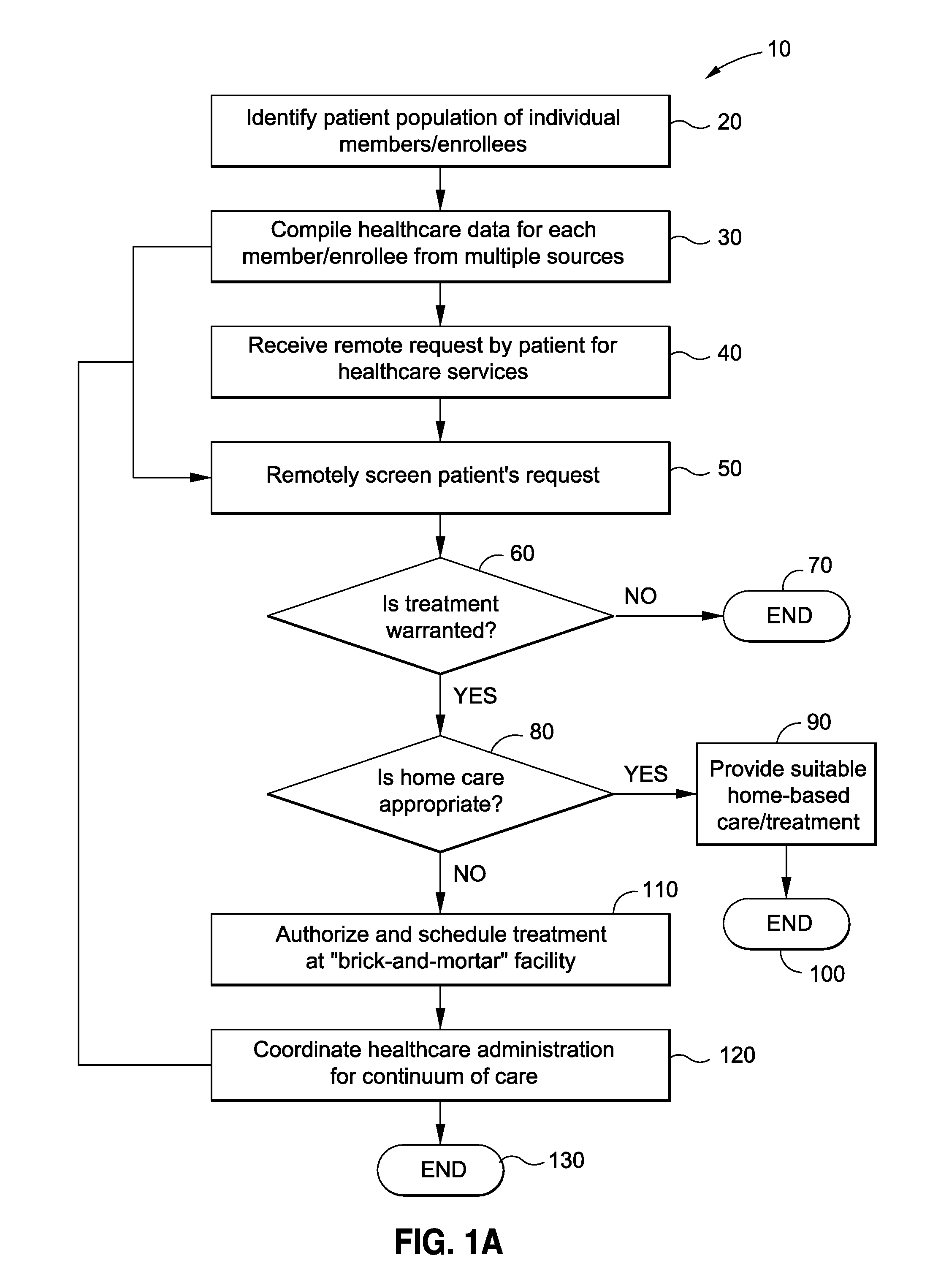
[0050]Referring now to the drawings, and initially to FIG. 1A, there is shown a flow chart depicting the general steps for performing certain novel methods for administering healthcare to a specific patient population that is operative to provide substantially more effective and efficient healthcare than prior art practices, particularly with respect to patients having complex and / or c...