
Method, module of access controls and a ue comprising the same
- Summary
- Abstract
- Description
- Claims
- Application Information
AI Technical Summary
Benefits of technology
Problems solved by technology
Method used
Image

Examples
embodiment 1
Detailed Embodiment 1
[0050]In the LTE system, the UE is in the idle state. The USIM of the UE is configured with an valid extended access barring, such as that the extended access barring configuration may be set as true. Besides, the USIM of the UE indicates the access level of the UE is 8 and 11.
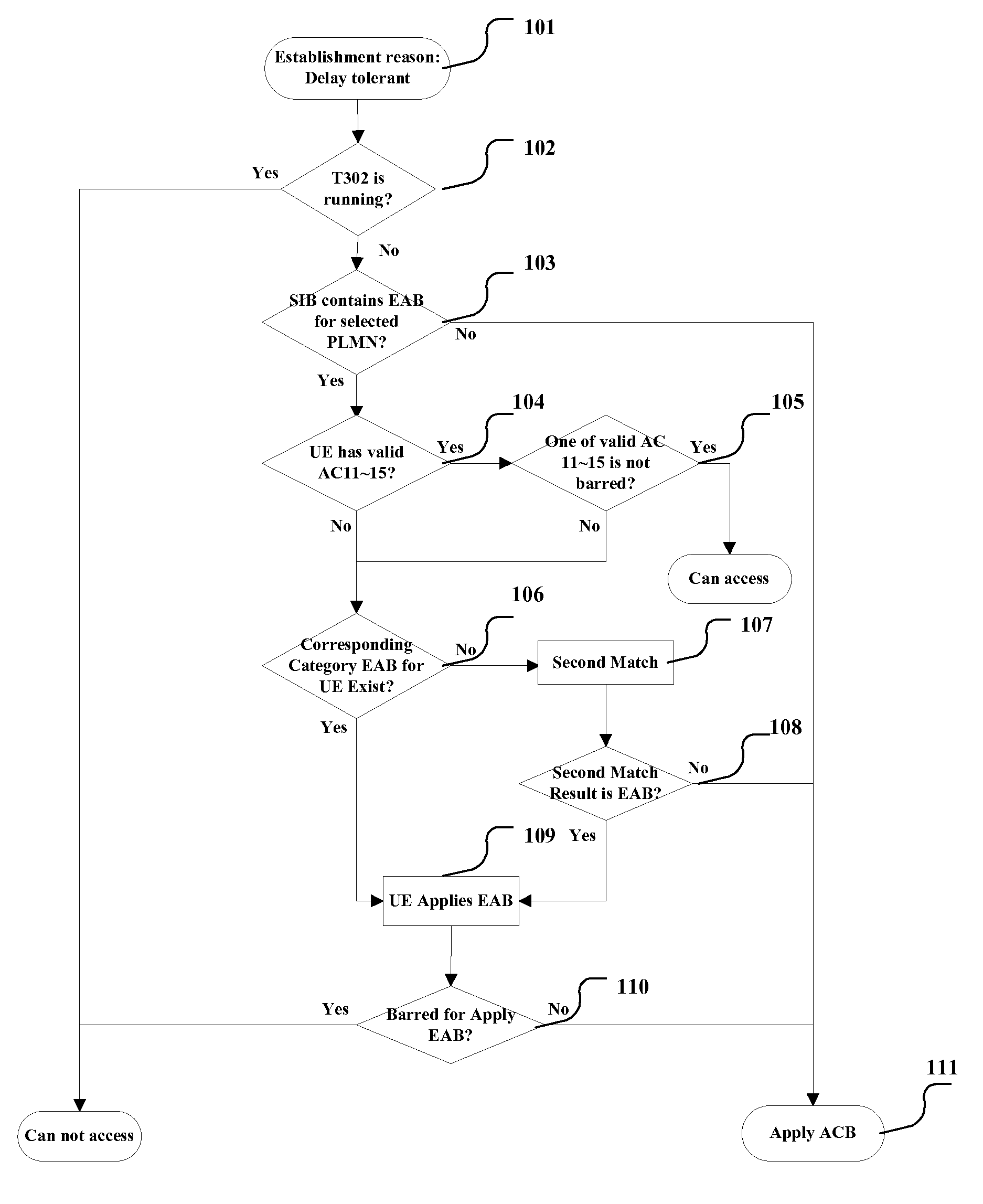
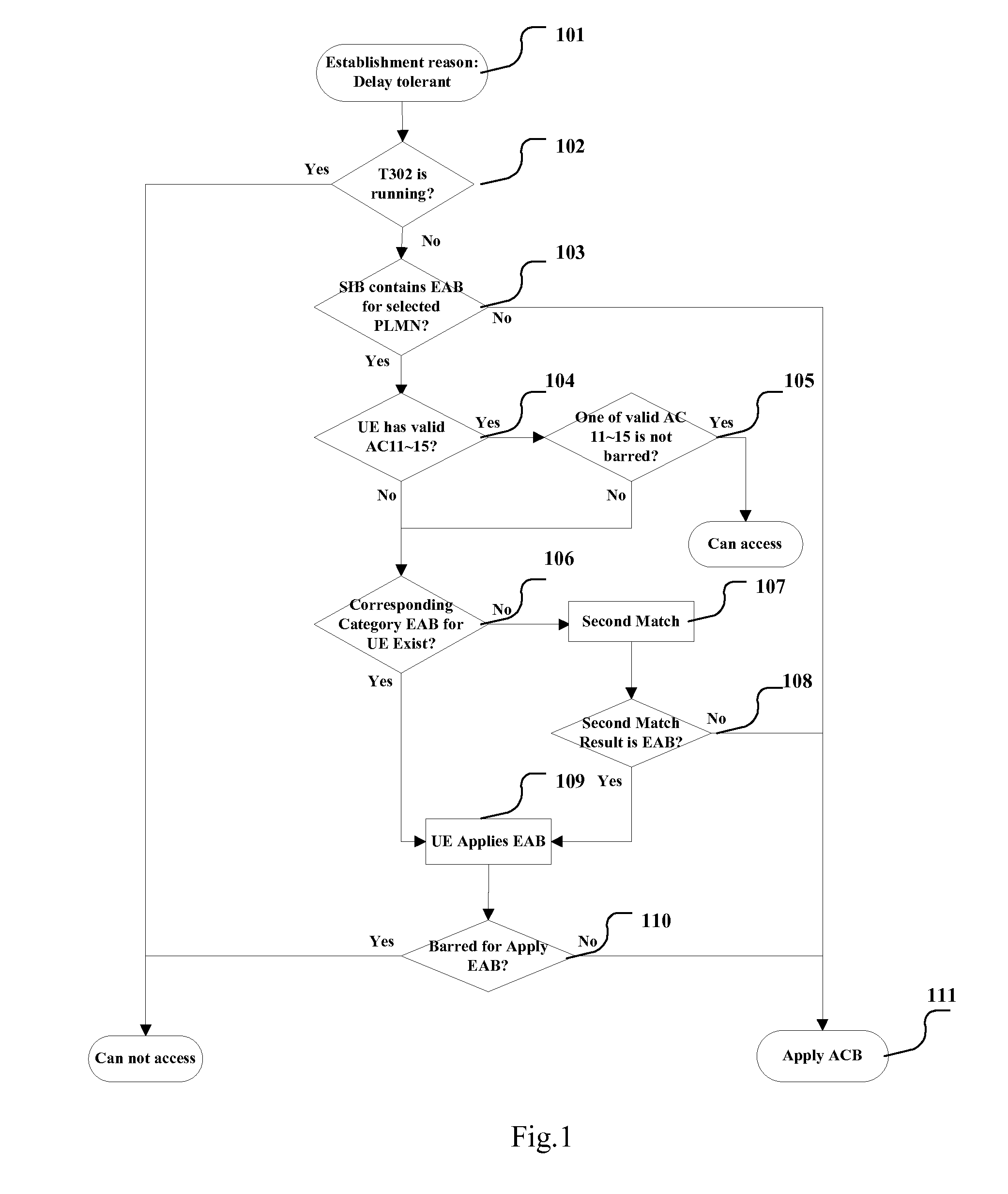
[0051]When the UE needs to initiate a delay tolerant service, or a low priority service, the non-access stratus (NAS for short) of the UE sends to the access stratus (AS) of the UE an establishment cause of delay tolerance or low priority. The process of implementing access determination in the AS of the UE is illustrated in FIG. 1.
[0052]Step 101: the AS of the UE receives the service request of its upper stratus (NAS), and the establishment cause of the service is delay tolerance.
[0053]Step 102: the UE determines whether the waiting time timer (T302) is running, if running, the UE considers access to the cell as barred; if T302 isn't running, the UE implements the step 103.
[0054]Here it n...
embodiment 2
Detailed Embodiment 2
[0080]In the LTE system, the UE resides in the cell of the base station, and the UE is in an idle state. The USIM of the UE is configured with the valid extended access barring, besides, the USIM of the UE indicates the access class of the UE is 5, i.e. the access class is 5.
[0081]When the UE needs to initiate the delay tolerant service, the NAS of the UE sends to the AS of the UE an establishment cause of delay tolerance. The process of access determination implemented in the AS of the UE is illustrated as FIG. 3:
[0082]Step 201: the AS of the UE receives the service request of its NAS, and the establishment cause of the service is delay tolerance.
[0083]Step 202: the UE determines whether the waiting time timer (T302), or the access barring timer (T303) set for the data service initiated by the user is running, if running, the UE considers access to the cell as barred; if neither of the timers is running, the UE implements the step 203.
[0084]Step 203: the UE det...
PUM
 Login to View More
 Abstract
Description
Claims
Application Information
 Login to View More