
Lacrosse head pocket and related method of manufacture
- Summary
- Abstract
- Description
- Claims
- Application Information
AI Technical Summary
Benefits of technology
Problems solved by technology
Method used
Image

Examples
first alternative embodiment
IV. First Alternative Embodiment
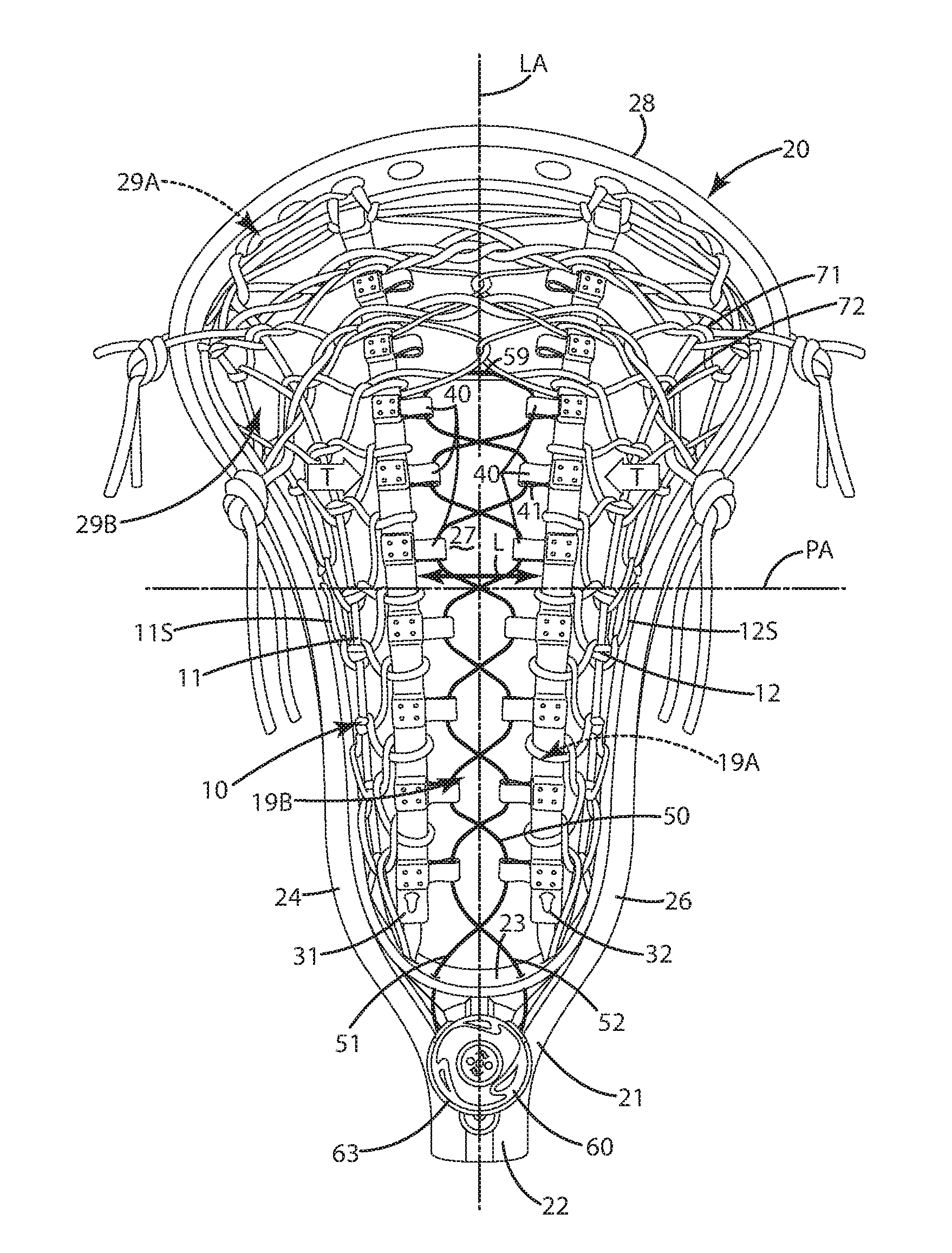
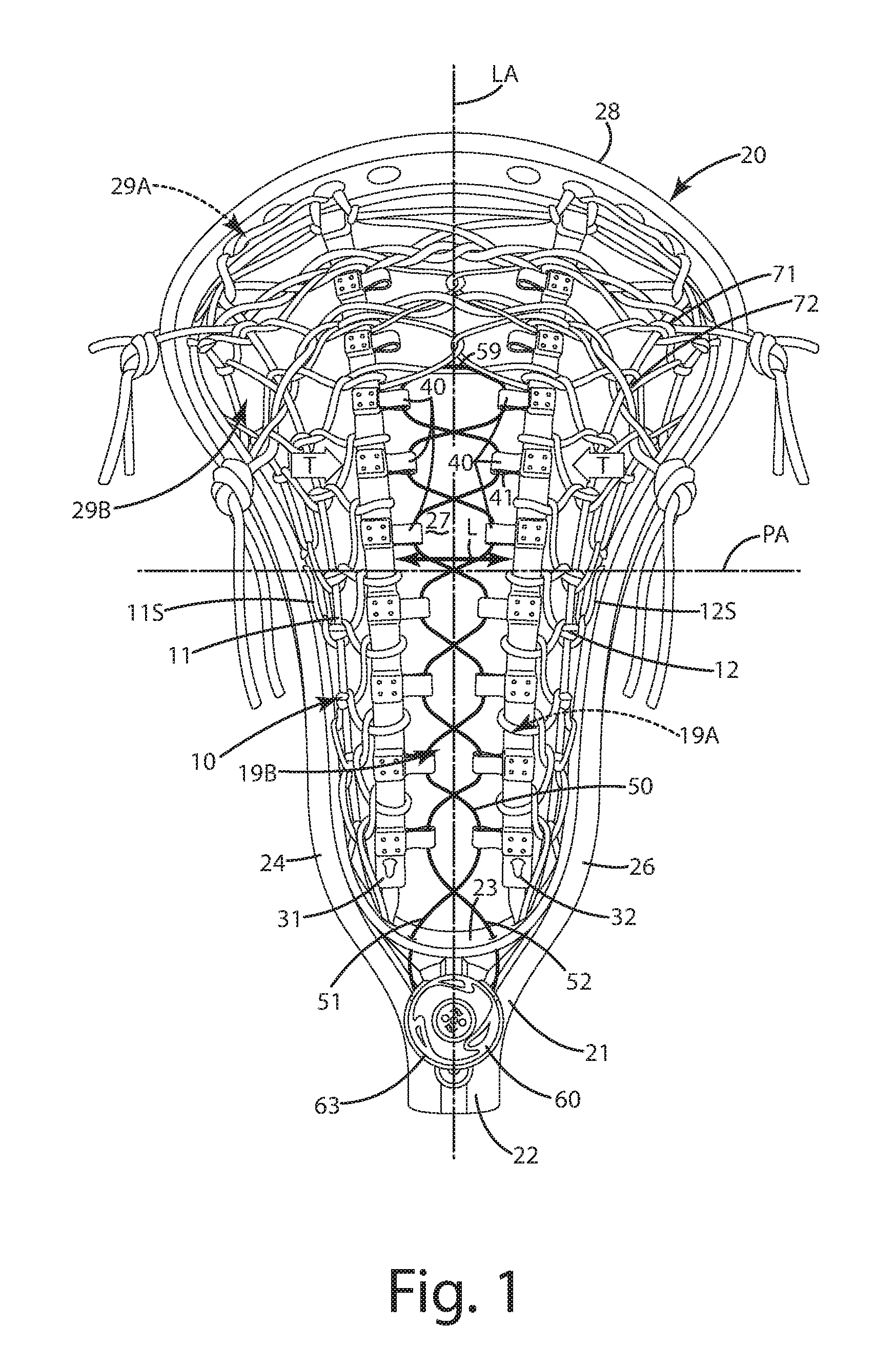
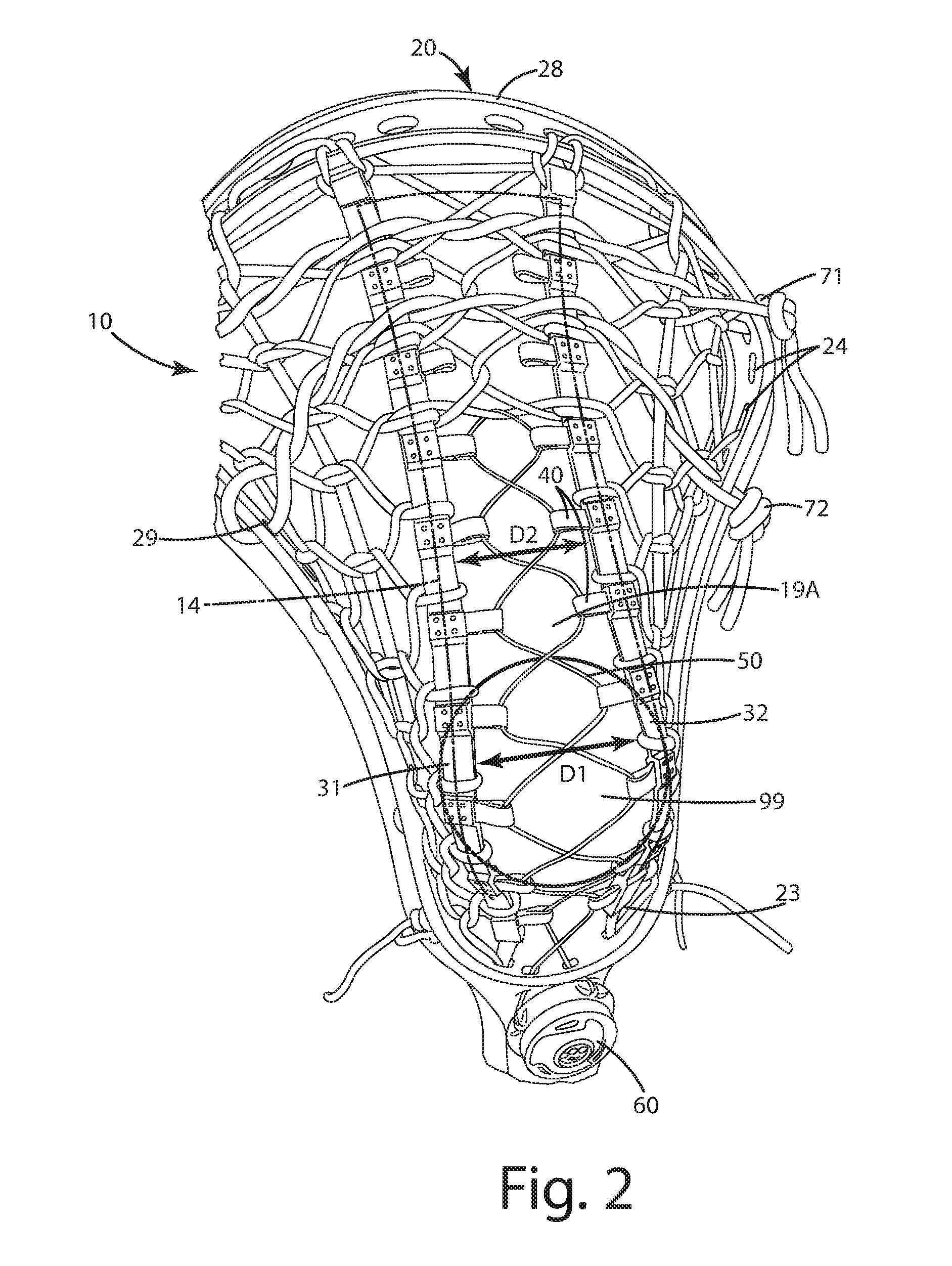
[0065]A first alternative embodiment of the lacrosse pocket is illustrated in FIG. 4 and generally designated 110. The pocket shown there is similar in structure, function and operation to the embodiment described above with several exceptions. For example, the pocket 110 can include a first tensioner 160 similar to the one described above. This tensioner can modify the strand 150 and its length, thereby altering the configuration of the runners and ball channel. The pocket and / or head can be outfitted with a second tensioning member 160′ which is similar to the tensioning member discussed in the embodiment above, but located near the scoop. The tensioning member 160′ can include a second strand 150′. This second strand 150′ can extend through guide members 140 that are associated with the respective first and second runners 131 or 132. The strand 150′ can further extend to additional guide members 140′ that are formed as a portion of the head, for ex...
second alternative embodiment
V. Second Alternative Embodiment
[0068]A second alternative embodiment of the lacrosse pocket is illustrated in FIG. 7 and generally designated 210. The pocket shown there is similar in structure, function and operation of the embodiments described above with several exceptions. For example, in this construction, the runners 231 and 232 generally extend in parallel to one another and / or to the longitudinal axis LA of the pocket 210. The guide members 240 of this embodiment however are different. In this construction, the guide members can be generally in the form of U shaped tubes that are fastened, glued, welded or optionally integrally formed with the respective runners 231 and 232. These U shaped tubes generally include a U shaped portion 242 that redirects the direction of the strand 250 as it extends therethrough. Each U shaped member 242 terminates at openings 243 that open generally toward the longitudinal axis LA of the lacrosse pocket. These guide members 240 can be integral...
third alternative embodiment
VI. Third Alternative Embodiment
[0069]A third alternative embodiment of the lacrosse pocket is illustrated in FIG. 8 and generally designated 310. The pocket shown there is similar in structure, function and operation to the embodiments described above with several exceptions. For example, the pocket 310 can include first and second runners 331 and 332. These runners can be generally joined with fixed length cross pieces 333 that extend therebetween. This can generally fix the distance between the runners 331 and 332 relative to one another. The pocket 310, however, can be outfitted with a strand 350 that functions like shooting strings. This strand 350 can be joined with the tensioning member 360, which itself is joined with a sidewall or scoop of the head. The strand extends through and moves relative to guide members 340. These guide members 340 can be in the form of tubes that allow the strand to move and / or slide relative to them. The strand is laced through those tubes, for ex...
PUM
 Login to View More
 Abstract
Description
Claims
Application Information
 Login to View More