[0008]It is one object of this invention to provide a pivotally mounted arrow rest that instantaneously or immediately moves away from an arrow when a bow cable moves forward during launch or discharge of the arrow.
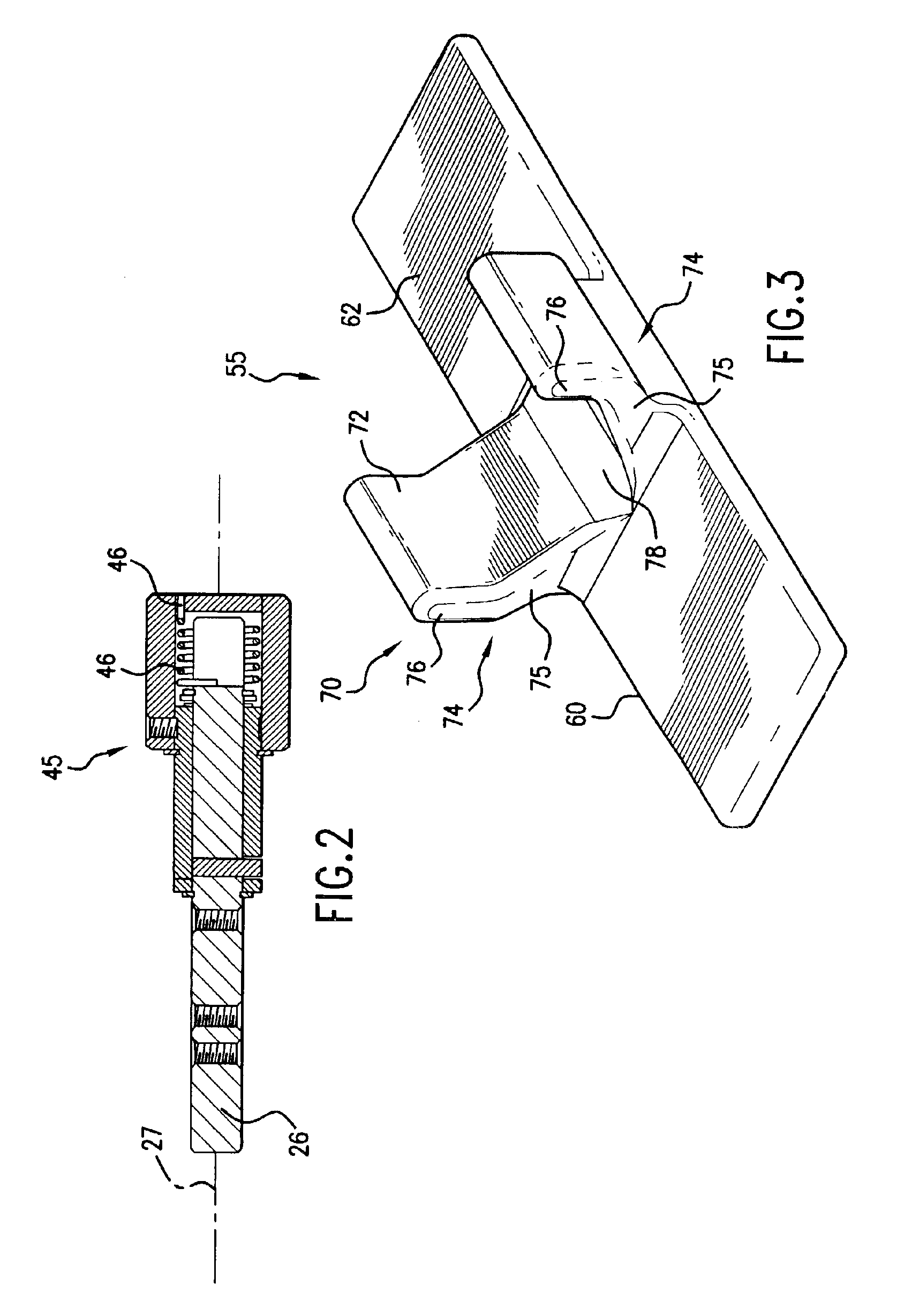
[0011]When the arrow shaft is positioned within the holding apparatus, such as when the arrow rest is in the unloaded position, the archery bow can be carried or moved into many different positions and the holding apparatus maintains the arrow shaft in a generally fixed position with respect to the archery bow. The holding apparatus of this invention prevents the arrow shaft from falling off of a shelf of the riser portion.
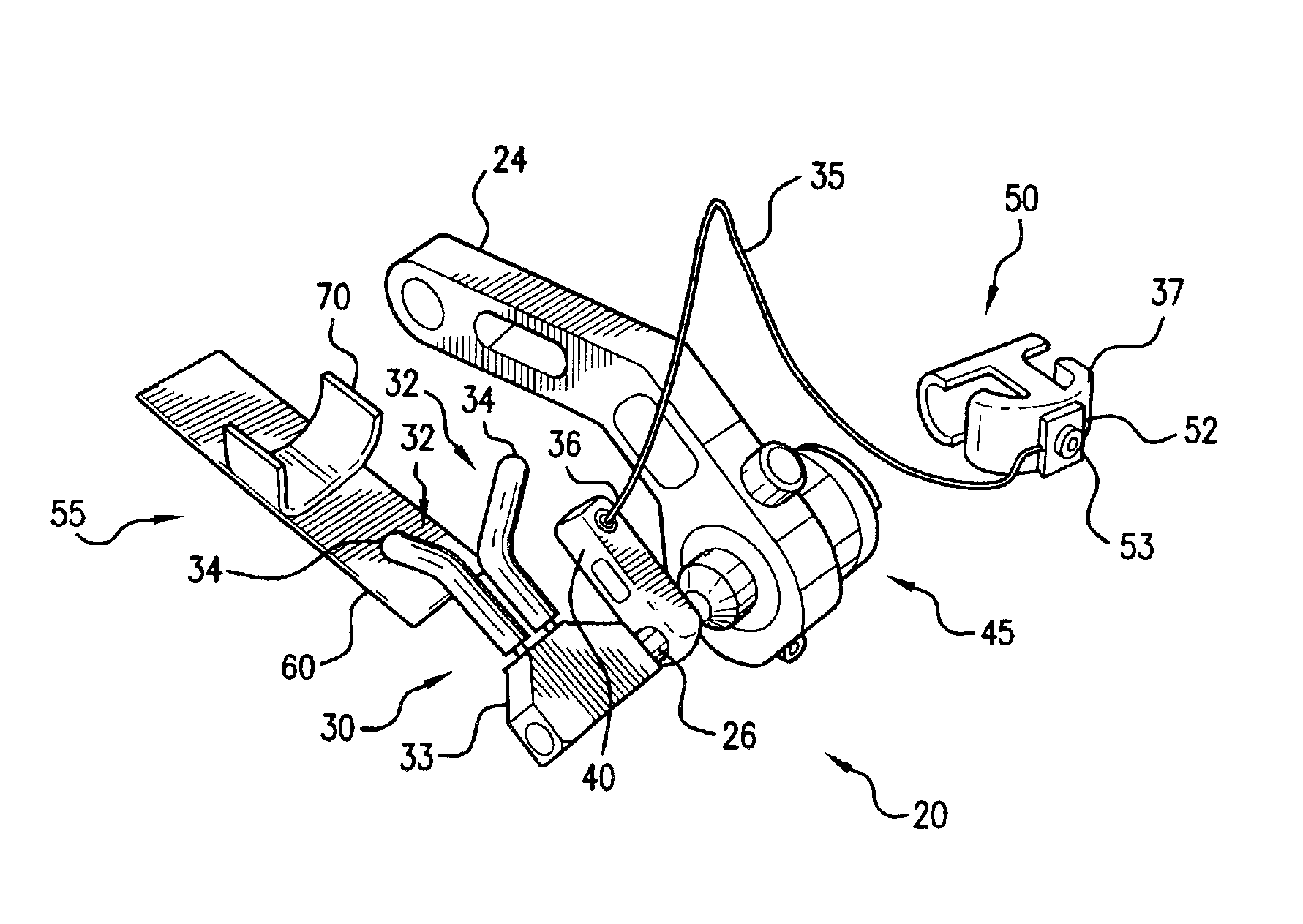
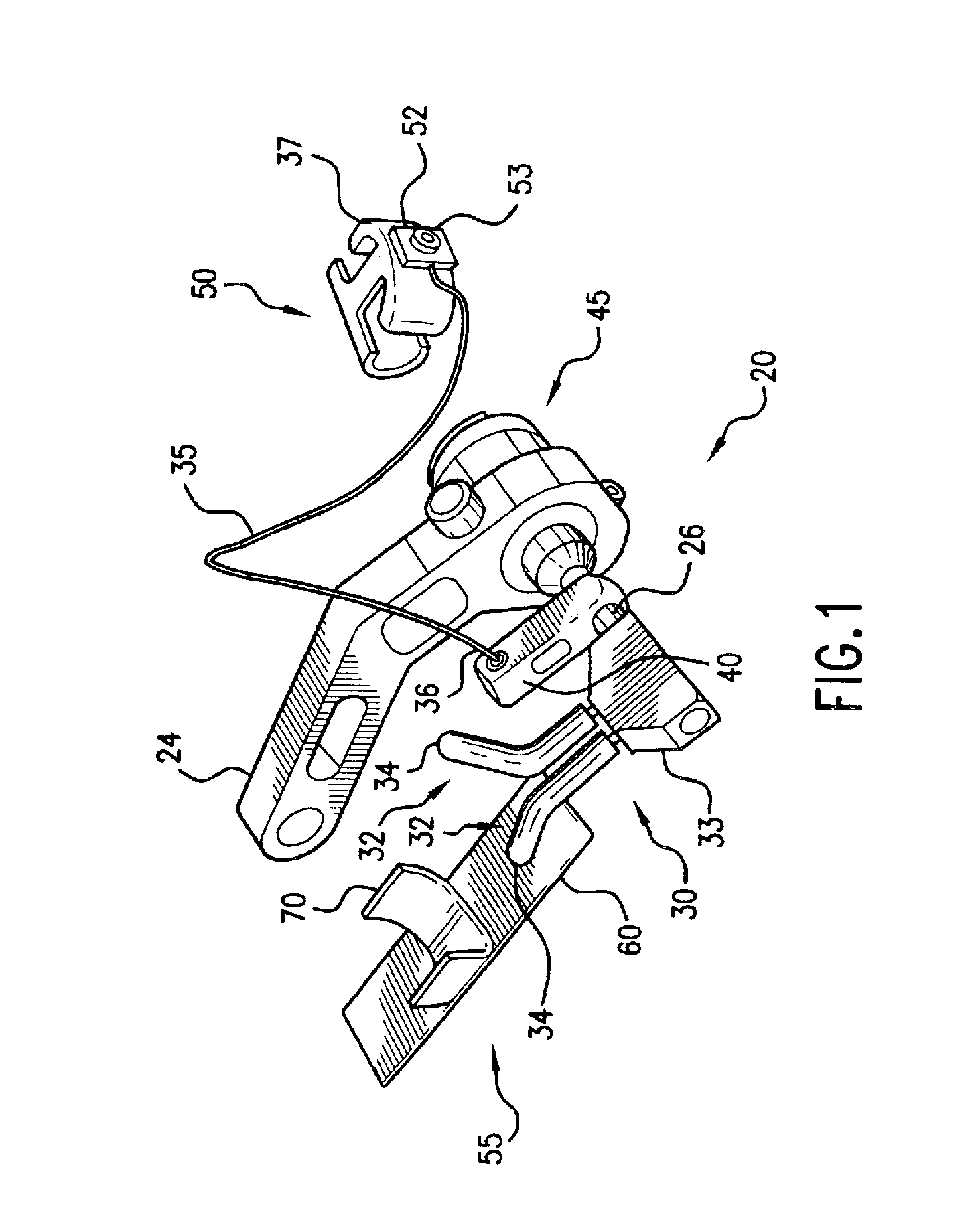
[0012]In one embodiment of this invention, the holding apparatus is wider than a diameter of the arrow shaft and thus the arrow shaft can move, to a limited extent, within the holding apparatus. The limited movement is acceptable because when the arrow rest moves into a loaded position, the arrow rest contacts and self-centers the arrow shaft with respect to the arrow rest and precisely positions the arrow shaft in a shooting window. In one embodiment of this invention, the arrow rest has two prongs that are spaced apart from each other. The prongs can easily center the arrow shaft on the arrow rest by simply using gravity forces.
[0013]In one embodiment of this invention, inside surfaces of walls forming the holding apparatus have a matte finish that provides enough friction between the inside surface and the arrow shaft to hold the arrow shaft within the holding apparatus, even when the archery bow is rotated, tilted or otherwise moved. Such feature allows an archer to mount an arrow by attaching a nock end to the bow string, and place the arrow shaft within the holding apparatus. When the bow string is not drawn back far enough to lift a pivotal arrow rest, in one embodiment, the walls frictionally hold the arrow shaft. Thus, an archer can load an arrow with respect to a bow and place the arrow shaft within the holding apparatus, and then carry the bow through different field conditions, without the arrow shaft falling or otherwise moving away from an area of the bow riser. When an archer spots a target, the archer can then place the archery bow into a firing position. With the pivotal arrow rest according to this invention, the archer can then draw the bow string and thereby pivot the arrow rest into a loaded position, which lifts the arrow shaft out of and away from the holding apparatus. When the arrow is discharged from the archery bow, neither the arrow shaft nor the fletching contact or interfere with the arrow rest or with the holding apparatus.
[0014]When an arrow rest can instantaneously or immediately pivot or otherwise move away from the arrow shaft and the fletching during launch or discharge of an arrow, there is a much greater chance that the arrow rest will not interfere with a flight path of the arrow. The arrow rest according to this invention uses a flexible inelastic member as a linkage between the bow cable and the arrow rest. Because the flexible member of this invention is also inelastic, there is no relatively short time period necessary, such as associated with the previously discussed conventional arrow rests, for the flexible inelastic member of this invention to decrease in length. The flexible inelastic member of this invention instantaneously or immediately overcomes the return bias force and thus the arrow rest of this invention instantaneously or immediately begins acting to move the arrow rest away from the discharged arrow.



 Login to View More
  Login to View More