Compartmentalized field flow fractionation

a fractionation field and fractionation technology, applied in the direction of filtration separation, separation process, instruments, etc., can solve the problems of inability to detect fractions such as correspondingly very low concentrations, associative limitations, and no longer be subject to the cross force needed to continue separation

US8163182B2Active Publication Date: 2012-04-24WYATT TECH
8 Cites 0 Cited by

Patent Information

Authority / Receiving Office
US · United States
Patent Type
Patents(United States)
Current Assignee / Owner
Publication Date
2012-04-24

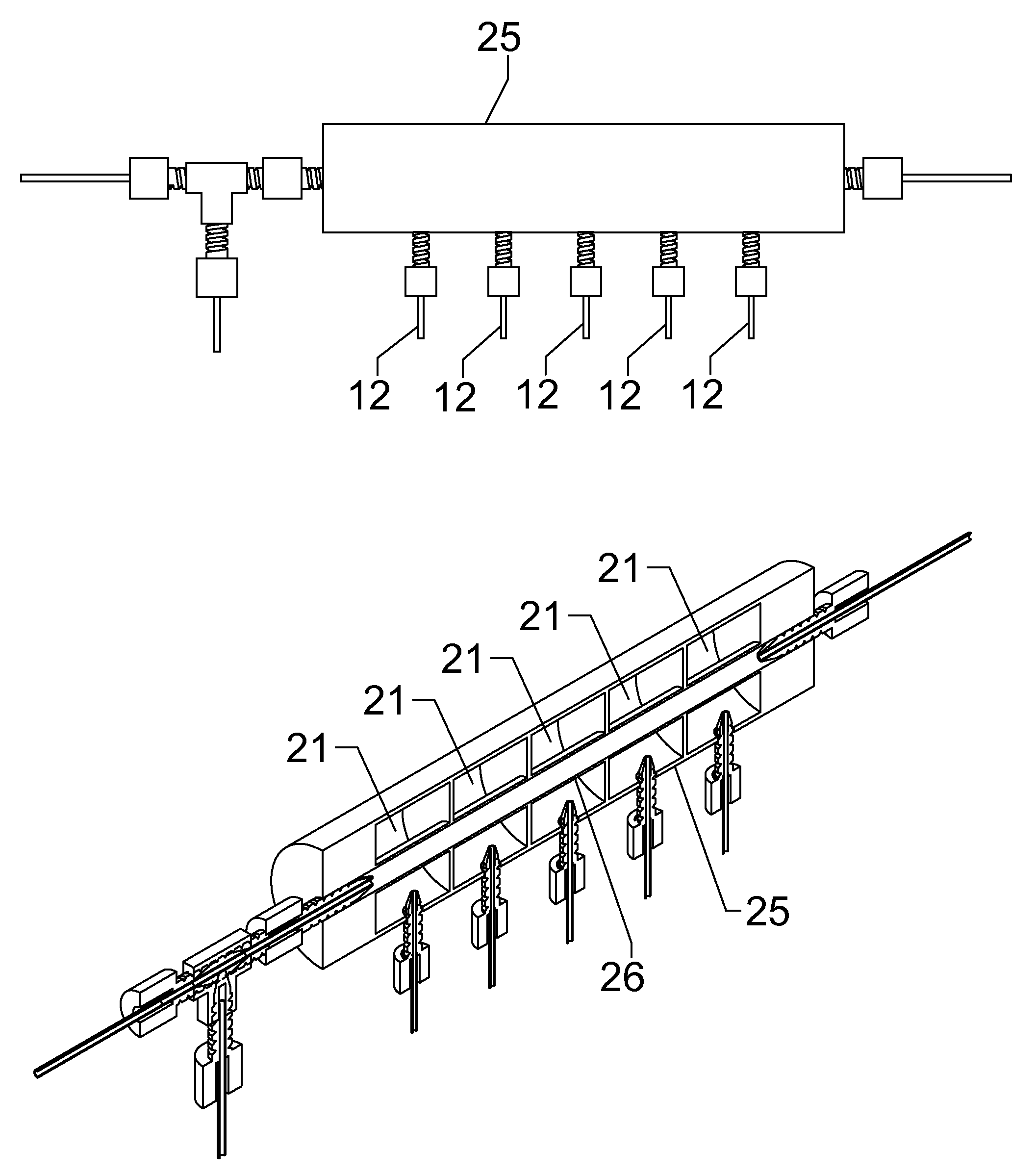
Smart Images

  • Figure 1
    Figure 1
  • Figure 2
    Figure 2
  • Figure 3
    Figure 3
Patent Text Reader

Abstract

A field flow fractionator to separate particles contained within an injected sample aliquot is described. As required, said fractionator may be used to capture, for subsequent removal, specific predefined classes of such particles. Based upon the cross flow or asymmetric flow field flow fractionators, the fractionator disclosed contains means to vary the applied transverse flows at a plurality of locations along the length of its separating channel. A plurality of separated compartments, each lying below a distinct and corresponding membrane supporting permeable frit segment, are provided individual means to control the localized flow through the membrane section thereabove. A corresponding concentric compartment implementation achieves the same type of compartmentalized cross flow when integrated with a hollow fiber fractionator.
Need to check novelty before this filing date? Find Prior Art

Description

RELATED APPLICATIONS AND PATENTS

[0001] The following patents and applications relate to similar characterizations of separated molecules and small particles:

[0002] U.S. Pat. No. 6,774,994, P. J. Wyatt and M. Weida “Method and apparatus for determining absolute number densities of particles in suspension” 10 Aug. 2004.

[0003] P. J. Wyatt, M. H. Chen, and D. N. Villalpando “Method and apparatus for optimizing the separation of small particles using Asymmetric Flow Field Flow Fractionation,” Ser. No. 12 / 157,367, filed 9 Jun. 2008.BACKGROUND

[0004] Throughout this specification, the term “particle” refers to the constituents of liquid sample aliquots that may be molecules of varying types and sizes, nanoparticles, virus like particles, liposomes, emulsions, bacteria, colloids, etc. Their size range may lie between 1 nm and several thousand micrometers.

[0005] The separation of particles in a solution by means of field flow fractionation, FFF, was studied and developed extensively by J. C. Giddi...

Examples

Embodiment Construction

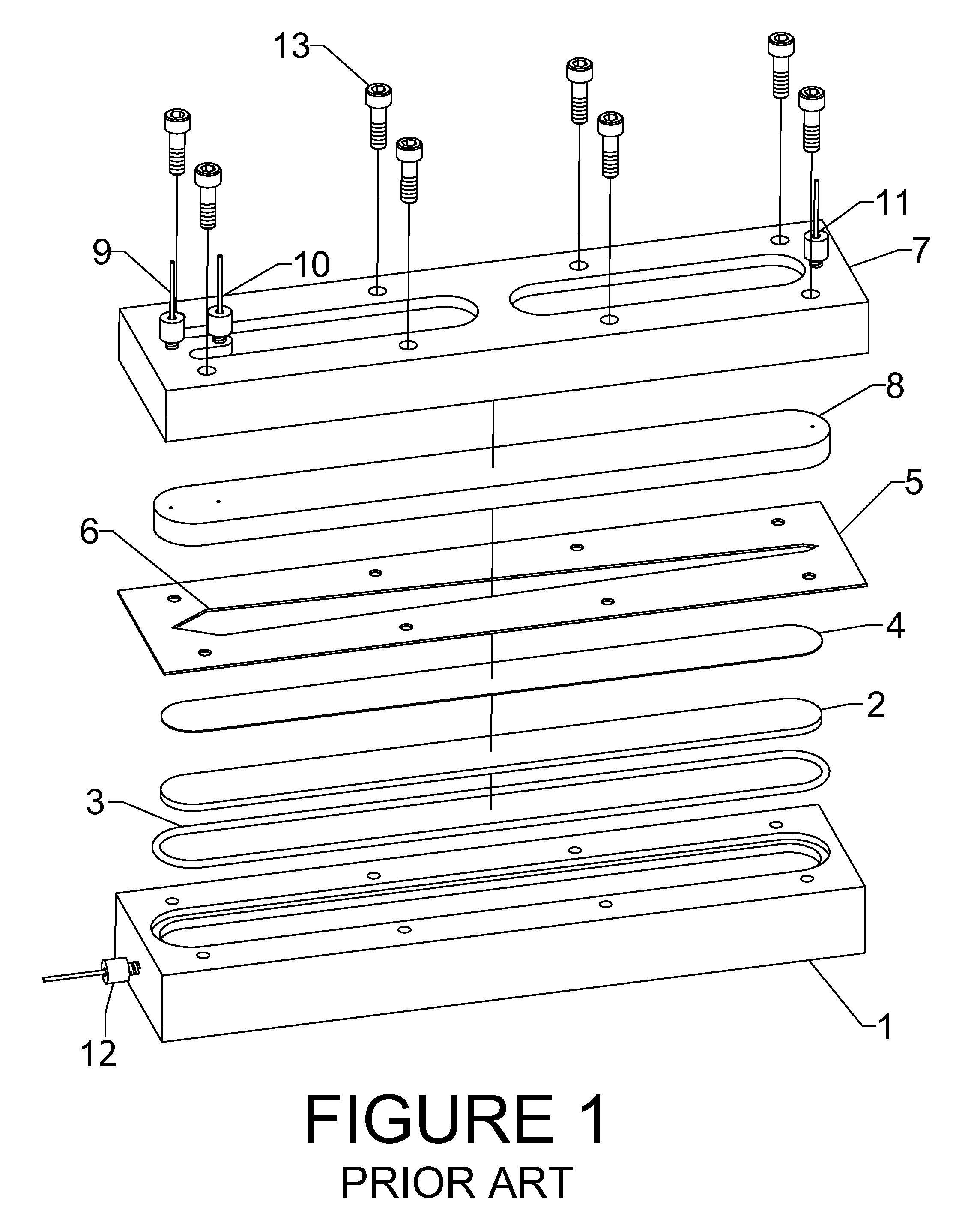
[0034]We begin with a review of the elements of an asymmetric flow FFF channel. The A4F channel, illustrated in FIG. 1, is comprised of the following elements together with means to hold them together:[0035]1) a bottom assembly structure 1 holding a liquid-permeable frit 2 surrounded by a sealing O-ring 3,[0036]2) a permeable membrane 4 that lies on the frit 2,[0037]3) a spacer 5 of thickness from about 75 μm to 800 μm into which has been cut a cavity 6, and[0038]4) a top assembly structure 7 generally holding a transparent plate 8 of material such as Lexan® or glass. The plate need not be transparent for some implementations.

[0039]The resulting sandwich is held together with bolts 13 or other means. The generally coffin-shaped or tapered cavity 6 in the spacer 5 will serve as the channel in which separation will occur. The top assembly structure 7 usually contains three holes, called ports, that pass through the top plate 8 and are centered above the channel permitting the attachme...