
Efficient cell culture system for hepatitis C virus genotype 1A and 1B
a cell culture system and hepatitis c virus technology, applied in the field of infectious recombinant hepatitis c genotype 1 viruses, can solve the problems of hcv research hampered, increased risk of liver cirrhosis, hepatocellular carcinoma, etc., and achieve the effect of enhancing potential
- Summary
- Abstract
- Description
- Claims
- Application Information
AI Technical Summary
Benefits of technology
Problems solved by technology
Method used
Image

Examples
example 1
Development of Viable H77C / JFH1 Recombinants and Homologous Neutralization with Chronic Phase Patient H Serum
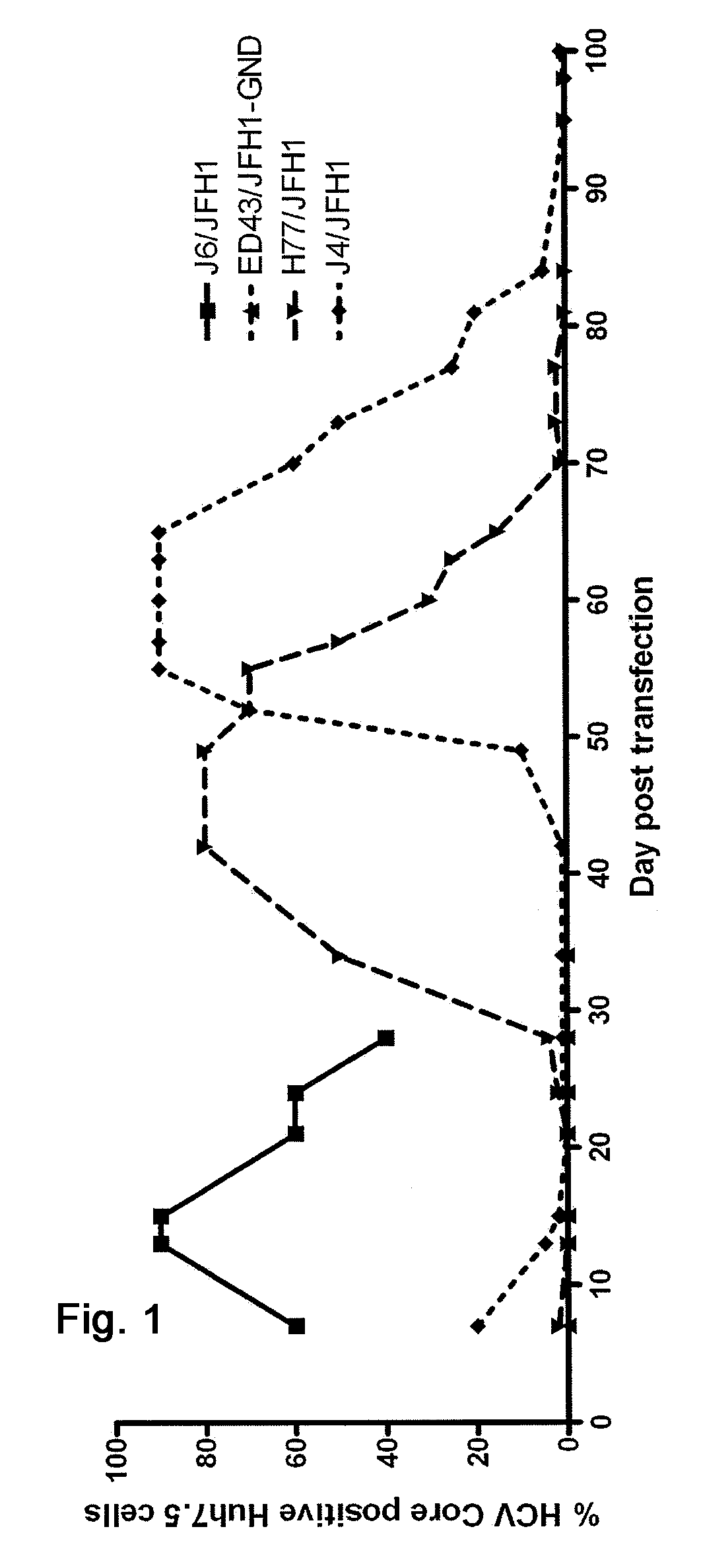
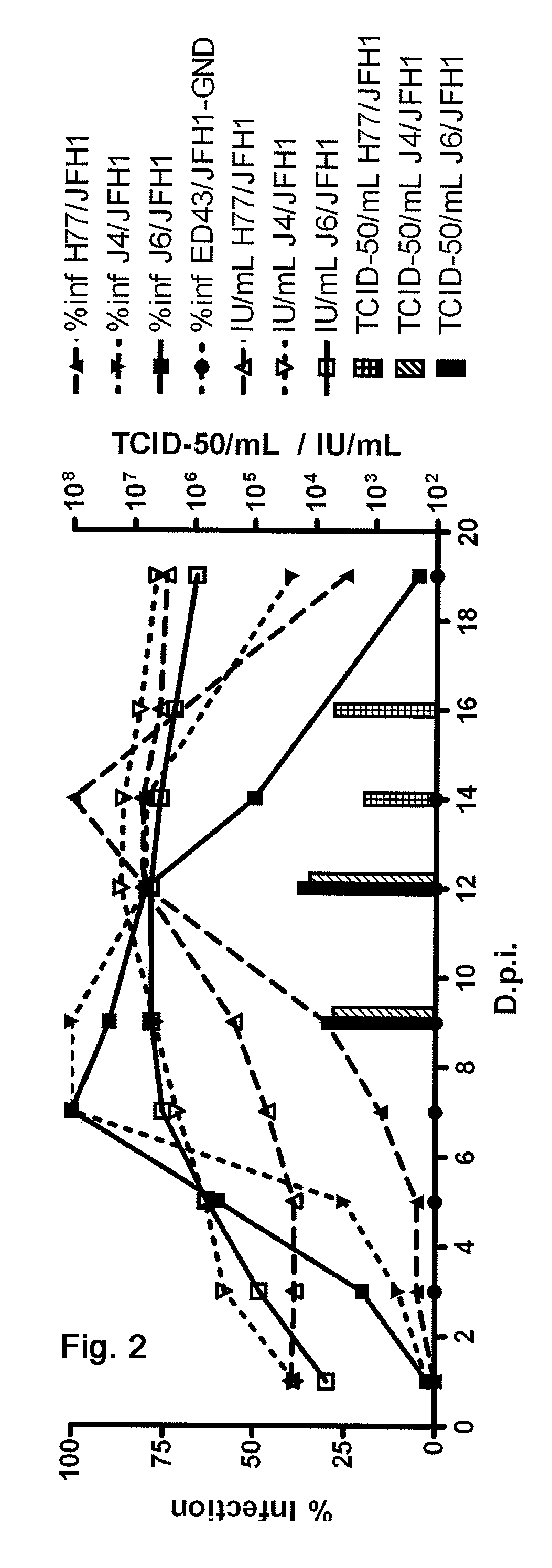
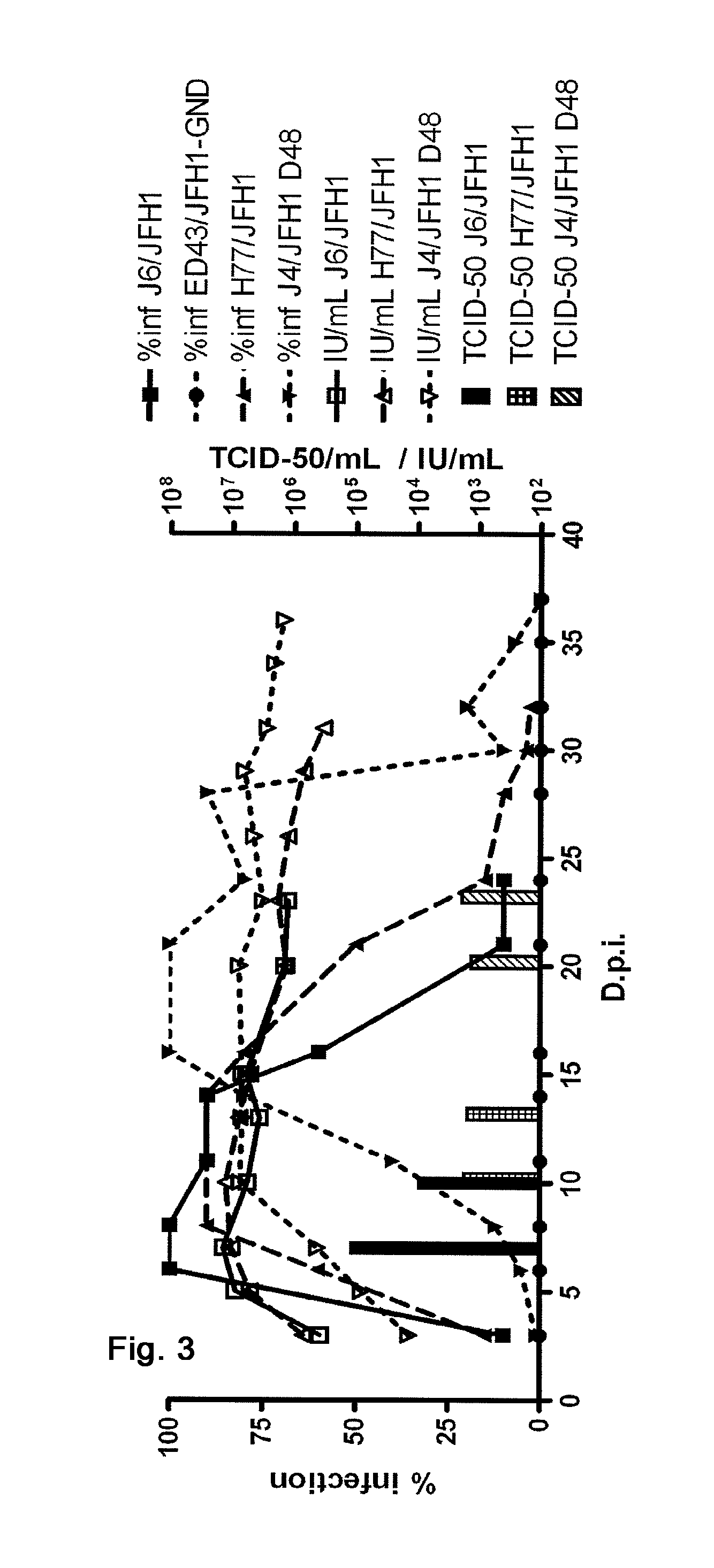
[0390]In order to study homologous neutralization with Patient H sera, the present inventors constructed pH77C / JFH1 with Core-NS2 from H77C. Following two independent transfections H77C / JFH1 spread to most cells after 41 or 19 days of culture, respectively (FIG. 1). Infectious virus could be passed to naïve cells yielding peak infectivity titers of ˜103.5TCID50 / mL and HCV RNA titers of ˜107 IU / mL (FIGS. 2 and 3). Sequencing of the ORF of 1st passage virus from the two transfections identified dominant amino acid changes in p7 and NS3 (V787A and Q1247L) or in NS3 (R1408W), respectively (Table 1). Reverse genetic studies showed that introduction of either Q1247L or R1408W in NS3 allowed production of infectious viral particles with relatively high infectivity titers immediately after transfection (FIGS. 4 and 6). V787A alone did not confer viability (FIG. 6), but continuous pro...
example 2
Testing of Cross-Genotype Neutralization of Genotype 1-6 Recombinant Viruses with 1a and 4a Anti-Sera
[0392]The H061a serum efficiently neutralized ED43 / JFH1-y (4a / JFH1) with a 50% titer of 1:12800, while the AA 4a serum showed low-level neutralization of H77C / JFH1 with a 50% titer of 1:50 (Table 3). To further broaden the investigation of cross-genotype neutralization, serial 2-fold dilutions of 1a and 4a sera were tested against ˜100 TCID50 of JFH1-based recombinant viruses expressing the envelope proteins of genotype 2a, 3a, 5a, and 6a. Genotype 2a and 3a viruses could not be neutralized at a 1:50 dilution of either serum. However, genotype 5a and 6a viruses were efficiently neutralized by both sera with 50% neutralization titers of at least 1:3200 (Table 3).
example 3
Development of Viable J4 / JFH1 Recombinants
[0393]In order to be able to do HCV genotype 1b specific functional analyses and development of drug and vaccine candidates, the present inventors constructed pJ4 / JFH1 with Core-NS2 from J4. Following transfection J4 / JFH1 spread to most cells after 50 days of culture (FIG. 1). Infectious virus could be passed to naïve cells yielding peak infectivity titers of ˜104 TCID50 / mL and HCV RNA titers of ˜107 IU / mL (FIGS. 2 and 3). Sequencing of the ORF of 1st passage virus from the two transfections identified dominant amino acid changes in NS2, NS3 and NS5B (F886L, Q1496L and S2484P, Table 2). Additional mutations acquired after 2nd passage of virus to naïve cells are listed in Table 2. Reverse genetic studies showed that introduction of either F886L, Q1496L, F886L and Q1496L or F886L, Q1496L and S2484P in combination allowed production of infectious viral particles with relatively high infectivity titers immediately after transfection (FIGS. 7 and...
PUM
| Property | Measurement | Unit |
|---|---|---|
| polarity | aaaaa | aaaaa |
| genetic heterogeneity | aaaaa | aaaaa |
| length | aaaaa | aaaaa |
Abstract
Description
Claims
Application Information
 Login to View More