Articulated bed-mounted finned-spar-buoy designed for current energy absorption and dissipation

a technology of current energy absorption and dissipation, which is applied in the direction of groynes, special-purpose vessels, transportation and packaging, etc., can solve the problems of buoy motions that become unstable at certain current speeds, ship handling and shoreline erosion, and navigation problems, so as to prevent the drift of sand bars

US8814469B2Active Publication Date: 2014-08-26MURTECH
28 Cites 5 Cited by

Patent Information

Authority / Receiving Office
US · United States
Patent Type
Patents(United States)
Current Assignee / Owner
Publication Date
2014-08-26

Smart Images

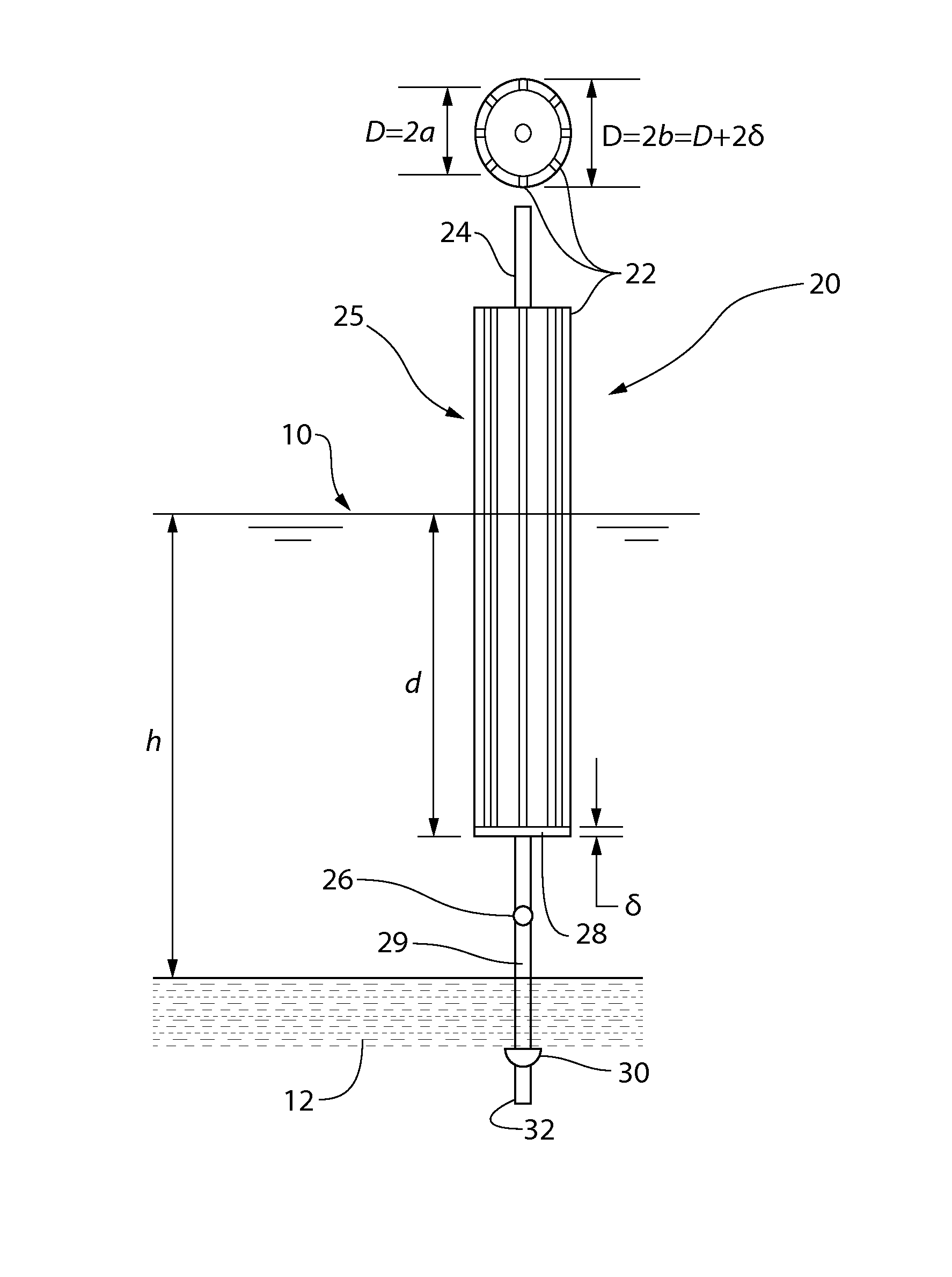
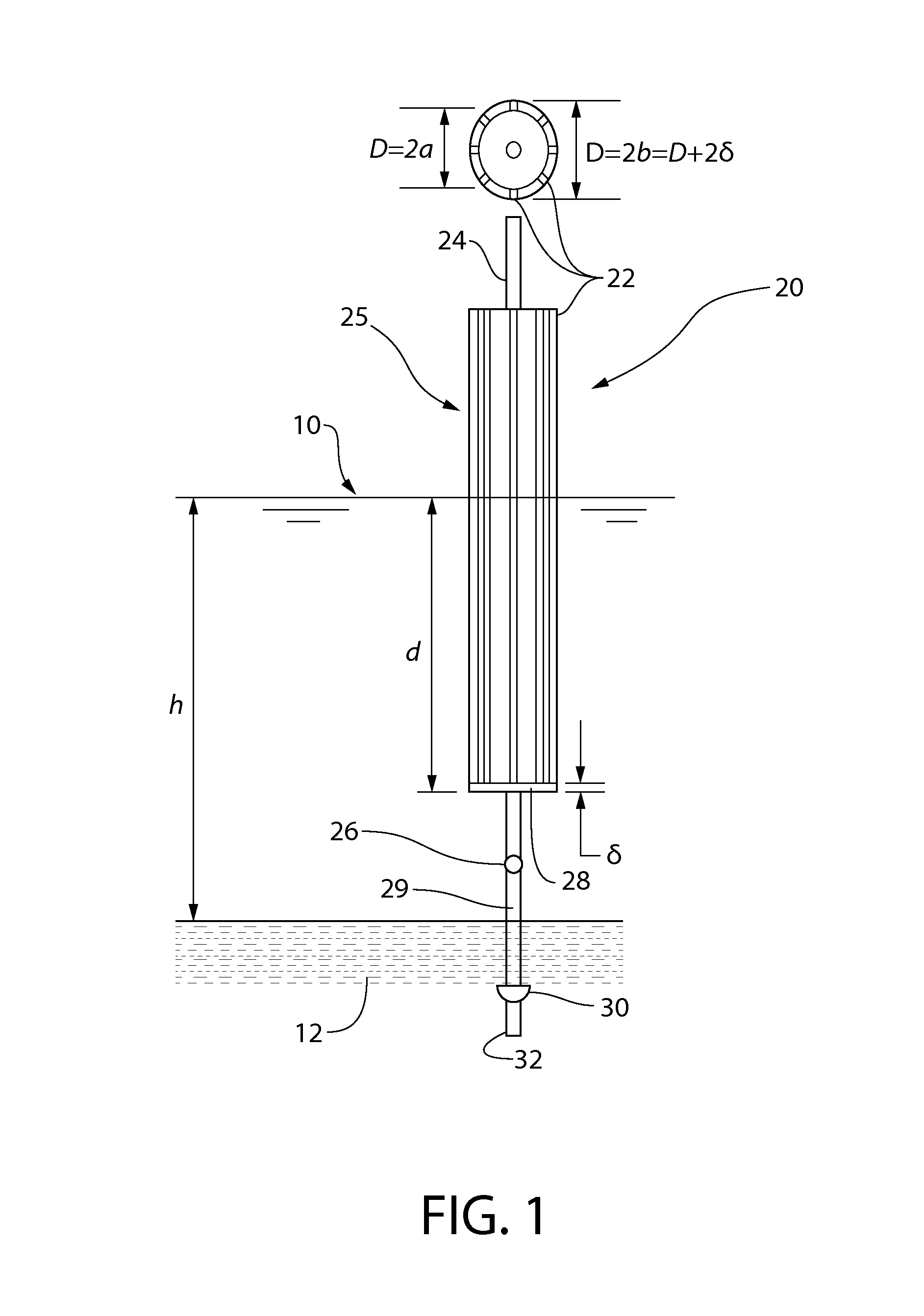
  • Figure 1
    Figure 1
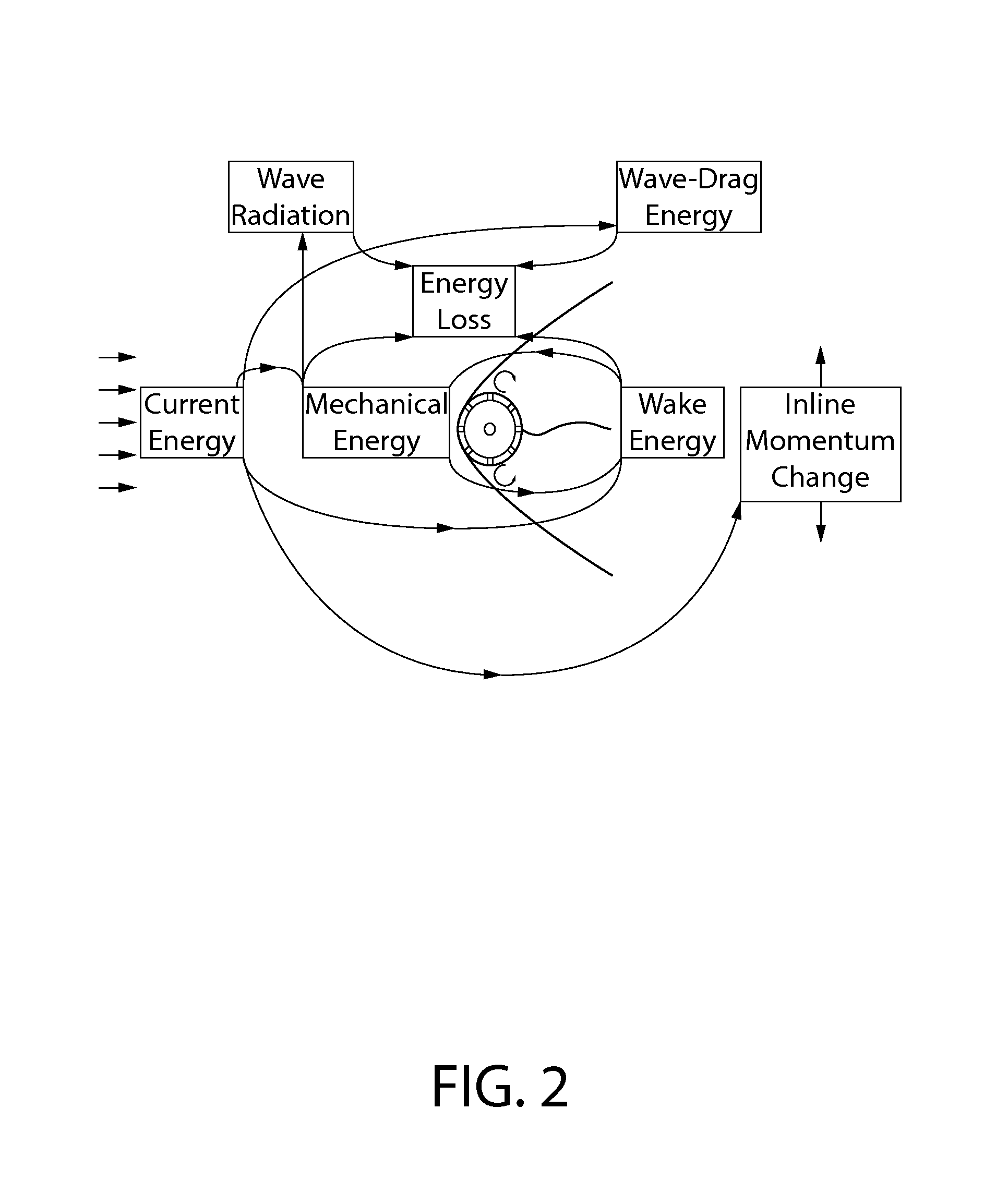
  • Figure 2
    Figure 2
  • Figure 3
    Figure 3
Patent Text Reader

Abstract

A constrained buoy experiencing vortex-induced, in-line and transverse angular motions and designed to absorb and attenuate the energies of streams, rivers and localized ocean currents is described. Referred to as a Finned-Spar-Buoy (FSB), the buoy design can be considered an exoskeleton, in that vertical fins are externally mounted on a vertical cylindrical float. The fins increase the drag coefficient by enhancing the wake losses. The FSB operates as a single unit or as a component of an array, depending on the application. The FSB can adjust to high-water events caused by tides, storm surges or spring-melting runoffs because the FSB can move axially along a center-staff which is attached to an anchor pole at a pivot point. The buoy-staff system is allowed to rotate in any angular direction from the vertical, still-water orientation of the center-staff. The FSB has a relatively small diameter-to-draft ratio, analytically qualifying the buoy as a slender-body.
Need to check novelty before this filing date? Find Prior Art

Description

STATEMENT REGARDING FEDERALLY SPONSORED RESEARCH OR DEVELOPMENT

[0001] “Not Applicable”FIELD OF THE INVENTION

[0002] This invention relates generally to floating systems including at least one buoy arranged to absorb and attenuate the energies of streams, rivers and localized ocean currents, and thus stabilize underwater sand bars.BACKGROUND OF THE INVENTION

[0003] For many years, strong river and tidal currents have posed problems in navigation, ship handling and shoreline erosion. The navigation problem in rivers stems from the fact that the currents cause bed erosion up-river and accretion down-river. The current, then, causes the accreted beds to meander. This is particularly true on the Mississippi River system, where bars appear at bends and, then, disappear. The U. S. Coast Guard has been responsible for marking these meandering bars. In order to warn mariners of the presence of sand bars, fast-water buoys have been deployed by the Coast Guard. These fast-water buoys have two major...

Examples

example

[0133]Sand bars in the Mississippi-Missouri river system pose navigation problems for the mariners on the rivers. As stated earlier, these bars are normally marked by fast-water buoys by the U. S. Coast Guard. Unfortunately, these buoys are at times lost due to either boat collisions or extreme flow events. In addition, the bars appear, disappear and migrate near river bends. As a result, a fast-water buoy might be at a site formerly occupied by a bar. The new position of the bar would, then, be unmarked and, as a result, the bar would be a navigation hazard.

[0134]In the Mississippi-Missouri river system, the approximate nominal current range is from 3 ft / s to 10 ft / s. Consider the deployment of an 8-fin FSB in 6 feet of water, where the current is uniform from the bed to the free surface. Referring to the sketch in FIG. 1, the draft (d) of the FSB is 5.5 ft, and the spring-loaded hinge is at z=−R=−6 ft. That is, the point of rotation is on the bed. The free-board of the FSB is 3 ft...