Check patentability & draft patents in minutes with Patsnap Eureka AI!

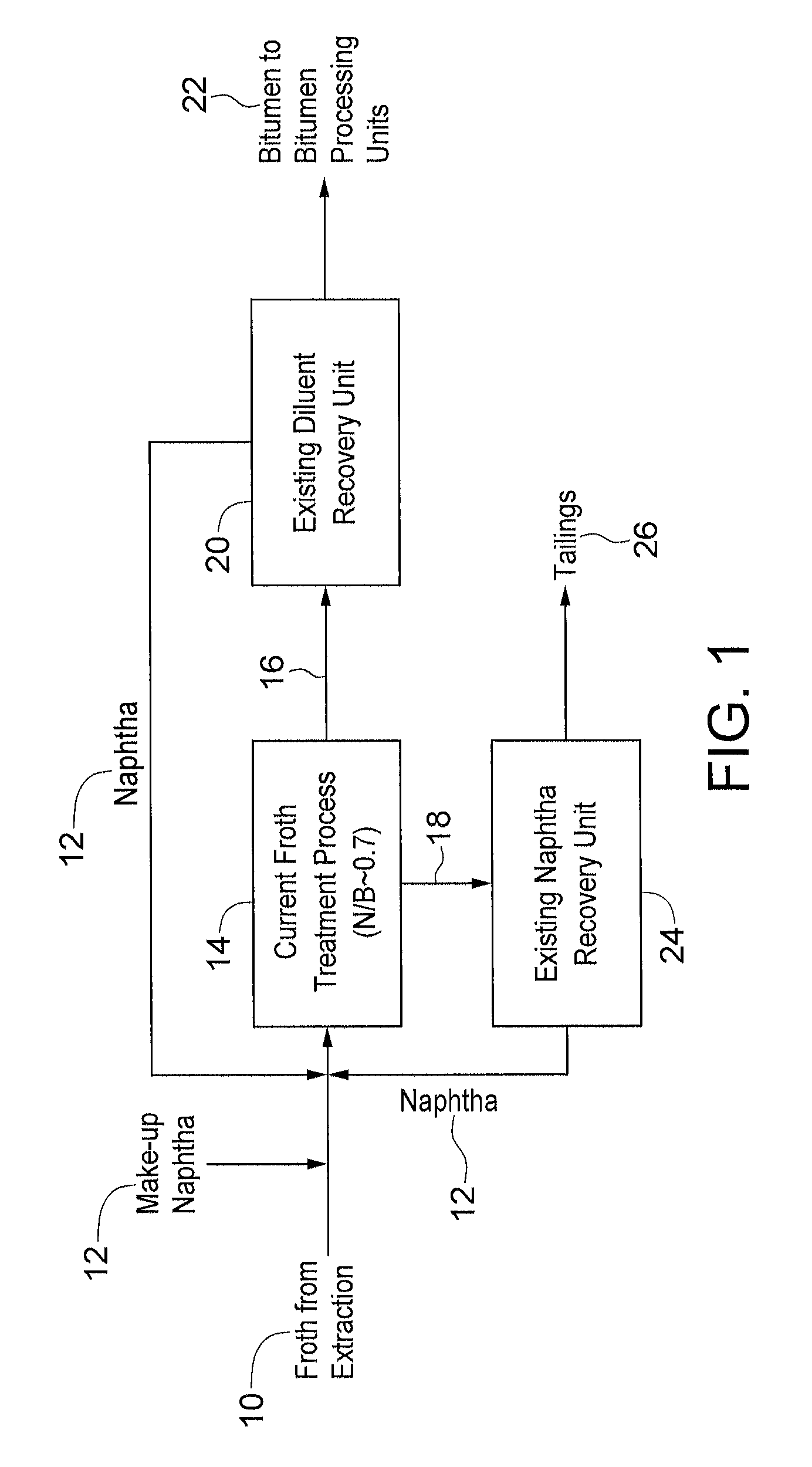
Naphtha based fungible bitumen process

a technology of fungible bitumen and naphtha, which is applied in the field of oil sands processing, can solve the problems of high loss of bitumen to froth treatment tailings, inability to sell to the open market, and inability to diluted bitumen to be directly piped to conventional refineries

Inactive Publication Date: 2014-10-21
SYNCRUDE CANADA LTD
View PDF7 Cites 0 Cited by
  • Summary
  • Abstract
  • Description
  • Claims
  • Application Information

AI Technical Summary

Benefits of technology

The process effectively reduces water and solids concentrations in bitumen to less than 0.5 vol %, enabling the production of marketable, fungible bitumen that can be directly pipelined to refineries, enhancing production flexibility and reducing upgrading costs.

Problems solved by technology

However, paraffinic type diluents precipitate a major proportion of asphaltenes from the bitumen froth, resulting in not only the trapping of water and solids by the asphaltenes, but also high bitumen losses (about 8%) to froth treatment tailings.
Due to the level of contamination which pose fouling and corrosion problems, the diluted bitumen is not suitable for direct pipelining to conventional refineries, cannot be sold to the open market, and must be upgraded using processes such as a coker or hadrocracker.
The inability to produce marketable diluted bitumen product from conventional naphtha-based processes is an impediment to the oil sands industry.
The opening of future mines creates a potential scenario that the current bitumen processing capacity may be insufficient to handle the quantity of bitumen product.

Method used

the structure of the environmentally friendly knitted fabric provided by the present invention; figure 2 Flow chart of the yarn wrapping machine for environmentally friendly knitted fabrics and storage devices; image 3 Is the parameter map of the yarn covering machine
View more

Image

Smart Image Click on the blue labels to locate them in the text.
Viewing Examples
Smart Image
  • Naphtha based fungible bitumen process
  • Naphtha based fungible bitumen process
  • Naphtha based fungible bitumen process

Examples

Experimental program
Comparison scheme
Effect test

example 1

[0032]An experimental run was conducted in which bitumen froth was directly fed with naphtha at various naphtha-to-bitumen ratios. The average froth compositions based on duplicate samples were 49.3% bitumen, 36.1% water and 14.6% solids. The naphtha-based froth treatment processes were simulated using a standard jar test for gravity based process and cold spin test for the centrifuge based process. Diluted bitumen water content was determined by Karl-Fischer titration. The percent water in diluted bitumen was based on an average of two samples. The results are summarized in Table 1:

[0033]

TABLE 1Weight Percent Water in Diluted BitumenNaphtha-to-BitumenGravity-Based SeparationCentrifuge-BasedRatio(wt %)Separation (wt %)0.73.672.442.01.040.644.00.350.1810.00.01N / A

[0034]The results in Table 1 show that as the naphtha-to-bitumen ratio increases, the percent water in the diluted bitumen decreases for both the gravity and centrifuge-based separation. For comparison, a naphtha-to-bitumen r...

example 2

[0035]An experimental run was conducted in which diluted bitumen obtained from an IPS unit was directly fed with naphtha at various naphtha-to-bitumen ratios. Diluted bitumen at a naphtha-to-bitumen ratio of about 0.7 was obtained from an IPS unit. In this sample, the average IPS product contained about 2 wt % water and about 1 wt % solids. The naphtha-based fungible bitumen process was simulated using a standard jar test for the gravity based process. The water content in the diluted bitumen was determined by Karl-Fischer titration. The percent water in fungible bitumen product as a function of settling time is presented in FIG. 4.

[0036]The results show that as the naphtha-to-bitumen ratio increases, the percent water in diluted bitumen decreases. The fungible bitumen water and solids content of 0.5 vol % or less was achieved at a naphtha-to-bitumen ratio of 1.8 for the gravity based process. Achieving the required specification was not attributable to a dilution effect as demonstr...

example 3

[0037]In this example, diluted bitumen obtained from convention bitumen froth treatment when using inclined plate settlers is used as the feed and mixed with various amounts of naphtha to give naphtha-to-bitumen ratios of about 1.8 to about 9.07. The resultant further diluted bitumen component was analyzed for both water content and solids content. The results are shown in Table 2.

[0038]

TABLE 2Water toSolids toSum ofAverageWater,Solids,Hydrocarbon,Bitumen,Naphtha,Bitumen,Bitumen,(Water + Solids) / N / Bwt %wt %wt %wt %wt %vol %vol %Bitumen, vol %1.800.0170.0999.89335.66464.2290.0490.250.303.630.0050.0599.94521.59678.3490.0230.230.255.370.0070.0599.94315.69784.2460.0470.320.375.800.0070.0699.93314.68785.2450.0510.410.467.080.0050.0499.95512.37587.5800.0400.320.369.070.0000.0299.9809.93090.0500.0000.200.20

As can be seen in Table 2, even at N / B ratios as low as 1.8, the diluted bitumen product consists of 0.017 wt % water and 0.09 wt % solids. The vol % of the sum of the water and solids t...

the structure of the environmentally friendly knitted fabric provided by the present invention; figure 2 Flow chart of the yarn wrapping machine for environmentally friendly knitted fabrics and storage devices; image 3 Is the parameter map of the yarn covering machine
Login to View More

PUM

PropertyMeasurementUnit
wt %aaaaaaaaaa
wt %aaaaaaaaaa
wt %aaaaaaaaaa
Login to View More

Abstract

The invention is directed to a process for cleaning bitumen froth by mixing a sufficient amount of naphtha with the bitumen froth to provide a naphtha-to-bitumen ratio within the range of about 4.0 (w / w) to about 10.0 (w / w) and separating substantially dry diluted bitumen from the water and solids. Also provided is a process for cleaning diluted bitumen by mixing a sufficient amount of naphtha with the diluted bitumen to provide a naphtha-to-bitumen ratio equal to or greater than about 1.8 (w / w) and separating marketable fungible raw bitumen from the water and solids.

Description

FIELD OF THE INVENTION[0001]The present invention relates generally to the field of oil sands processing, particularly to processes of cleaning bitumen froth or diluted bitumen using naphtha.BACKGROUND OF THE INVENTION[0002]Oil sand deposits such as those found in the Athabasca Region of Alberta, Canada, generally comprise water-wet sand grains held together by a matrix of viscous heavy oil or bitumen. Bitumen is a complex and viscous mixture of large or heavy hydrocarbon molecules which contain a significant amount of sulfur, nitrogen and oxygen. Oil sands processing involves extraction and froth treatment to produce diluted bitumen which is further processed to produce synthetic crude oil and other valuable commodities. Extraction is typically conducted by mixing the oil sand in hot water and aerating the resultant slurry to promote the attachment of bitumen to air bubbles, creating a lower-density bitumen froth which floats and can be recovered in a separator such as a gravity se...

Claims

the structure of the environmentally friendly knitted fabric provided by the present invention; figure 2 Flow chart of the yarn wrapping machine for environmentally friendly knitted fabrics and storage devices; image 3 Is the parameter map of the yarn covering machine
Login to View More

Application Information

Patent Timeline
no application Login to View More
Patent Type & Authority Patents(United States)
IPC IPC(8): C10G1/04
CPCC10G1/045
Inventor NG, YIN MING SAMSONKNAPPER, BRIANKRESTA, JIM
Owner SYNCRUDE CANADA LTD
Features
  • R&D
  • Intellectual Property
  • Life Sciences
  • Materials
  • Tech Scout
Why Patsnap Eureka
  • Unparalleled Data Quality
  • Higher Quality Content
  • 60% Fewer Hallucinations
Social media
Patsnap Eureka Blog
Learn More