
Environment friendly blast furnace stemming
An environment-friendly blast clay technology, applied in the field of refractory materials, can solve the problems of poor adaptability, large quality fluctuation, and high consumption of blast clay, and achieve the effects of low labor intensity, strong slag resistance, and low iron consumption
Patent Information
- Authority / Receiving Office
- CN · China
- Patent Type
- Patents(China)
- Current Assignee / Owner
- Publication Date
- 2013-08-21
Smart Images
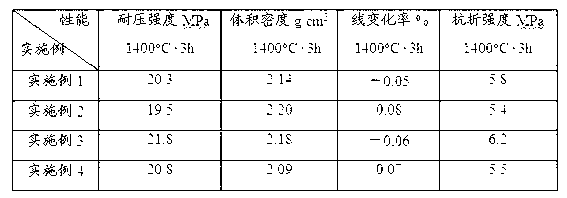
Figure 1
Abstract
Description
technical field
[0001] The invention relates to the field of refractory materials, in particular to an environment-friendly blast furnace clay. Background technique
[0002] At present, most blast furnace clays use tar and asphalt as binders, which have the following disadvantages: (1) The coke content of the binder is about 25%, which is high, resulting in low bonding strength of the clay and easy fracture at high temperature; (2) During production It is easy to break the iron hole and it is difficult to open the iron hole, which affects the normal production of the blast furnace and reduces the service life of the blast furnace; (3) A lot of black smoke will come out of the opening during the tapping process, which will not only cause air pollution, but also take away some (4) The content of carcinogens such as benzopyrene and benzene in the binder is high, especially the content of benzopyrene is as high as 10000ppm. With the black smoke coming out, it enters the air and ...
Examples
Embodiment 1
[0022] for 3200m 3 Blast furnace clay, the parts by weight of its components are as follows: corundum: 5 parts, alumina powder: 20 parts, silicon carbide: 20 parts, composite clay: 20 parts, composite powder: 25 parts, rutile powder: 3 parts , ferrosilicon nitride: 6.8 parts, wetting agent: 0.2 parts; modified asphalt obtained after fractionation: 13 parts; wherein the composite powder is a mixture of silicon oxide and boron carbide with a weight ratio of 1:2, and the composite clay is A mixture of equal weights of kaolin and ball clay. The above-mentioned gun mud adopts the following method to prepare: in the mud rolling machine, 65 o After rolling for 30 minutes, the block will be cut into slices, and then the sliced material will be added to the extruder to be extruded into strips for output.
Embodiment 2
[0024] for 4700m 3 Blast furnace clay, the parts by weight of its components are as follows: corundum: 20 parts, homogenized bauxite: 10 parts, silicon carbide: 15 parts, composite clay: 15 parts, composite powder: 19.5 parts, rutile powder: 5 parts, ferrosilicon nitride: 15 parts, wetting agent: 0.5 parts; modified binder added with 5~10% of total weight of sodium peroxide: 20 parts; the weight ratio of composite powder is 1:1:6 It is a mixture of titanium oxide, aluminum oxide and boron carbide, and the composite clay is a mixture of kaolin, ball clay and bentonite in equal weight. The above-mentioned gun mud adopts the following method to prepare: in the mud rolling machine 75 o After rolling for 30 minutes, the block will be cut into slices, and then the sliced material will be added to the extruder to be extruded into strips for output.
Embodiment 3
[0026] for 2500m 3 Blast furnace clay, the parts by weight of its components are as follows: corundum: 12 parts, alumina powder: 30 parts, silicon carbide: 15 parts, composite clay: 10 parts, composite powder: 18 parts, rutile powder: 1 part , ferrosilicon nitride: 13.5 parts, wetting agent: 0.5 parts; modified binder: 17 parts; wherein the composite powder is a mixture of magnesium oxide, calcium oxide and silicon carbide in a weight ratio of 1:1:5. The above-mentioned gun mud adopts the following method to prepare: in the mud rolling machine 70 o After rolling for 35 minutes, the block will be cut into slices, and then the sliced material will be added to the extruder and extruded into strips for output.