
Magnesium-based alloy
A magnesium-based alloy, weight percent technology, applied in the field of metal material processing, can solve the problems of inability to meet the requirements of thin-walled and ultra-thin 3C products, poor magnesium alloy strength, casting performance and corrosion resistance, etc. Castability, strong activity, proportion and application value improvement effect
Patent Information
- Authority / Receiving Office
- CN · China
- Current Assignee / Owner
- Publication Date
- 2015-06-03
- Estimated Expiration
- Not applicable · inactive patent
Smart Images

Figure 1 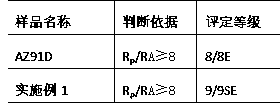
Figure 2 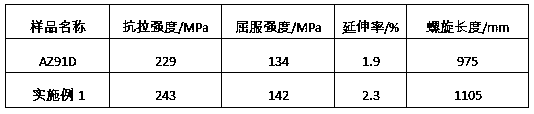
Figure 3
Abstract
Description
technical field
[0001] The invention relates to the technical field of metal material processing, in particular to a magnesium-based alloy applied to ultra-thin 3C products. Background technique
[0002] Magnesium alloy is an alloy composed of magnesium and other elements. It is the lightest material in structural engineering. It has excellent characteristics of small specific gravity, high rigidity, good vibration damping, good resistance to electromagnetic interference, good heat dissipation, and good texture. , are widely used in aerospace, transportation, chemical industry, rocket and other fields.
[0003] 3C electronic products refer to the combination of computer (Computer), communication (Communication) and consumer electronics (Consumer Electronics). Usually, the wall thickness of magnesium alloy 3C products is more than 0.8mm; and ultra-thin consumer electronic products The wall thickness is about 0.45-0.80mm, and the emergence of thin-walled products also puts fo...
Examples
Embodiment 1
[0031] A magnesium-based alloy of the present invention is used as a material for 3C cover products of 0.70-0.80 mm, or for casting, or as a machinable material, and its raw materials and weight percentages are:
[0032] Aluminum (Al): 9.23%, Zinc (Zn): 0.73%, Manganese (Mn): 0.095%, Silicon (Si): 0.049%,
[0033] Cerium (Ce): 0.31%, Lanthanum (La): 0.56%, Strontium (Sr) 0.15%, and the balance is magnesium and impurities caused by the manufacturing process.
[0034] The composition of the magnesium-based alloy in Example 1 is compared with the composition of the commercially available AZ91D magnesium alloy as shown in Table 1.
[0035] The magnesium-based alloy of embodiment 1 and the commercially available AZ91D magnesium alloy are tested for corrosion resistance, mechanical properties and casting properties, and the results are shown in chart 2 and chart 3
[0036] After testing, as shown in Table 2, the corrosion resistance of the magnesium-based alloy in Example 1 is high...
Embodiment 2
[0038] A magnesium-based alloy of the present invention is used as a material for 3C cover products of 0.60-0.70 mm, or for casting, or as a machinable material, and its raw materials and weight percentages are:
[0039] Aluminum (Al): 9.01%, zinc (Zn): 0.69%, manganese (Mn): 0.75%, silicon (Si): 0.042%, cerium 0.31%, lanthanum 0.56%, strontium 0.15%, samarium (Sm) 0.5% , and the balance is magnesium and impurities caused by the manufacturing process.
[0040] The composition of the magnesium-based alloy in Example 2 is compared with the composition of the rare earth magnesium alloy in Example 1 as shown in Table 4.
[0041] Corrosion resistance, mechanical properties and casting properties were tested on the magnesium-based alloy of Example 2 and the magnesium-based alloy of Example 1, and the results are shown in Table 5 and Table 6.
[0042] After testing, as shown in Table 5, the corrosion resistance of the magnesium-based alloy of Example 2 is higher than that of Example...
Embodiment 3
[0044]A magnesium-based alloy of the present invention is used as a material for 3C cover products of 0.45-0.60 mm, or for casting, or as a machinable material, and its raw materials and weight percentages are:
[0045] Aluminum (Al): 9.43%, zinc (Zn): 0.70%, manganese (Mn): 0.070%, silicon (Si): 0.039%, cerium 0.31%, lanthanum 0.56%, samarium 0.5%, strontium 0.15%, titanium ( Ti) 0.15%, the balance is magnesium and impurities caused by the manufacturing process.
[0046] The composition of the magnesium-based alloy in Example 3 is compared with the composition of the magnesium-based alloy in Example 2 as shown in Table 7.
[0047] The magnesium-based alloy of embodiment 3 and the magnesium-based alloy of embodiment 2 are tested for corrosion resistance, mechanical properties and casting performance, and the results are shown in chart 8 and chart 9
[0048] After testing, as shown in Table 8, the corrosion resistance of the magnesium-based alloy of Example 3 is higher than th...