
Primer and probe sequences and applications of primers and probes for detection of Edwardsiella tarda lamp‑lfd
A LAMP-LFD, Edwards tarda technology, applied in the field of primers and probe sequences for detecting Edwardian tarda, to achieve the effect of obvious results, clear and obvious detection results, and simple operation
Patent Information
- Authority / Receiving Office
- CN · China
- Patent Type
- Patents(China)
- Current Assignee / Owner
- Publication Date
- 2017-12-26
Smart Images
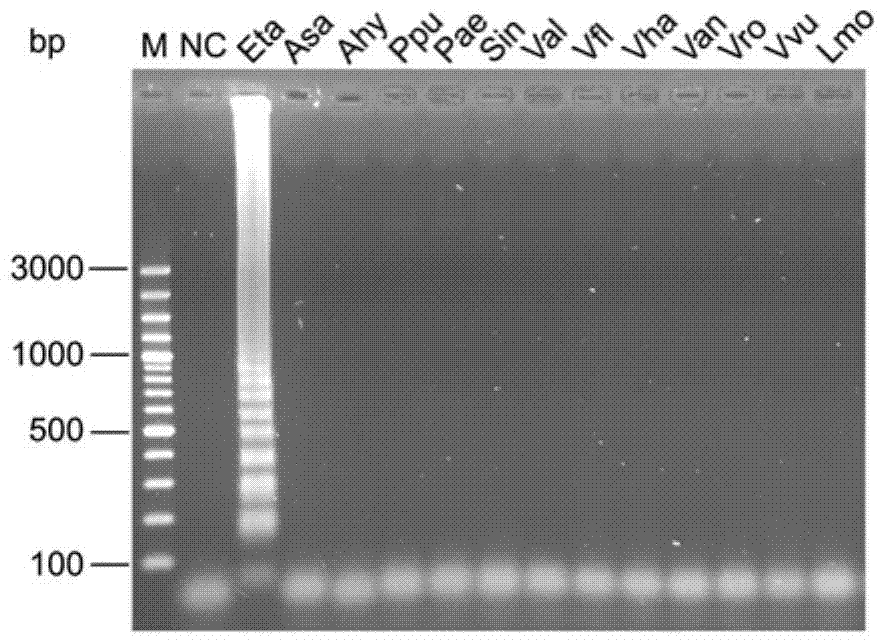
Figure 1 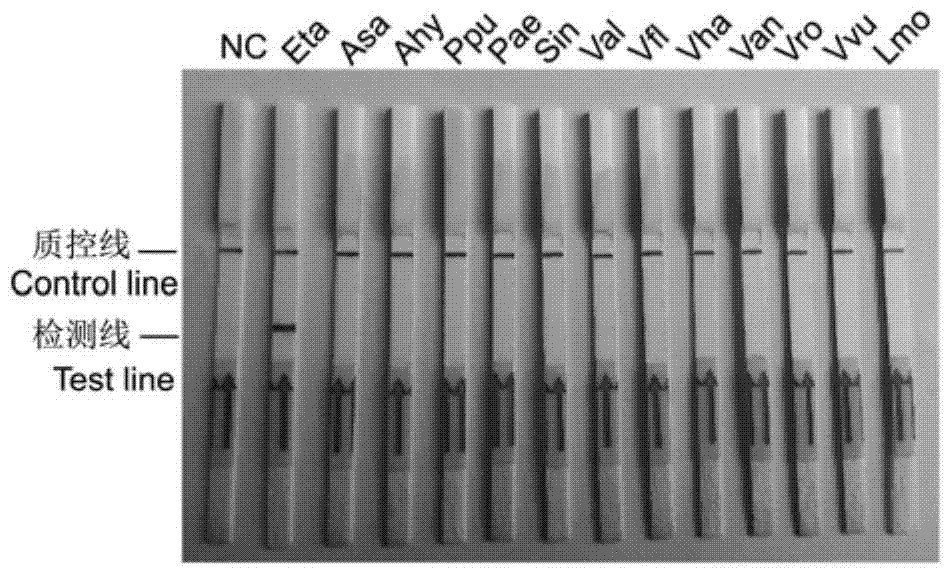
Figure 2 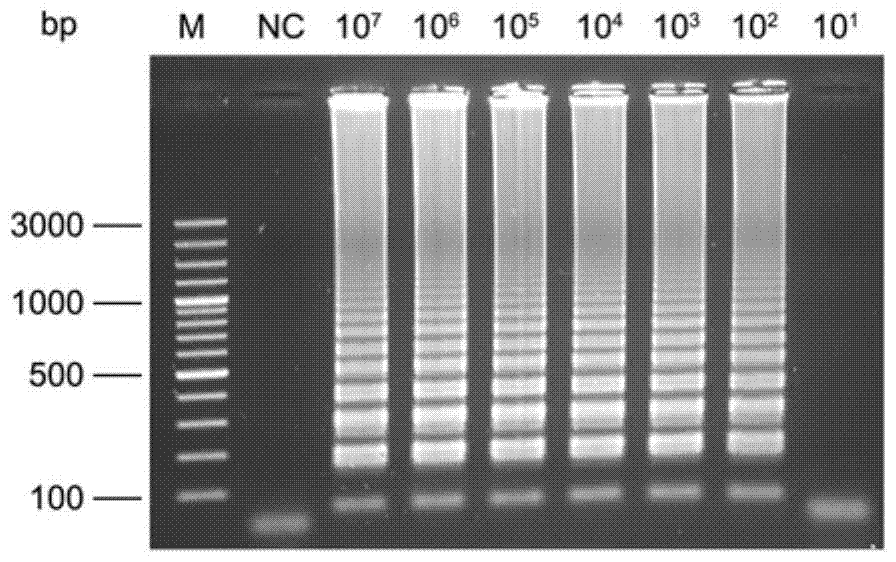
Figure 3
Abstract
Description
technical field
[0001] The invention relates to a primer and a probe sequence for detecting Edwardsiella tarda, in particular to a primer and a probe sequence for detecting Edwardsiella tarda LAMP-LFD and the application of the primer and the probe. Background technique
[0002] Edwardsiella tarda ( Edwardsiella tarda ) is a Gram-negative short bacillus belonging to the family Enterobacteriaceae and the genus Edwardsiella. It has a wide host range and can infect fish, amphibians, reptiles, and mammals including humans. The bacterium is ubiquitous in freshwater and seawater environments, and water transmission is an important transmission route of Edwardsiella tarda. The deterioration of the water environment can easily lead to the outbreak of the disease. Fish is the most common host of Edwardsiella tarda, which can infect more than 20 types of marine and freshwater fish including flounder, turbot, eel, carp, tilapia, etc., resulting in thick sores on the body surface, skin...
Examples
Embodiment 1
[0036] Establishment of a method for the detection of Edwardsiella tarda by LAMP-LFD technique
[0037] 1. Primer design: Design according to the coding sequence of Edwardsiella tarda outer membrane protein A (GenBank accession number: EF528483) published in NCBI, where the primer sequence is as follows:
[0038] EtaompA-F3: 5'-CATTAGCAGTGGCACTGG-3'
[0039] EtaompA-B3: 5'-TGCCTTGAACTTACCGTTC-3',
[0040] EtaompA-FIP: 5'-TCGGATGAGACTTCGTGGAGTttttGTAGGTGGTAAACTGGGTTG-3',
[0041] EtaompA-BIP: 5'-CGGTGCTTTCTTCGGTTACCAttttCCAGTCGTAGCCCATTTC-3',
[0042] EtaompA-LF: 5'-AAGCTGTTACCGATGTAGTGG-3',
[0043] EtaompA-LB: 5'-CTAATCCGTACCTGGGCTTC-3',
[0044] Probe EtaompA-HP: 5'-ATACGAATCAGCTGGGCGC-3',
[0045] Among them, the 5' end of EtaompA-FIP is labeled with biotin; the 5' end of probe EtaompA-HP is labeled with fluorescein isothiocyanate.
[0046] 2. Sample DNA extraction: Streak the Edwardsiella tarda strain (E. tarda MCCC235) stored at -70°C for a long time on LB solid med...
Embodiment 2
[0053] Specificity determination of Edwardsiella tarda LAMP-LFD detection using primers and probes of the invention
[0054] Using the designed specific primers and probes, Edwardsiella tarda MCCC235, Aeromonas salmonicida ATCC 33658, Aeromonas hydrophila ATCC 7966, Vibrio vulnificus ATCC 27562, Vibrio harveyi ATCC 33866 , Vibrio riverina ATCC 33809, Pseudomonas putida MCCC 1A01082, Streptococcus iniae ATCC 29178, Vibrio alginolyticus ATCC33787, Vibrio anguillarum ayu-H080701, Vibrio rotiferus DSM 17186T, Listeria monocytogenes ATCC 19115, Aeruginosa Genomic DNA of Pseudomonas ATCC 9027 etc. was used as a template, and LAMP-LFD reaction was performed according to steps 3 and 4 of the above-mentioned Example 1 to verify the specificity of primers and probes, and double distilled water was used as a negative control. The result is as figure 1 and figure 2 As shown, using the electrophoresis method ( figure 1 ) and LFD ( figure 2 ) can only be amplified from the genomic D...
Embodiment 3
[0056] Sensitivity determination of Edwardsiella tarda LAMP-LFD detection using primers and probes of the present invention
[0057] Adopt the method of step 2 of above-mentioned embodiment 1 to extract the genomic DNA of Edwardsiella tarda, carry out 10 times serial dilution, select 3.50 * 10 7 , 3.50×10 6 , 3.50×10 5 , 3.50×10 4 , 3.50×10 3 , 3.50×10 2 , 3.50×10 1 cfu / mL was used as a template, and the LAMP-LFD reaction was performed according to steps 3 and 4 of the above-mentioned Example 1 to verify the sensitivity of the primers and probes, and double-distilled water was used as a negative control. The result is as image 3 , Figure 4 and Figure 5 As shown, the sensitivity of the LAMP-LFD detection using the primers and probes provided by the invention is 3.50×10 2 cfu / mL ( Figure 4 ), consistent with the sensitivity obtained by agarose gel electrophoresis detection of LAMP amplification products ( image 3 ), which is 100 times that of the conventional P...