
Solid red-transfer-yellow up-conversion copolymer system and its preparation method and application
A copolymer and solid-state technology, applied in the field of solid red-to-yellow upconversion copolymer system and its preparation, can solve the problems of needing deoxygenation, low conversion efficiency, etc., and achieve high-efficiency upconversion efficiency and excellent light permeability and thermal stability
Patent Information
- Authority / Receiving Office
- CN · China
- Patent Type
- Patents(China)
- Current Assignee / Owner
- Publication Date
- 2019-01-01
Smart Images
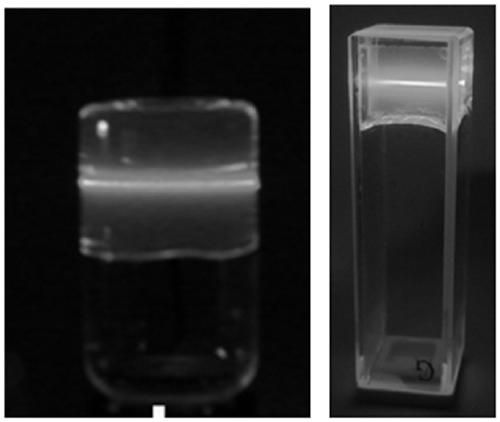
Figure 1 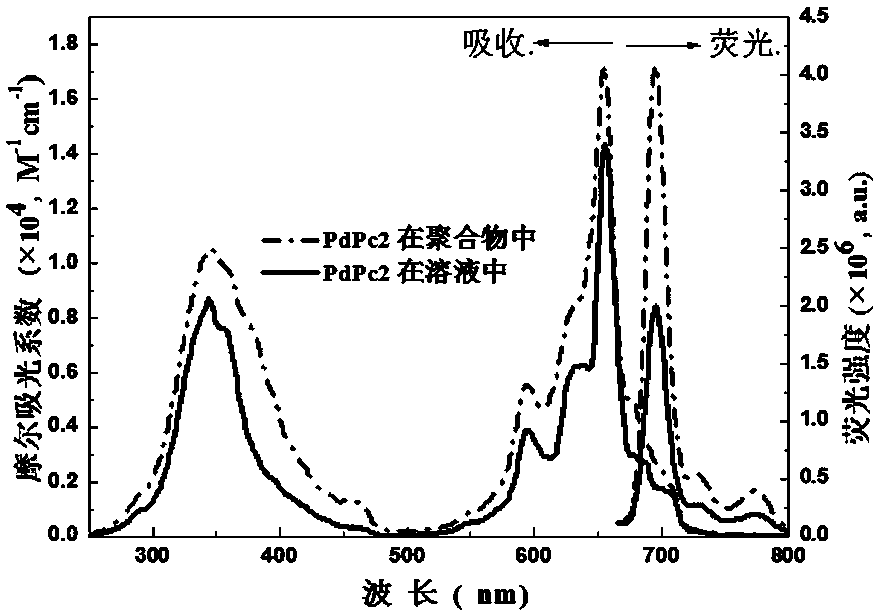
Figure 2 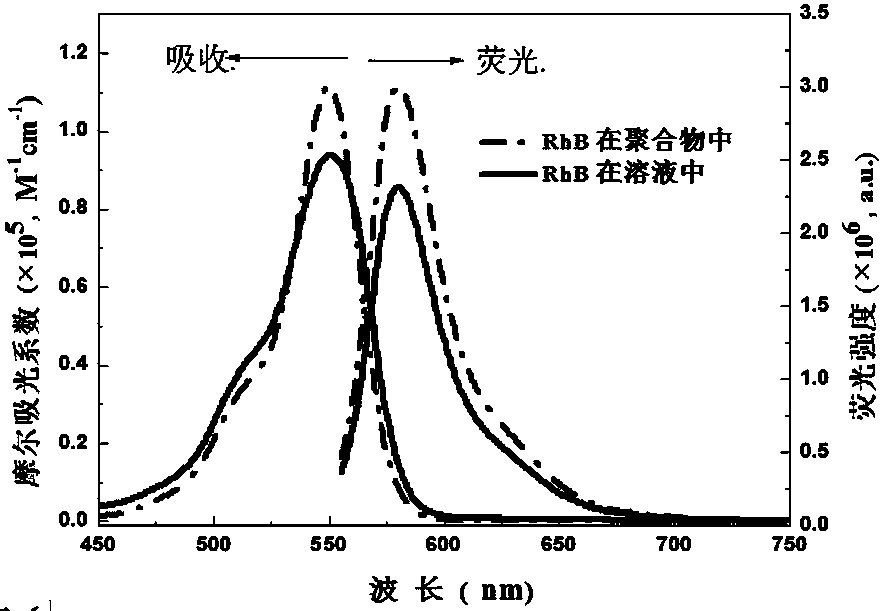
Figure 3
Abstract
Description
[0001] The invention belongs to the field of triplet annihilation upconversion, and specifically relates to a solid red-transition-yellow upconversion copolymer system and its preparation method and application. Background technique
[0002] Materials based on triplet-triplet annihilation upconversion (TTA-UC) usually consist of a sensitizer and a luminescent agent dissolved in an organic solvent to form a two-component system. The mechanism is: (1) irradiation of low-energy excitation light, the sensitizer The energy absorbed by the excitation light is converted from its ground state (S 0 ) to the singlet excited state ( 1 S*), and then transition to the triplet excited state ( 3 S*); (2) The sensitizer transfers the energy of its triplet excited state ( 3 S*) transferred to the luminescent agent ( 3 A*); (3) When the concentration of acceptor molecules in the triplet excited state reaches a certain level, two are in the triplet state ( 3 A*) The luminescent agent molecul...
Examples
Embodiment 1
[0054] (1) Two-component upconversion solution (PdPc 2 / luminescent agent) configuration: the sensitizer (PdPc 2 ) Mother liquor (concentration is 4×10 -5 mol / L) and luminescent agent mother solution (concentration is 1×10 -2 mol / L) are mixed according to a certain molar ratio and degassed to obtain a two-component solution of sensitizer / luminescent agent. The solvents involved in all the above solutions are spectrally pure n-propanol / ethylene glycol (v / v, 1 / 2).
[0055] The luminescent agent can be any one of the following rhodamine derivatives:
[0056]
[0057] (2) Preparation of solid-state up-conversion copolymer system: In a nitrogen atmosphere, 2-hydroxyethylene methyl acrylate (HEMA) and 3-(methacryloyloxy)propyltrimethoxysilane (TMSPMA) Mix according to 1:1 (mass ratio), add 0.5% (mass ratio) of azobisisobutyronitrile as an initiator, and then add a two-component solution (the molar ratio of sensitizer and luminescent agent is 1:3000), Vacuumize (30 min) aft...
Embodiment 2
[0078] According to the preparation method of Example 1, wherein HEMA and TMSPMA are mixed at 1:2 (mass ratio), 0.5% (mass ratio) of azobisisobutyronitrile is added as an initiator, and then a two-component solution (sensitizer The molar ratio of the luminescent agent and the luminescent agent is 1:3000) to prepare a solid-state up-conversion copolymer system. When the luminescent agent is RhB, RhBS, and Rh6G, the up-conversion efficiencies are 9.6%, 12.3%, and 2.9%, respectively. Correspondingly, under other conditions being the same, the upconversion efficiencies of the luminescent agents RhB, RhBS and Rh6G in the solution state are: 6.8%, 8.7% and 2.2%, respectively. Comparing Example 1 with Example 2, it can be seen that the ratio of the two polymer monomers has little influence on the up-conversion efficiency of the solid-state up-conversion system; meanwhile, under the same conditions, the up-conversion efficiency of the solid-state up-conversion system is greater than U...
Embodiment 3
[0080] According to the preparation method of Example 1, the solvents involved in the sensitizer and luminescent agent solutions are both spectroscopically pure propanol / ethylene glycol (v / v, 1 / 6); HEMA and TMSPMA are 1:4 (mass ratio ) mixed, adding 0.5% (mass ratio) of azobisisobutyronitrile as an initiator, and then adding a two-component solution (the molar ratio of sensitizer and luminescent agent is 1:3000) to prepare a solid-state up-conversion copolymer system , when the luminescent agent is RhB, RhBS, and Rh6G, the up-conversion efficiency is 9.4%, 11.8%, and 2.6%, respectively. Correspondingly, under other conditions being the same, the upconversion efficiencies of the luminescent agents RhB, RhBS, and Rh6G in the solution state were: 6.4%, 8.3%, and 1.9%, respectively. Comparing Example 1 with Example 3, it can be seen that as the ratio of solvent n-propanol / ethylene glycol changes, the up-conversion efficiency of the solution state also decreases; meanwhile, under t...