
Photovoltaic polyolefin encapsulating adhesive film
A technology for encapsulating adhesive films and polyolefins. It is used in applications, adhesives, household appliances, etc. It can solve problems such as differences in glass batch stability, decreased adhesion between polyolefin films and glass, and delamination of polyolefin films. , to reduce the phenomenon of salting out, solve the delamination of polyolefin packaging film, and improve the hydrophobicity
Patent Information
- Authority / Receiving Office
- CN · China
- Patent Type
- Applications(China)
- Current Assignee / Owner
- Publication Date
- 2018-11-13
Smart Images
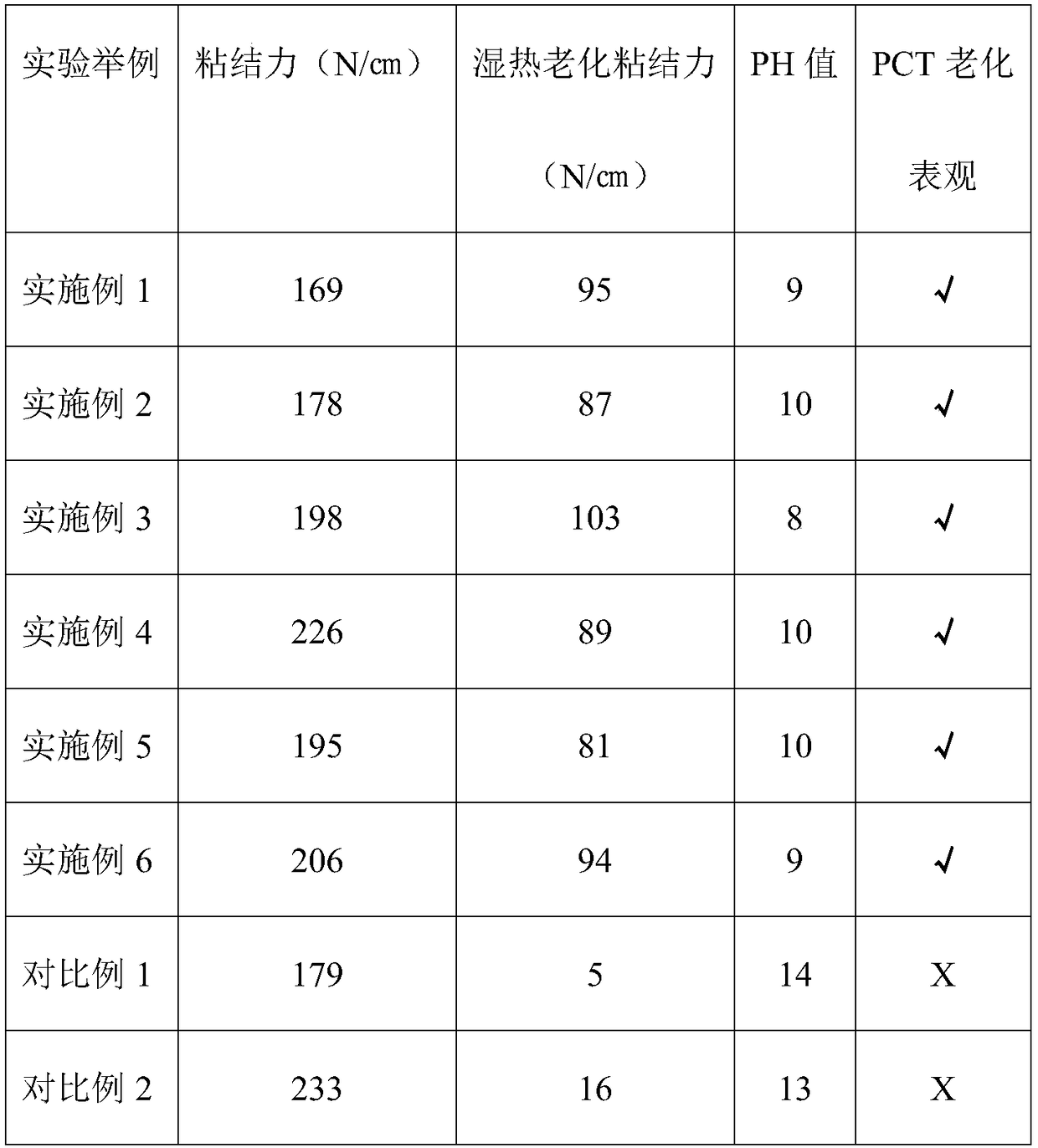
Figure 1
Abstract
Description
Technical field
[0001] The invention belongs to the field of photovoltaic new energy materials, and specifically relates to a polyolefin encapsulating film for photovoltaics. Background technique
[0002] The packaging material of solar cell modules can provide protection for solar cell modules. Currently, the widely used packaging material is ethylene-vinyl acetate copolymer (EVA). In a long-term high temperature and high humidity environment, the EVA film is easily hydrolyzed and releases acetic acid corrosion. Circuits cause component resistance to increase and power generation to decrease; at the same time, acetic acid is also one of the causes of snail patterns. Solar cell modules have been used in high-voltage environments for a long time. Due to the insufficient insulation of the EVA film, wet leakage current channels are easily generated between the EVA film, the back sheet, the glass and the frame, and a large amount of charge is accumulated on the surface of the cell, m...
Examples
Embodiment 1
[0044] Ethylene-1-octene random copolymer (Dow Chemical ENGAGE 8137) 100g, in which 0.1g tert-butylperoxycarbonate-2-ethylhexyl ester was added as a crosslinking agent, and 0.1g trimethylolpropane trimethyl Base acrylate as a crosslinking agent, 2g of anti-aging agent (containing 0.8g of 2,2'-dihydroxy-4-methoxybenzophenone as a UV absorber, 0.6g of Lowilite-62 and Lowilite- 94 weight ratio 1:1 mixture as light stabilizer, 0.2g of tetra[methyl-β-(3,5-di-tert-butyl-4-hydroxyphenyl)propionate]pentaerythritol ester and 0.1g of tri (2,4-Di-tert-butylphenyl) phosphite as an antioxidant, 0.2g of nano-magnesium hydroxide as an acid absorbent, 0.1gMgAl(CO 3 )(OH)·nH 2 O as a metal ion trapping agent), 0.05g γ-(methacryloxy)propyltrimethoxysilane as a silane coupling agent, 4g hydrogenated C5 petroleum resin (Puyang Kairuide Petroleum Resin Co., Ltd. BT100, softening point 90-100°C) as a stabilizer. The uniformly mixed materials are added to the melt-extrusion casting machine for extru...
Embodiment 2
[0046] Propylene-ethylene random copolymer (Dow Chemical VERSIFY 3401) 100g, in which 2.5g of tert-butylperoxycarbonate-2-ethylhexyl ester was added as a crosslinking agent, and 0.5g of pentaerythritol tetramethacrylate was used as a crosslinking aid Coupling agent, 0.05g anti-aging agent (containing 0.05 parts of Lowilite-62 and Lowilite-94 weight ratio 1:1 mixture as light stabilizer), 10g silane grafted POE, 0.05 parts of γ-(methacryloyloxy) ) Propyltrimethoxysilane is used as a silane coupling agent, and 0.7g of n-octyltriethoxysilane is used as a stabilizer. The uniformly mixed materials are added to the melt-extrusion casting machine for extrusion, and the temperature is controlled at 100°C. The extrudate is cast, cooled, drawn, and crimped to obtain a polyolefin encapsulating film with a thickness of 0.45 mm.
Embodiment 3
[0048] Propylene-ethylene random copolymer (ExxonMobil Vistamaxx 6202FL) 100g, in which 2g tetracosyl peroxydicarbonate is added as a crosslinking agent, 3g 1,3,5-triallyl-s-triazine- 2,4,6-triketone is used as a crosslinking agent, 1g of anti-aging agent (0.1g of Lowilite-62 and Lowilite-94 weight ratio 1:1 mixture as light stabilizer, 0.2g of tetra[methyl- A mixture of β-(3,5-di-tert-butyl-4-hydroxyphenyl) propionate] pentaerythritol ester and 0.1 g of tris(2,4-di-tert-butylphenyl) phosphite as an antioxidant , 0.3g of nano-magnesium hydroxide as acid absorbent, 0.3gMgAl(CO 3 )(OH)·nH 2 O is used as a metal ion trap), 1 g of vinyl ethoxysilane is used as a silane coupling agent, and 0.5 g of paraffin wax (Honeywell AC1702, softening point 90°C) is used as a stabilizer. The uniformly mixed materials are added to the melt-extrusion casting machine for extrusion, and the temperature is controlled at 100°C. The extrudate is cast, cooled, drawn, and crimped to obtain a polyolefin ...