
Processing technology of jet-molded high-speed steel
A processing technology, spray forming technology, applied in the field of spray forming high-speed steel processing technology, can solve the problems of reducing the overall hardness and tensile strength of high-speed steel, inconvenient recycling and processing of high-speed steel, and less precipitation of carbides, etc., to achieve slow down The effect of decreasing hardness, high tensile strength, and large overall hardness
Patent Information
- Authority / Receiving Office
- CN · China
- Patent Type
- Applications(China)
- Current Assignee / Owner
- Publication Date
- 2022-04-22
- Estimated Expiration
- Not applicable · inactive patent
Smart Images
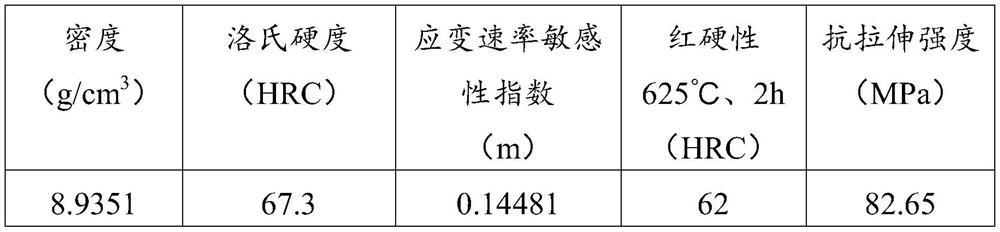
Figure 1
Abstract
Description
technical field
[0001] The invention relates to the technical field of high-speed steel processing, and more specifically, the invention relates to a spray-forming high-speed steel processing technology. Background technique
[0002] High-speed steel is a tool steel with high hardness, high wear resistance and high heat resistance, also known as high-speed tool steel or front steel, commonly known as white steel, high-speed steel has good process performance, good strength and toughness, so it is mainly It is used to manufacture complex thin-edged and impact-resistant metal cutting tools, as well as high-temperature bearings and cold extrusion dies, etc.;
[0003] The prior art has the following deficiencies: the treatment process of high-speed steel and the types of metal additives are few, which leads to a small amount of carbide precipitation during the processing of high-speed steel, reduces the overall hardness and tensile strength of high-speed steel, and has poor temp...
Examples
Embodiment 1
[0039] Sample preparation for the microstructure of the high-speed steel sample: use a wire cutting machine to cut the sample into small pieces, 10mm in height, and grind and polish to obtain a metallographic sample, use 4% nitric acid alcohol for corrosion, and conduct metallographic testing under a Zeiss metallographic microscope For tissue observation, the morphology of matrix and carbide was observed under FEI-Siron field emission scanning electron microscope.
Embodiment 2
[0041] Carbon replica sample preparation: mount the high-speed steel sample with cold mounting materials to make a mosaic sample, grind the sample, polish and corrode, choose picric acid as the corrosion agent, and the specific composition ratio is 1g picric acid + 5m1 hydrochloric acid + 500m1 methanol, Corrosion for 3 minutes, after the sample is corroded, carry out vacuum sputtering coating and carbon spraying. The film time and coating thickness are controlled by computer to ensure the uniformity and thickness of the carbon film. After the sample is coated, use a blade to divide the coating surface into 3mmX3mm. Square grid, using the electrolytic film removal method, the time is 5min, so that the size of the removed film is consistent with the size of the copper mesh, after the film is removed, use the copper mesh to pick up the carbon film, then wash it in alcohol, and finally dry it on filter paper That's it.
Embodiment 3
[0043] Hardness performance test: FR-3e digital Rockwell hardness tester is used, the loading load is 150kg, and the loading position is close to the center of the carbon film sample, within 1 / 2 of the radius.