
Preparation and usage of plasmodium fusion antigen
a technology of plasmodium fusion and antigen, which is applied in the field of fusion proteins, can solve the problems of ineffective control of malaria, poor efficacy of subsequent clinical trials, and great difficulties and challenges of anti-malaria drugs and mosquito vector control
Patent Information
- Authority / Receiving Office
- US · United States
- Patent Type
- Applications(United States)
- Current Assignee / Owner
- Publication Date
- 2004-04-01
- Estimated Expiration
- Not applicable · inactive patent
Smart Images
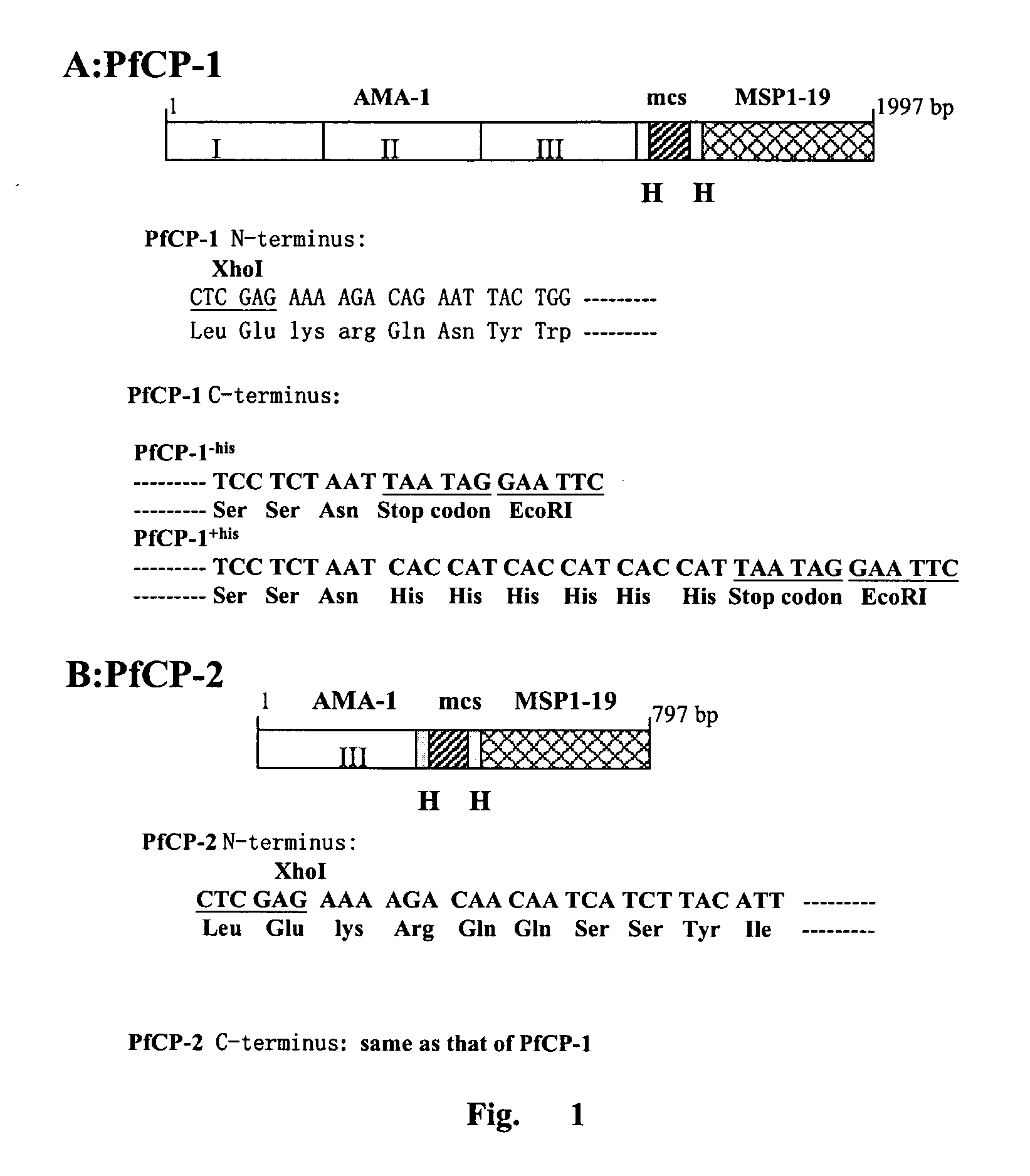
Figure 1 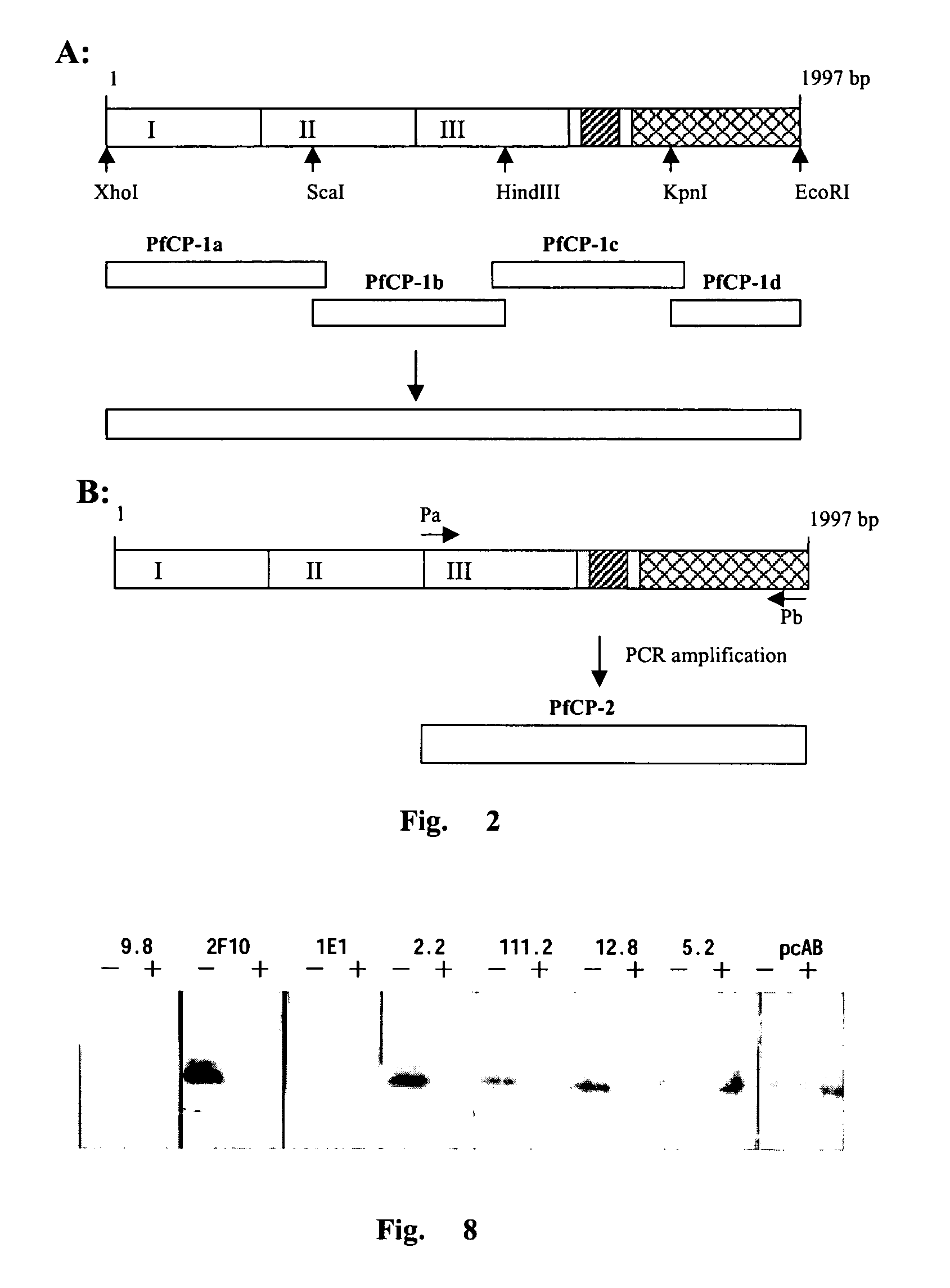
Figure 2 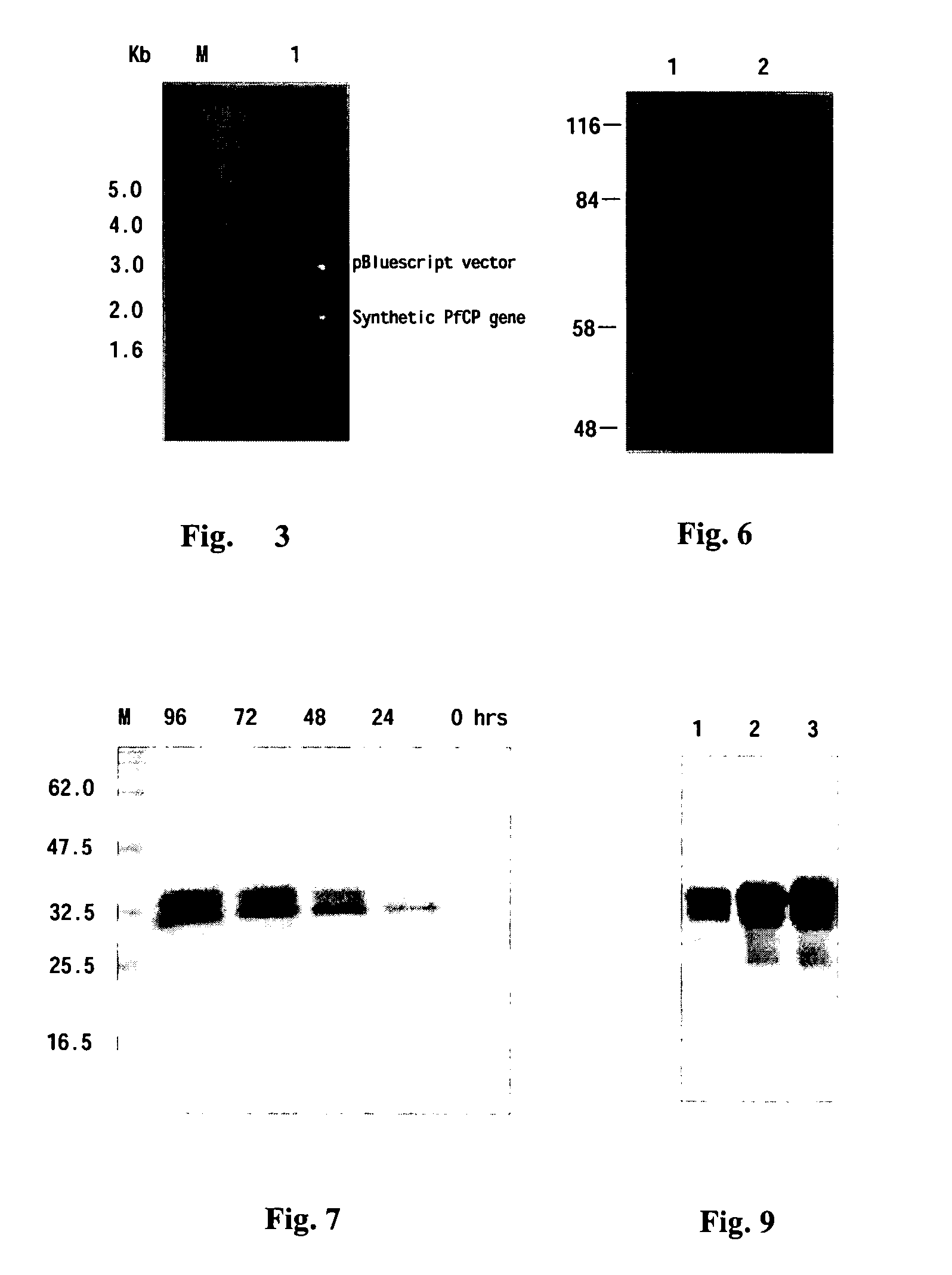
Figure 3
Abstract
Description
[0001] The present invention relates to DNA recombinant techniques and gene engineering vaccines. More specifically, the present invention relates to a fusion protein containing Merozoite Surface Protein 1 (MSP1) and Apical Membrane Antigen-1 (AMA-1) of Plasmodium, a DNA sequence encoding the fusion protein, a vector containing the DNA sequence, host cells containing the vector, a genetic engineering method to prepare the fusion protein, and uses of the fusion protein in developing vaccine against malaria.
[0002] Malaria is one of the most ancient infectious diseases that still has strong impact upon human health. According to the World Health Organization (WHO), about 40% of the world's population are still under the threat of malaria, which has been distributed to more than 100 countries. Today, there are about 300-500 million malaria cases every year, of which about 3 million die from it. Moreover, because of the emergence and quick spread diffusion of drug resistance by plasmodia...
Examples
example 2
Expression of PfCP in Pichia pastoris
[0099] 2.1 Construction of Expression Vector
[0100] PfCP-1 or PfCP-2 was cloned in yeast expression vector pPIC9 using XhoI and EcoRI sites. The Saccharomyces cerevisiae alpha-factor signal peptide and its cleavage site (Lys-Arg) was introduced in frame with the PfCP coding sequences. Thus the mature secretary proteins should not contain any signal peptide residue.
[0101] The vector pPIC9K was identical to pPIC9 except for the presence of the Kanamycin resistance gene to screen for multiple-copy insertion. Using the BamHI and SalI sites on the vectors, transferring the BamHI / SalI fragments from pPIC9 to pPIC9k to generate pPIC9K / PfCP-1 (FIG. 4) and pPIC9K / PfCP-2 vectors(FIG. 5).
[0102] 2.2 Transformation of Pichia pastoris SMD1168
[0103] The pPIC9K / PfCP-1 and pPIC9K / PfCP-2 was linearized with SalI. Transformation of Pichia pastoris strain SMD1168 was carried out by electroporation with 10 ug of linearized DNA. The His.sup.+ transformants were further...
example 3
Interaction of the AMA-1 / MSP-1 Fusion Protein and a Panel of Monoclonal Antibodies
[0107] MSP1-19 and AMA-1 are cysteine-rich proteins that form several disulfide bonds. Moreover, their functional antibodies are disulfide bond-dependent. Thus the key issue for this invention is to retain all conformational epitopes after fusion of the two proteins into one molecule. Therefore, to gain an insight into conformational properties of the fusion proteins, in this experiment a panel of monoclonal antibodies were used to react with PfCP-1 and PfCP-2 fusion protein.
[0108] Total 13 monoclonal antibodies, of them 10 recognizing conformational epitopes, were used to interact with PfCP-1. The expression products were subjected to electrophoresis in SDS-PAGE under non-reducing conditions, and then transferred onto pyroxylin membrane. The membrane-bound proteins were reacted with each of the 13 mAbs respectively and visualized via the AP-conjugate secondary antibody following standard procedures. T...
example 4
Fermentation and Purification of AMA-1 / MSP 1 Fusion Protein
[0111] Expression conditions were optimized to achieve the yield of 840 mg / L in flask expression.
[0112] During fermentation of the yeast strain in 15-liter fermentor, the cells grow fast and increase by index exponent. The cell density could reach OD.sub.660=112.5 value. During the period of methanol induction, the cell density was maintained at the same level while the target protein appeared in the first 3-7 hours and then dramatically increased. By 53 hours after induction, the expression yield reached 2600 mg / L.
[0113] PfCP-2 expression product was purified by two steps. At the first step protein was purified with Ni-NTA column because 6His residues located at the C-terminus of PfCP-2 that can combine to the Ni-NTA chelate. The bound proteins were eluted by a buffer containing 250 mM imidazole. At the second step, proteins eluted from Ni-NTA were further purified by gel filtration chromatography. The protein of >98% purit...