
Method for Inhibiting Telomerase Activity and an Agent for Inhibiting the Same
a technology of telomerase activity and inhibitory agent, which is applied in the direction of transferases, instruments, drug compositions, etc., can solve the problems of shortened telomeres upon cell division, shortening telomere length, and most normal cells have a limited lifespan, so as to enhance proteasome-dependent degradation, and enhance nuclear telomerase activity
Patent Information
- Authority / Receiving Office
- US · United States
- Patent Type
- Applications(United States)
- Current Assignee / Owner
- Publication Date
- 2008-01-03
- Estimated Expiration
- Not applicable · inactive patent
Smart Images
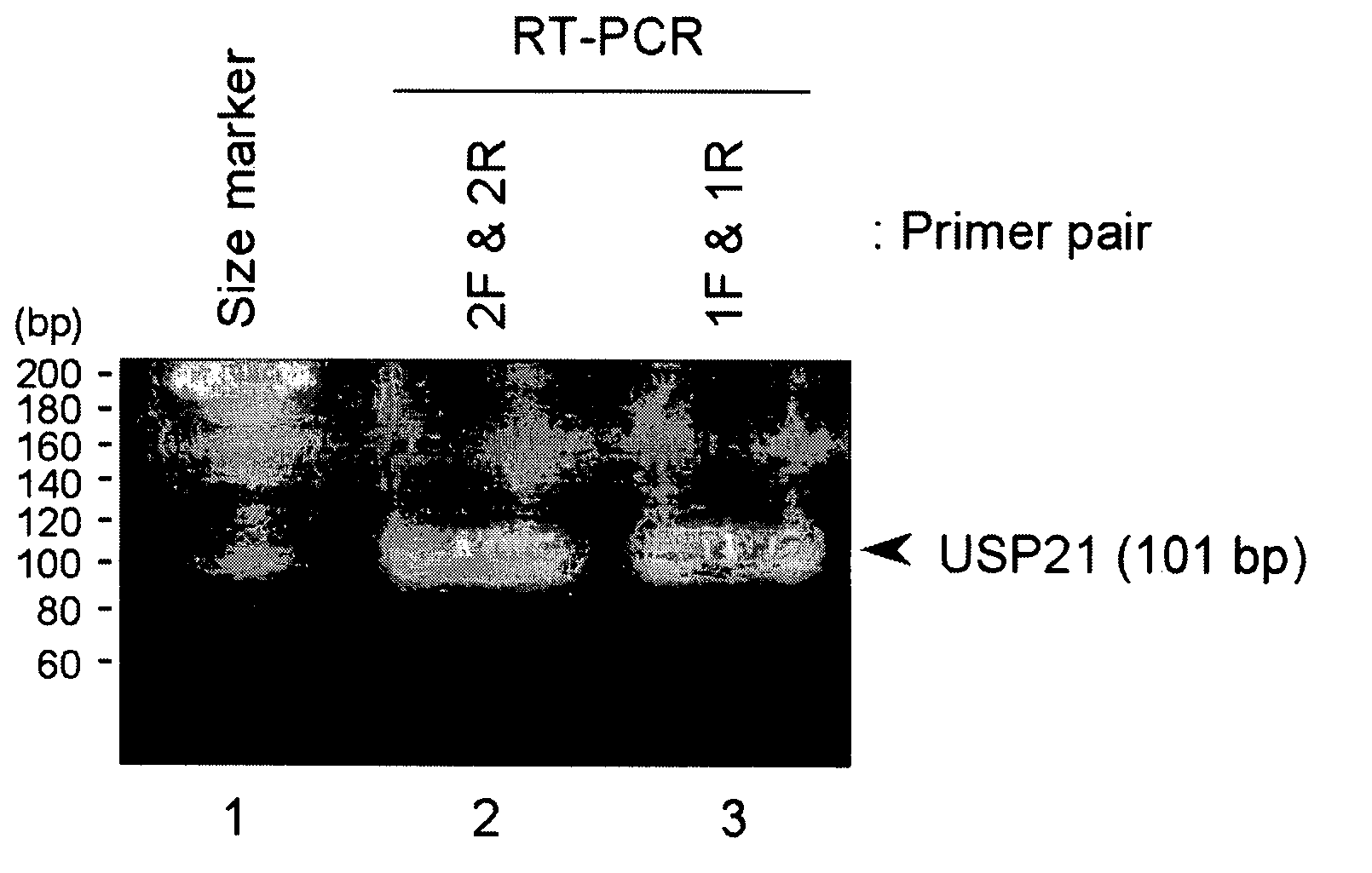
Figure 1 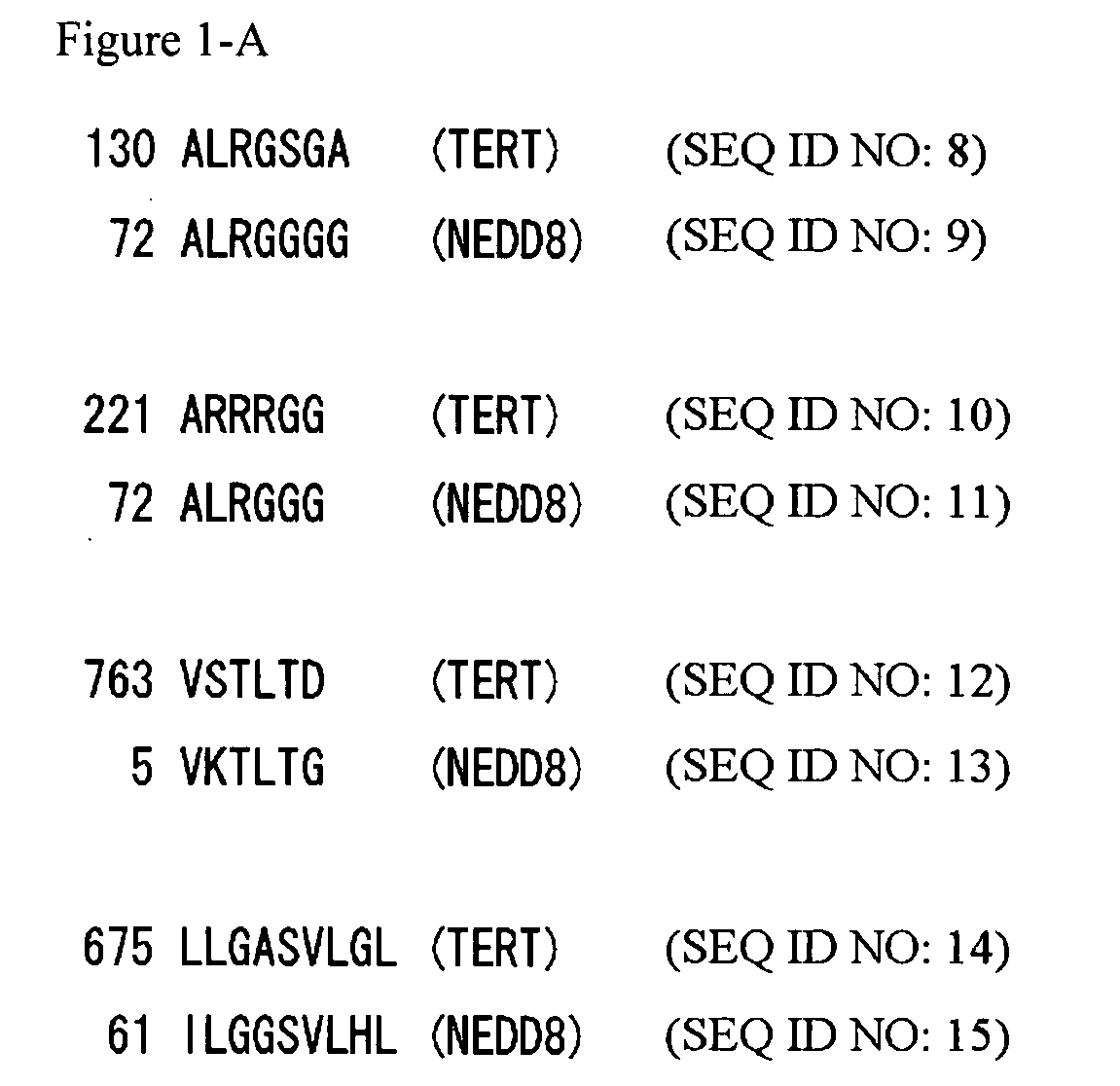
Figure 2 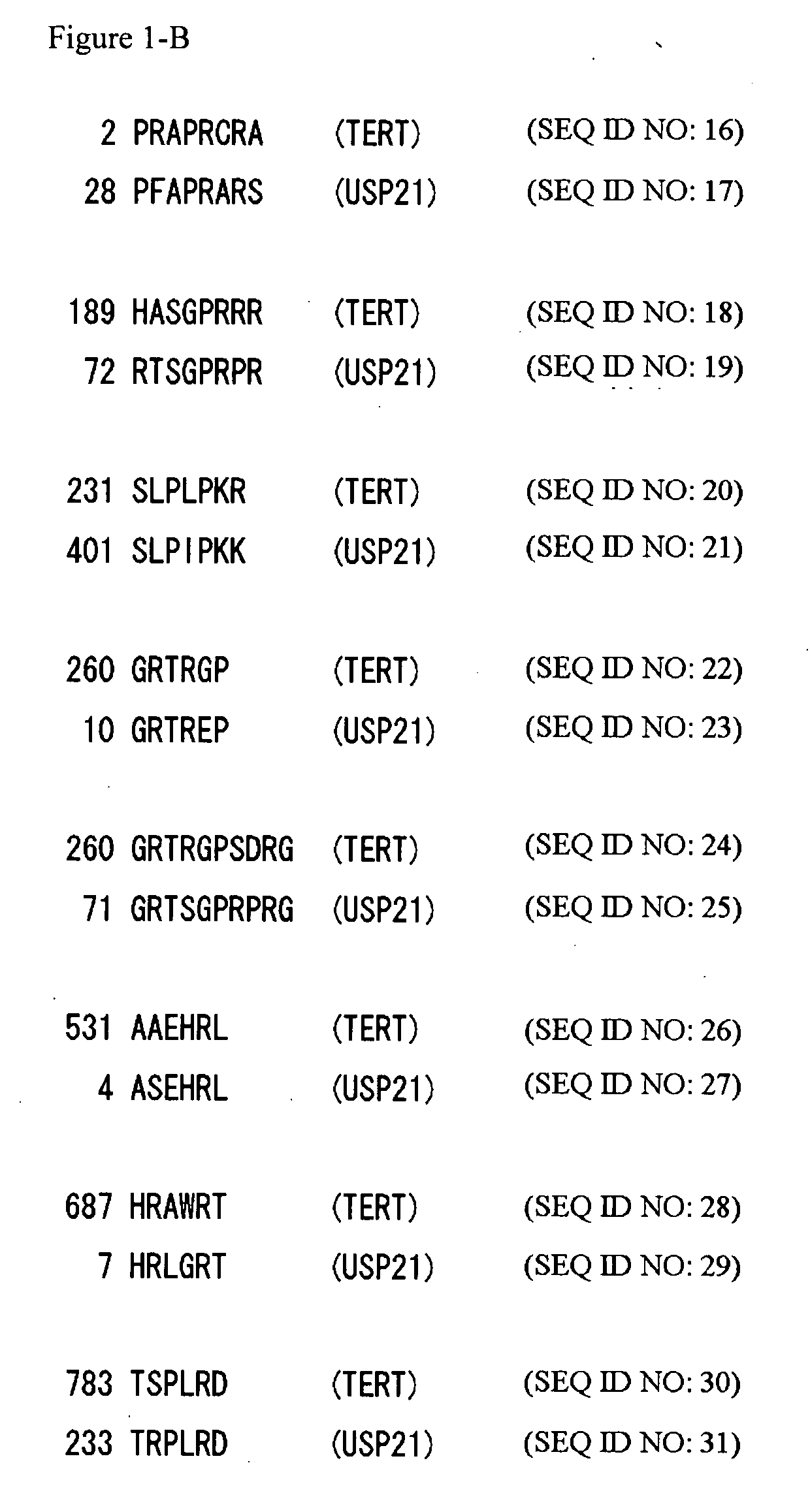
Figure 3
Abstract
Description
TECHNICAL FIELD
[0001] The present invention relates to a method of enhancing degradation of telomerase reverse transcriptase (hereinafter, TERT), comprising inhibiting binding of TERT to ubiquitin specific protease 21 (hereinafter, USP21), and to a method of inhibiting telomerase activity, comprising utilizing the method of enhancing degradation. Further, the present invention relates to a method of enhancing degradation of TERT, comprising inhibiting binding of NEDD8 (neural precursor cell expressed, developmentally down-regulated gene 8)-conjugated TERT to USP21, and to a method of inhibiting telomerase activity, comprising utilizing the method of enhancing degradation.
[0002] Further, the present invention relates to a method of enhancing degradation of TERT, comprising inhibiting NEDD8 deconjugation by USP21 from NEDD8-conjugated TERT, and to a method of inhibiting telomerase activity, comprising the method of enhancing degradation.
[0003] Furthermore, the present invention rel...
Examples
example 1
[0164] (In-silico Search for Proteins Having a Function of Interacting with TERT)
[0165] Predicting proteins which interact with TERT, a catalytic subunit of telomerase, was conducted in accordance with the prediction method described in the Patent Reference 1. Specifically, the amino acid sequence of TERT was decomposed into oligopeptides having a pre-determined length in order to search in a database for proteins having the amino acid sequence of each of the oligopeptides, or having homologous amino acid sequences to these amino acid sequences. Then, local alignment was conducted between the proteins obtained and TERT to identify proteins having a high local alignment score that might be capable of interacting with TERT.
[0166] As a result of analysis, NEDD8 and USP21 were identified as proteins predicted to have a function of interacting with TERT (FIG. 1-A and FIG. 1-B, respectively). The amino acid sequence of NEDD8 (SEQ ID NO: 4) was found to contain oligopeptides, ALRGGGG (SE...
example 2
[0167] (Binding of TERT to USP21 and to NEDD8)
[0168] Binding of TERT to both USP21 and NEDD8 was examined in vivo, using a cell co-expression system. The binding of TERT to USP21 was further examined by an in vitro binding assay using a pull-down method.
[0169]
[0170] Human TERT cDNA, human USP21 cDNA and human NEDD8 cDNA were cloned from human thymus cDNA, human kidney cDNA and human brain cDNA (all purchased from Clontech), respectively, by reverse transcription polymerase chain reaction (hereinafter, may be referred to RT-PCR).
[0171] A plasmid for expressing TERT in animal cells was constructed by introducing human TERT cDNA into an animal cell expression vector, pCIneo (Promega). The plasmid obtained in this manner is referred to as pCIneo-TERT.
[0172] A plasmid for expressing N-terminal FLAG-tagged TERT in animal cells was constructed by introducing human TERT cDNA having a FLAG-tag coding sequence inserted just before the initiation codon into pCI (Clontech). The plasmid obta...
example 3
[0187] (NEDD8 Conjugation to TERT and NEDD8 Deconjugation by USP21 from NEDD8-conjugated TERT)
[0188] Example 2 suggested a possibility of NEDD8 conjugation to TERT. Then, it was examined, using a binding assay employing a cell co-expression / immunocoprecipitation method similar to Example 2, whether NEDD8-conjugated TERT undergoes NEDD8 deconjugation by USP21 that is reported to be a deubiquitination / NEDD8 deconjugation protease (Non-patent Reference 9).
[0189]
[0190] The TERT expression plasmid, the N-terminal FLAG-tagged NEDD8 expression plasmid, the N-terminal HA-tagged USP21 expression plasmid, and the N-terminal HA-tagged USP21C221A expression plasmid, which were prepared as in Example 2, were used.
[0191]
[0192] 4× HEK293T cells were cultured overnight at 37° C. under the atmosphere of 5% CO2 in a dish with 60 mm diameter, and then transfected with 2 μg of pCIneo-TERT and 2 μg of pCI-FLAG-NEDD8 together with 2 μg of pCI-HA-USP21 or 2 μg of pCI-HA-USP21C221 A in various combinati...