
Pullulanase Variants and Uses Thereof
a technology of pullulanase and variants, which is applied in the field of pullulanase variants, can solve the problems of unfavorable panose formation in the saccharification process, and achieve the effect of high stringency conditions
Patent Information
- Authority / Receiving Office
- US · United States
- Patent Type
- Applications(United States)
- Current Assignee / Owner
- Publication Date
- 2013-01-17
- Estimated Expiration
- Not applicable · inactive patent
Smart Images
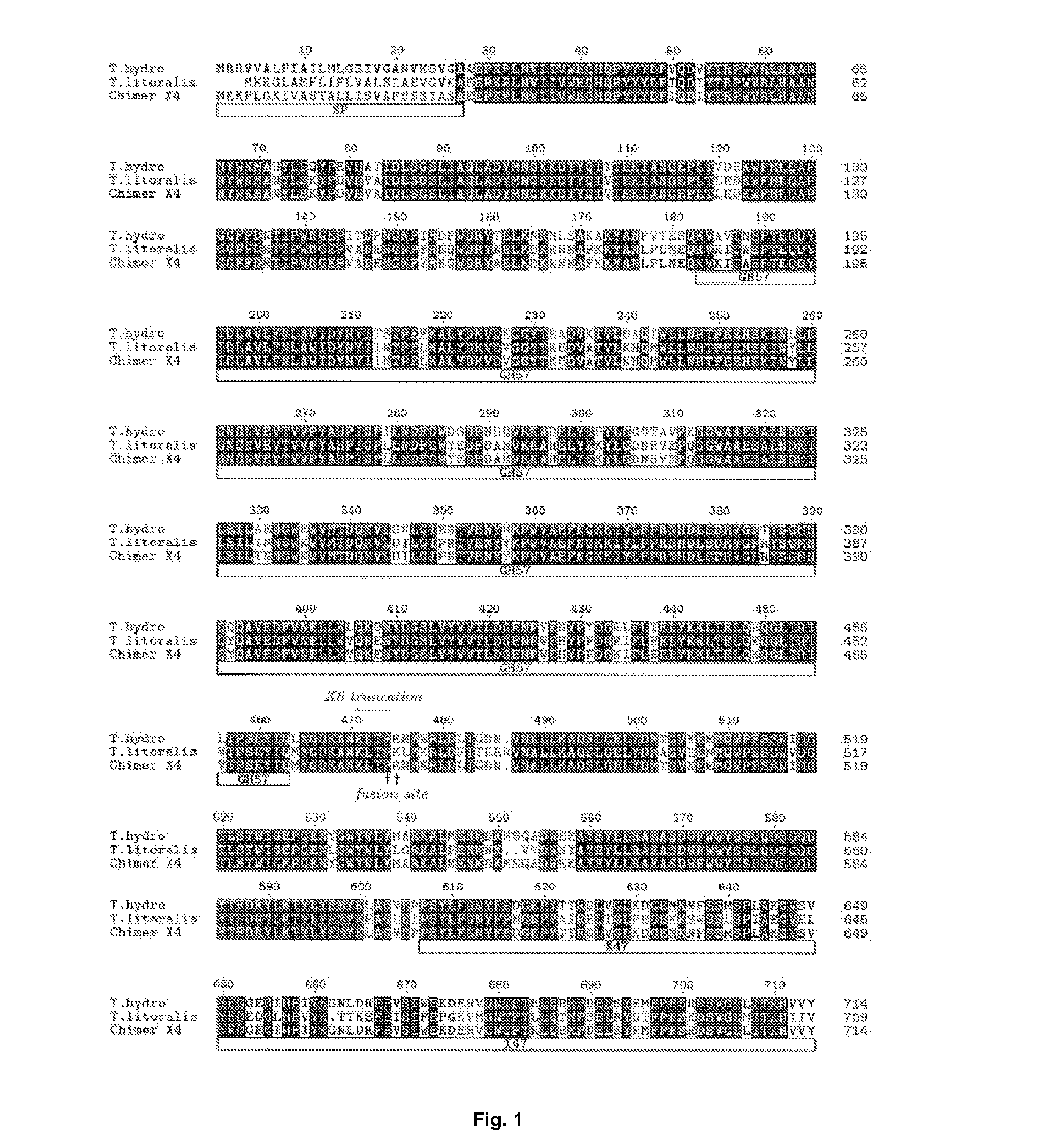
Figure 1 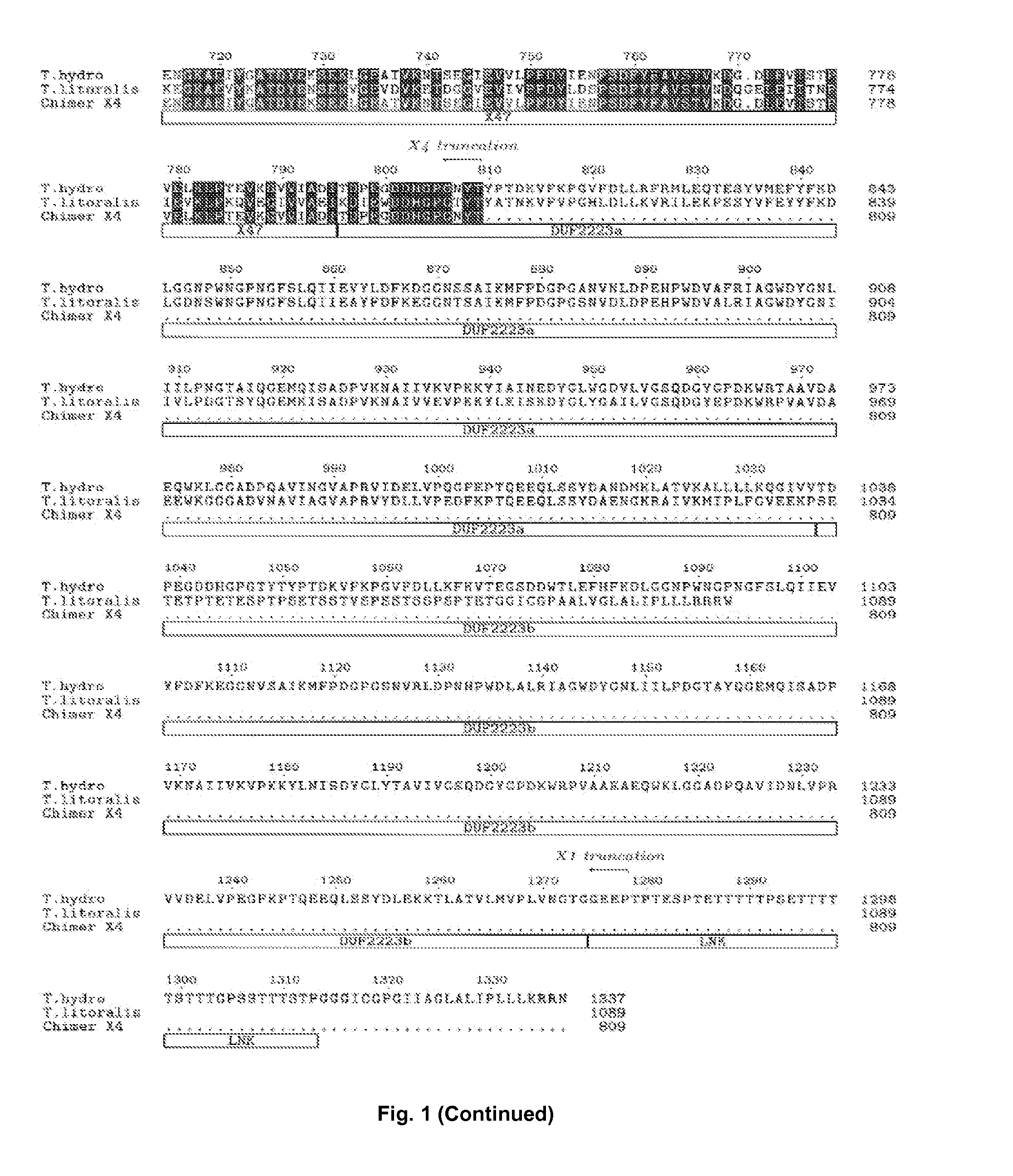
Figure 2 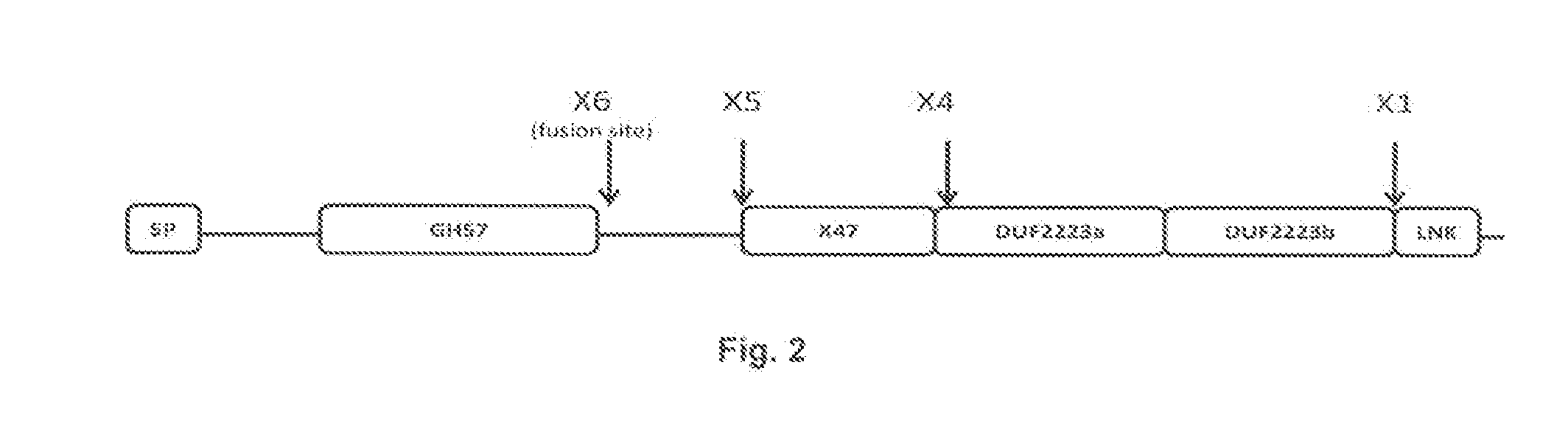
Figure 3
Abstract
Description
REFERENCE TO SEQUENCE LISTING
[0001] This application contains a Sequence Listing in computer readable form. The computer readable form is incorporated herein by reference.FIELD OF THE INVENTION
[0002] The present invention relates to pullulanase variant having pullulanase activity and isolated polynucleotides encoding said pullulanase variants. The invention also relates to nucleic acid constructs, vectors, and host cells comprising the polynucleotides as well as methods of producing and using the polypeptides. The invention also relates to the use of said pullulanase variants for starch convention processes include processes for producing a fermentation product, such as especially ethanol.BACKGROUND OF THE INVENTION
[0003] A pullulanase is an enzyme which can degrade alpha-(1,6)-linkage of pullulan, amylopectin and other branched substrates. In the grain industry, bacterial pullulanases have been used for the purpose of removing alpha-1,6 bonds in starch, which may cause undesirable pan...
Examples
example 1
[0163]Cloning and Expression of Thermococcus hydrothermalis DSM 14834 Pullulanase in Bacillus subtilis
[0164]A synthetic gene based on the protein sequence of Thermococcus hydrothermalis DSM 14834 Apu (Uniprot: Q9Y8I8) was designed and the gene was codon optimized for Bacillus subtilis. The C-terminal sequence (including the part of the putative linker, indicated in the alignment—FIG. 1) TPTESPTETTTTTPSETTTTTSTTTGPSSTTTSTPGGGICGPGIIAGLALIPLLLKRRN (SEQ ID NO: 5) and the native signal peptide (MRRVVALFIAILMLGSIVGANVKSVG—SEQ ID NO: 6) was not part of the designed synthetic gene (SEQ ID NO: 1 (DNA) and SEQ ID NO: 2 (protein)).The synthetic gene was extracted by double-digestion according to the manufacturer's manual (FastDigest®, Fermentas, Germany) from a plasmid carrying the synthetic gene. The synthetic gene was cloned in an expression vector comprising the genetic elements as described in WO 99 / 43835 (hereby incorporated by reference). By doing so, the signal peptide from the alkali...
example 2
Cloning and Expression of Variants of Thermococcus hydrothermalis DSM 14834 Pullulanase in Bacillus subtilis
[0167]In order to increase the recombinant expression yield of Apu and to identify which domains are necessary for the pullulanase activity, we have made truncations of the enzyme. The expression plasmid containing the synthetic gene described in Example 1 was used as template for a PCR(1). PCR(1) was performed in a total volume of 26 microliters, the following reagents were added, 1 microliter of vector DNA preparation (template), 50 pmol of each of the primer pairs below, 5 microliters dNTPs and 0.5 microliter Phusion® polymerase (Finnzymes, Finland) in Phusion HF buffer. The PCR conditions were 98° C. for 2 min; 9 cycles of 98° C. for 15 sec; 65° C. for 45 sec; 72° C. for 4 min; followed by 72° C. for 10 min; 4° C. for 20 min and 15° C. until the end of the PCR program. The primer pairs used were:
For X4 truncation:
For X4 truncation:1354(SEQ ID NO: 31)5′- GCCAAGGCCGGTTTTTTA...
example 3
[0170]Cloning and Expression of a Truncated Pullulanase Fusion of Thermococcus litoralis DSM 5473 and Thermococcus hydrothermalis DSM 14834 in Bacillus subtilis
[0171]A truncated synthetic gene based on the protein sequence of Thermococcus litoralis DSM 5473 was designed and the gene was codon optimized for Bacillus subtilis. In the synthetic gene, the C-terminal sequence after amino acid 474 in SEQ ID NO: 4 was deleted as indicated in the alignment FIG. 2 (“X6 truncation”).
[0172]Cloning of the synthetic gene into Bacillis subtilis the selection of correct clones and the cultivation of the clones was performed as described in Example 1. The X6 truncation of T. litoralis did not display any pullulanase activity (see table in Example 4). The derived expression plasmid C526A was used in a following PCR amplification as template.
Fusion of Thermococcus litoralis and Thermococcus hydrothermalis DNA
[0173]Using the expression plasmid C526A carrying the apu gene from Thermococcus litoralis a...