
Substrate for lithium ion battery separators and lithium ion battery separator
Patent Information
- Authority / Receiving Office
- US · United States
- Current Assignee / Owner
- Publication Date
- 2021-09-16
Smart Images
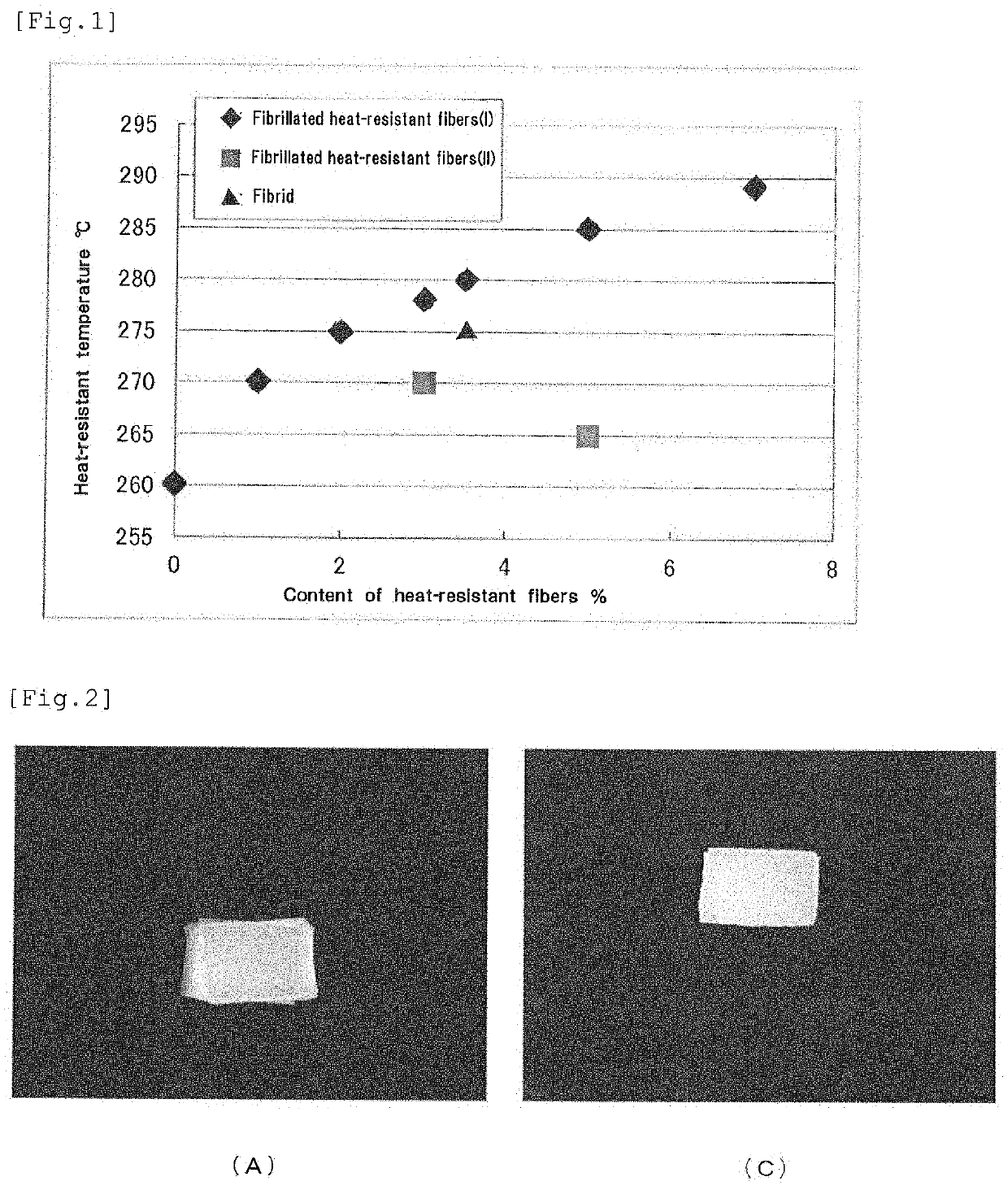
Figure 1 
Figure 2 
Figure 3
Abstract
Description
TECHNICAL FIELD
[0001] The present invention relates to a substrate for lithium ion battery separators and a lithium ion battery separator. The term “substrate for lithium ion battery separators” may be simply referred to as “substrate”. The term “lithium ion battery separator” may be simply referred to as “separator”.BACKGROUND ART
[0002] The use of a lithium ion battery is now expanding to electric automobiles in addition to portable equipment in the past. In the field of electric automobiles, as compared with portable equipment, a large-sized lithium ion battery is employed.
[0003] As the lithium ion battery separator, a porous film made of a polyolefin such as polyethylene or polypropylene is often used. The porous film made of a polyolefin has a heat fuse function (shut-down function) that it melts and closes pores to prevent the movement of a lithium ion and shut down a current when the inside temperature of a battery rises up to 130° C. However, when the temperature further rises i...
Examples
example 1
Example 1-1
[0174]55.5 parts by mass of oriented crystallized PET-based synthetic resin short fibers having a fineness of 0.06 dtex and a fiber length of 3 mm, 40.0 parts by mass of undrawn PET-based synthetic resin short fibers for single-component binders having a fineness of 0.2 dtex and a fiber length of 3 mm (softening point of 120° C., melting point of 230° C.) and 4.5 parts by mass of fibrillated heat-resistant fibers obtained by fibrillating a pulp-like product of wholly aromatic polyamide fibers (average fiber length of 1.7 mm, average fiber diameter of 10 μm) to a modified freeness of up to 50 ml with a high-pressure homogenizer were dispersed in water with a pulper to prepare homogeneous papermaking slurry having a concentration of 0.5 mass %, and a wet paper web was obtained by using an inclination type paper machine and dried with a cylinder drier having a surface temperature of 135° C. to obtain a sheet. The obtained sheet was calendered with a heat calender having a st...
example 1-2
[0177]A substrate 1-2 having a basis weight of 10 g / m2 and a thickness of 15 μm was manufactured in the same manner as the substrate 1-1 except that 59.0 parts by mass of oriented crystallized PET-based synthetic resin short fibers having a fineness of 0.06 dtex and a fiber length of 3 mm, 40.0 parts by mass of undrawn PET-based synthetic resin short fibers for single-component binders having a fineness of 0.2 dtex and a fiber length of 3 mm and 1.0 part by mass of fibrillated heat-resistant fibers having a modified freeness of 50 ml were used. Then, the coating solution prepared in Example 1-1 was applied to a coating weight of 12 q / m2 in the same manner as in Example 1-1 and dried to manufacture a separator.
example 1-3
[0178]A substrate 1-3 having a basis weight of 8 g / m2 and a thickness of 11 μm was manufactured by using the papermaking slurry of Example 1-1 in the same manner as the substrate 1-1. Then, the coating solution prepared in Example 1-1 was applied to a coating weight of 12 g / m2 in the same manner as in Example 1-1 and dried to manufacture a separator.