
Film for organic EL device and an organic EL device using the film
a technology of organic el and film, which is applied in the direction of discharge tube/lamp details, natural mineral layered products, synthetic resin layered products, etc., can solve the problems of insufficient gas-barrier property to encapsulate organic el devices, insufficient gas-barrier properties to achieve, etc., and achieve high light taking-out efficiency
Patent Information
- Authority / Receiving Office
- US · United States
- Patent Type
- Patents(United States)
- Current Assignee / Owner
- Publication Date
- 2003-10-28
- Estimated Expiration
- Not applicable · inactive patent
Smart Images
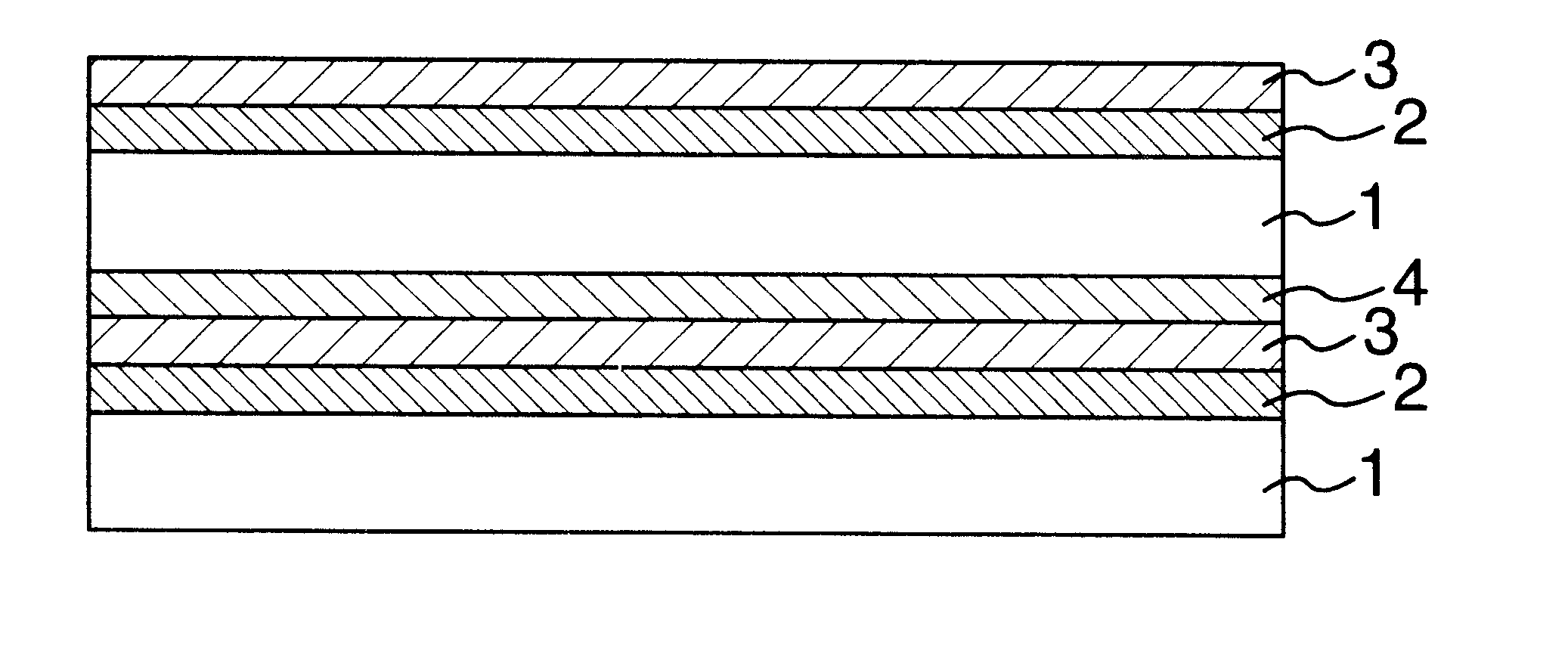
Figure 1 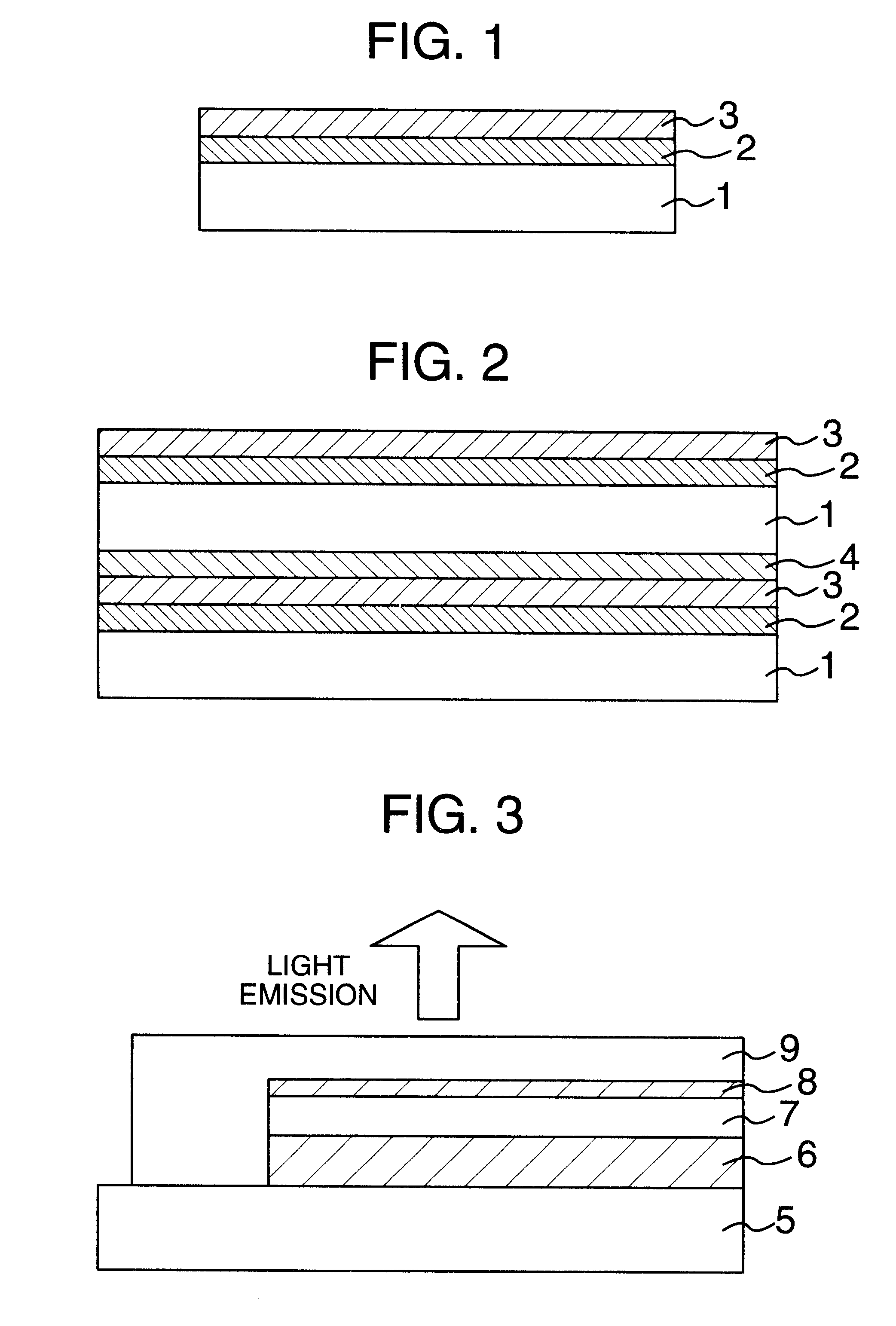
Figure 2 
Figure 3
Abstract
Description
(1) Field of the InventionThe present invention relates to a film having a gas barrier property, effective for prevention of the deterioration of organic EL device caused by oxygen and moisture, as well as to an organic EL device using such a film.(2) Related Art StatementElectroluminescent (hereinafter abbreviated as EL) devices are a light-emitting device utilizing the light emission of a solid fluorescent substance or electroluminescence.Currently, inorganic EL devices using an inorganic material as a light-emitting substance are put to practical use in, for example, the backlight or flat display of liquid crystal display.For organic EL devices, active development and research works are under way based on a prospect that such devices can be produced by a simple process at a low cost. Organic solids which are used as the light-emitting layer, hole transport layer, etc. of organic EL device, are generally weak to moisture and oxygen and incur formation of dark spots and reduction i...
Examples
example 1
There was synthesized, as follows, an organic inorganic hybrid material to be used for forming, by coating, a film of the present invention for organic EL device.
There were mixed, in ethanol or isopropyl alcohol, component (A), CF.sub.3 --(CH.sub.2).sub.n --Si(OCH.sub.3).sub.3 (n=1 to 10), component (B), an alkoxy group-containing photosensitive acrylic resin, and component (C), CH.sub.2.dbd.CH--Si(OCH.sub.3).sub.3, at a molar ratio of (A):(B):(C)=1:1:1. Thereto were added a stoichiometric amount of water and a slight amount of an acid as a catalyst to give rise to hydrolysis of the alkoxy group of each component and a polycondensation reaction, whereby there was produced a solution of an organic inorganic hybrid material containing siloxane group, fluorine group and photosensitive group.
The organic inorganic hybrid material solution obtained above was coated on a PET substrate 1 having a thickness of 12 .mu.m, as shown in FIG. 1. Then, an ultraviolet light (365 nm or 254 nm, 10 mW / ...
example 2
Using each of the films used in Example 1, lamination of two or five same films was conducted using, as a sealant layer, an LLDPE film (TUX-TC) having a thickness of 5 .mu.m, to produce various laminated films. These laminated films were measured for oxygen permeability and moisture permeability in the same manners as in Example 1. An example of the structures of these laminated films is shown in FIG. 2. In FIG. 2, 4 refers to a sealant layer for laminating two same films. The oxygen and moisture permeabilities of the laminated films obtained by lamination of two same films are shown in Table 2, and the oxygen and moisture permeabilities of the laminated films obtained by lamination of five same films are shown in Table 3.
The laminated film, i.e. the sample No. 1-3, obtained by laminating two same multi-layered films containing an organic inorganic hybrid material, of the present invention, showed significantly reduced gas permeabilities as compared with the single multi-layered fil...
example 3
The coating solution containing an organic inorganic hybrid material, used in Example 1 was mixed with a SnO.sub.2 dispersion to prepare, as coating dispsersions, six kinds of uniform dispersions containing 1, 5, 10, 30, 50 or 70% by weight of spherical SnO.sub.2 fine particles (particle diameter=200 nm). Each of these dispersions was coated on a PET film having a thickness of 25 .mu.m, to prepare six kinds of film samples having a coating layer thickness of about 1 .mu.m. The organic inorganic hybrid material film (in which spherical SnO.sub.2 fine particles were dispersed) of each film sample was measured for oxygen and moisture permeabilities. The results are shown in Table 4. As clear from Table 4, the organic inorganic hybrid material films containing 5 to 50% by weight of dispersed SnO.sub.2 fine particles showed improved oxygen and moisture permeabilities owing to the presence of dispersed SnO.sub.2 fine particles while retaining film transparency.