Time sequence mapping method for text to audio realized by computer

A computer and audio technology, applied in the field of audio analysis, can solve the problems of low word-level granularity of animation, large-capacity file occupancy, individual inability of spoken words, etc., and achieve the effect of small data transmission bandwidth and easy modification.

CN101079301BInactive Publication Date: 2010-06-09埃里克・路易斯・汉森
4 Cites 0 Cited by

Patent Information

Authority / Receiving Office
CN · China
Patent Type
Patents(China)
Current Assignee / Owner
Publication Date
2010-06-09
Estimated Expiration
Not applicable · inactive patent

Smart Images

  • Figure 1
    Figure 1
  • Figure 2
    Figure 2
  • Figure 3
    Figure 3
Patent Text Reader

Abstract

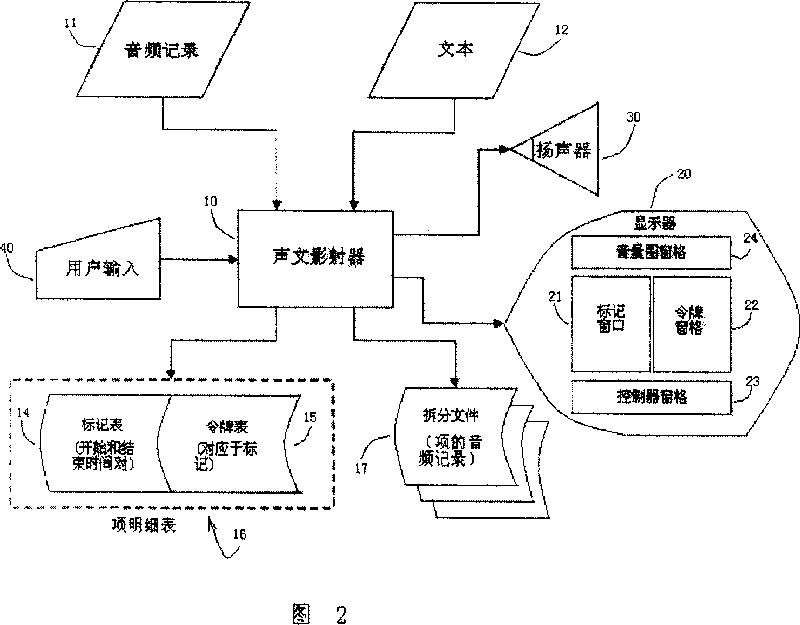
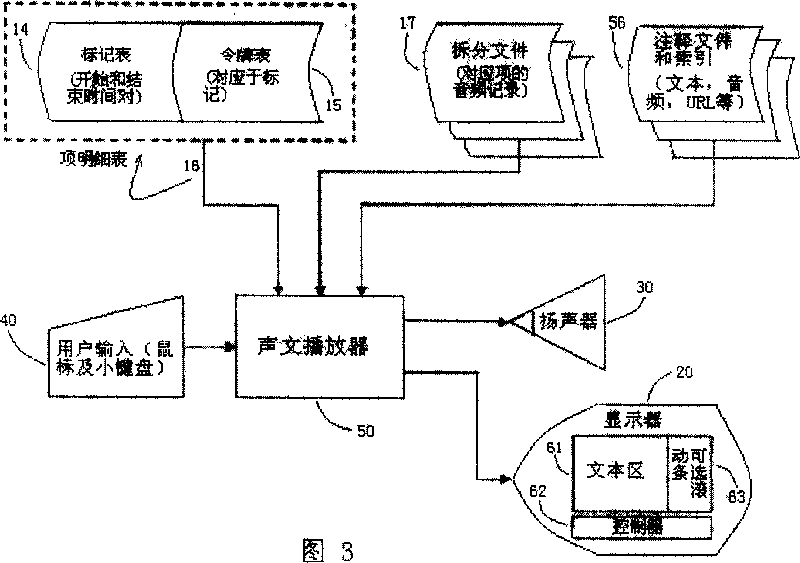
The present invention introduces a device, method and computer reading media for mapping establishing text to audio time sequence. The present invention also introduces a device, method and computer reading media for playing audio text animation. A mapping agent (10) takes the text (12) and the corresponding audio record (11) as input, and makes begin and end time assign to the text unit (15). Theplayer (50) takes text (15), audio (17) and mapping (16) as input, and makes text animation and displays text (15) in-phase along with playing the audio (17). The present invention is used to endow vitality during the process of playing audio record; to instead the traditional playback control to control audio play; to play and display the note of voice recording; to implement the characteristicof flowing audio without using basic stream protocol.
Need to check novelty before this filing date? Find Prior Art

Description

technical field

[0001] The invention relates to the field of audio analysis, in particular audio such as speeches containing textual descriptions. More specifically, the corresponding process for creating text-to-audio mappings. Background technique

[0002] The first technological advance in language-based was the development of simple vocalizations, which at the time could only convey meaning in temporal isolation. Later, people combined these initial vocalizations in time phase and sequential order to form streams of speech. Later, people invented drawing simple symbols or images on cave walls or other suitable surfaces, but they only communicated in isolation in space. Later generations linked these symbols or images with spoken language in time. Later, people combined these independent language-related graphics in a sequential order in space to form written language or "text". Specifically, our innovative ancestors began to order the sequential space of morphologica...

Examples

Embodiment Construction

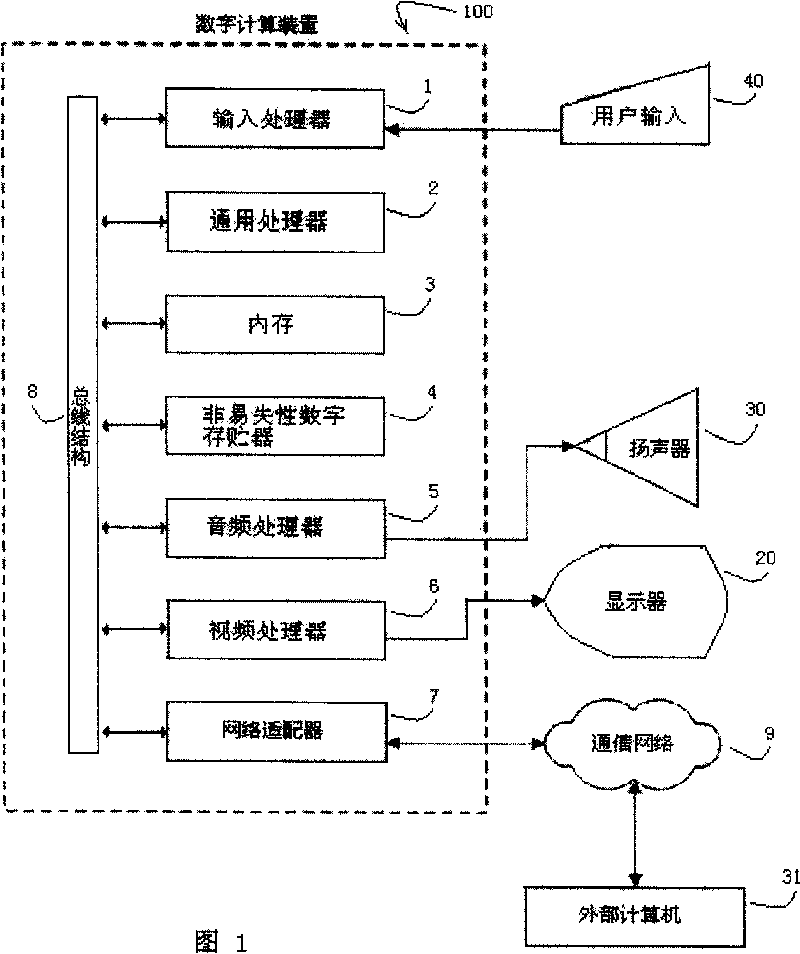
[0058] The present invention can be embodied in various forms. Therefore, the details disclosed herein are not so much limitations as examples to teach one skilled in the art to use the invention on any suitable system or structure or in any way.

[0059] figure 1 A digital computing device 100 of the present invention is shown. The composition of digital computing device 100 is as follows: 1. input processor, 2. general purpose processor, 3. memory, 4. non-volatile digital storage, 5. audio processor, 6. video processor, 7. network adapter, The above components are all connected together through the bus structure 8 . Digital computing device 100 may be incorporated into a standard personal computer, cell phone, smart phone, palmtop computer, notebook computer, personal digital assistant, or the like, equipped with appropriate input, video display, and audio hardware. It can also be implemented with dedicated hardware and software. They can be integrated into consumer appl...