
Multi-frequency band self-excited interference elimination repeater
A technology of interference elimination and self-excitation elimination, applied in electrical components, wireless communications, radio relay systems, etc., can solve problems such as base station control channel blocking, repeater system self-excited oscillation, and difficulty in engineering applications. Small input quantity, reduced isolation requirements, and the effect of eliminating interference
- Summary
- Abstract
- Description
- Claims
- Application Information
AI Technical Summary
Problems solved by technology
Method used
Image

Examples
Embodiment Construction
[0026] The present invention will be described in further detail below in conjunction with the accompanying drawings and embodiments. The specific implementation examples described here are only used to explain the present invention, not to limit the present invention.
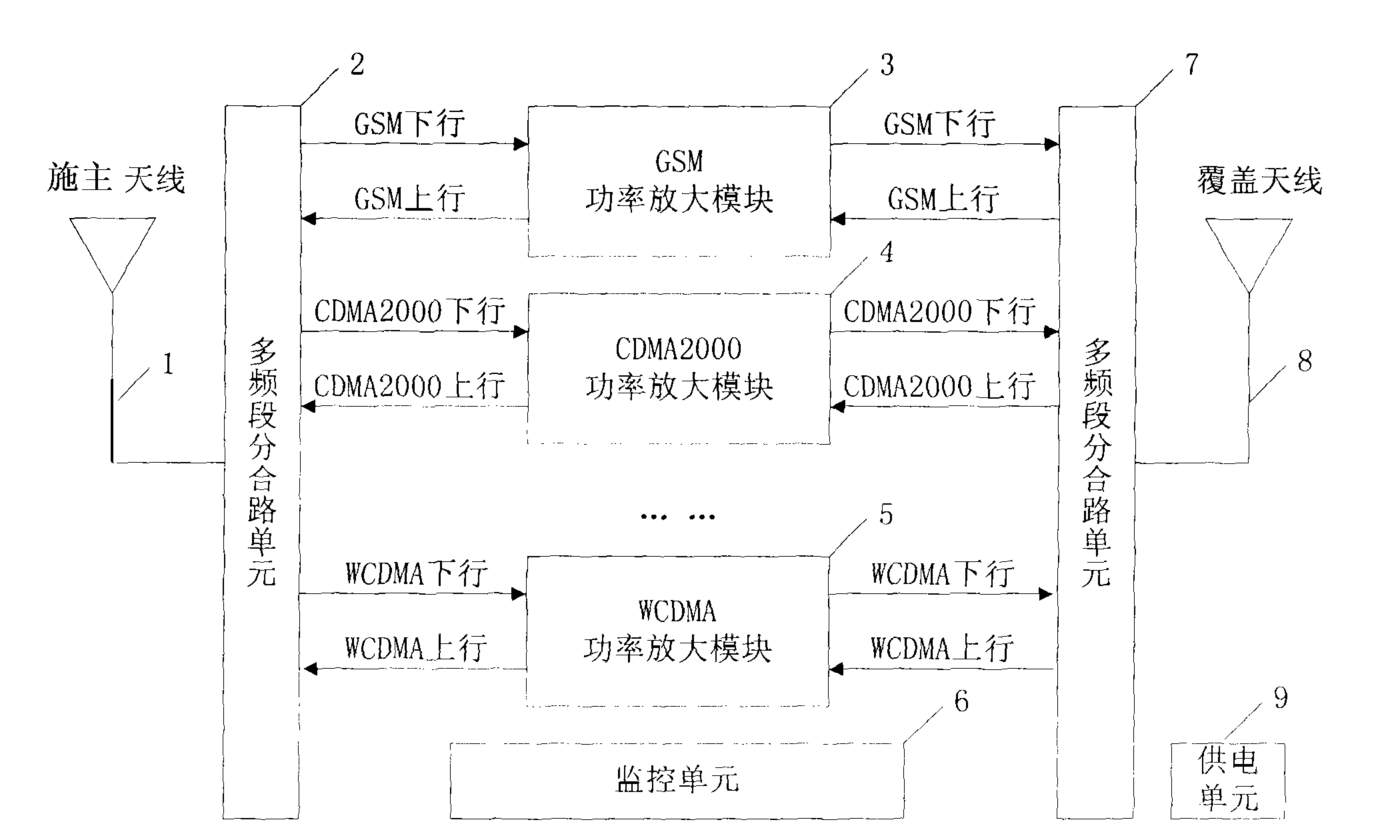
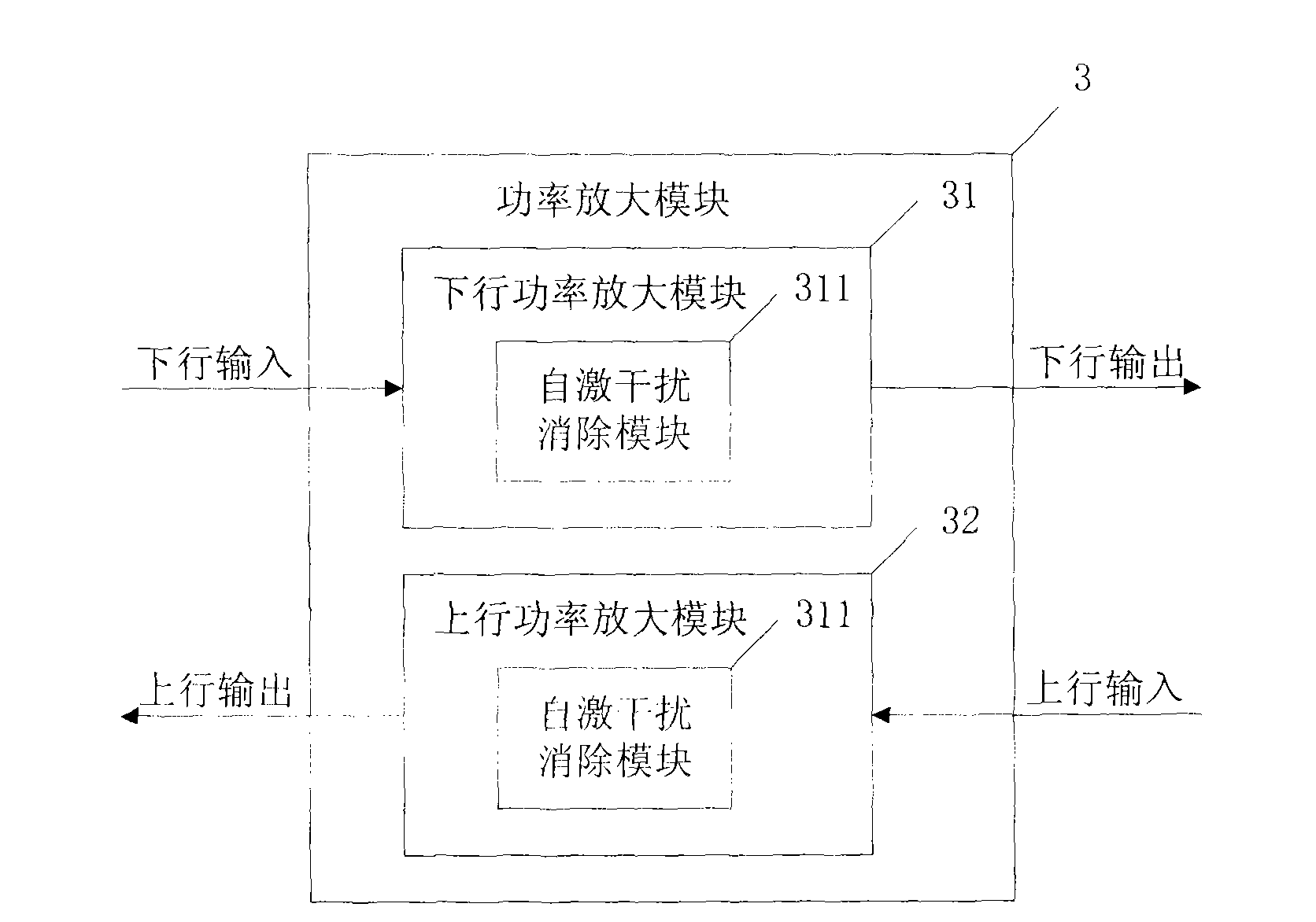
[0027] figure 1 Among them, the donor antenna 1 couples downlink signals from various base stations operating in different communication systems and frequency bands from the air. These downlink signals may include GSM frequency bands, CDMA frequency bands, CDMA2000 frequency bands, WCDMA frequency bands, etc. These downlink signals are respectively outputted by the multi-band splitting and combining unit 2 as downlink signals of different frequency bands. These downlink signals are respectively filtered and amplified by different power amplifier modules 3, 4, 5, etc., and then passed through the multi-band splitting and combining unit. 7 Combine the processed downlink signals of multiple frequency bands, and ...
PUM
 Login to View More
 Abstract
Description
Claims
Application Information
 Login to View More