

Synthesis and purification process for DOPO
A process, the technology of phosphorus trichloride, applied in the field of flame retardants, can solve the problems of high impurity content, high reaction temperature, and difficulty in industrialization, and achieve the effects of short cyclization time, high purity, and reduced difficulty in process conditions
Patent Information
- Authority / Receiving Office
- CN · China
- Current Assignee / Owner
- Publication Date
- 2011-11-02
- Estimated Expiration
- Not applicable · inactive patent
Smart Images
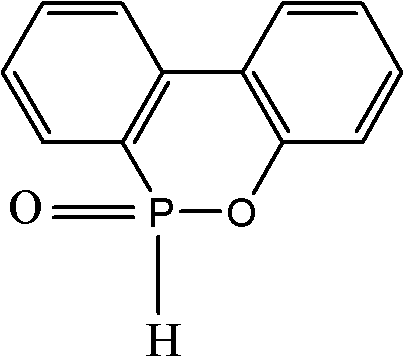
Figure 1 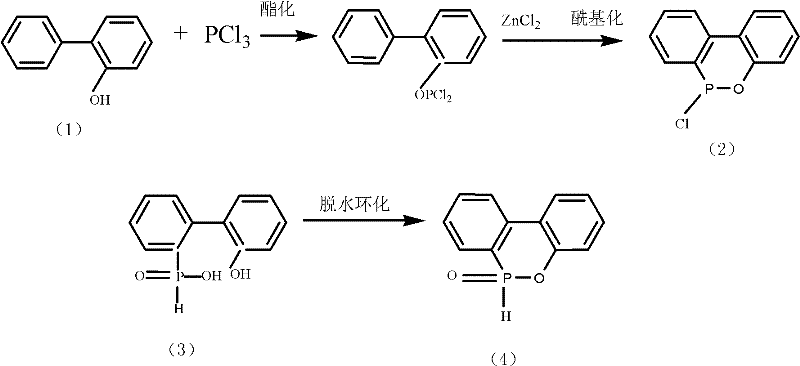
Figure 2
Abstract
Description
technical field
[0001] The invention belongs to the technical field of flame retardants, and in particular relates to a DOPO synthesis and purification process. Background technique
[0002] 9,10-dihydro-9-oxa-10-phosphaphenanthrene-10-oxide (DOPO) is a new type of halogen-free organic phosphorus flame retardant intermediate, which can be used in circuit boards, semiconductor packaging materials, plastics, Flame retardant for photosensitive materials, etc., can also be used as antioxidants, antibacterial agents, precursors for synthetic luminescent materials, etc. Its structural formula is:
[0003]
[0004] So far, foreign countries have done extensive research on the synthesis and application of DOPO. German patent DE2034887 first reported the synthesis method of DOPO, and then German patent DE19505352 and US patents US5717127 and US5481071 all reported the preparation of DOPO. The above-mentioned patents have basically all adopted the same synthetic method: using or...
Examples
Embodiment 1
[0025] Step 1, the synthesis of 6-chloro-(6 hydrogen)-diphenyl(c,e)[1,2]-phosphaphenanthrene: using anhydrous zinc chloride as a catalyst, using o-phenylphenol and phosphorus trichloride As raw materials, o-phenylphenol, anhydrous zinc chloride and phosphorus trichloride were sequentially added to the reactor, heated to 175°C at a heating rate of 3°C / min and reacted for 4 hours to generate 6-chloro-(6 hydrogen) -diphenyl (c, e) [1,2]-phosphaphenanthrene liquid; the mol ratio of the phosphorus trichloride and o-phenylphenol is 1.2:1, and the consumption of anhydrous zinc chloride is o-phenylphenol 0.5% of the mass; among them, phosphorus trichloride is added in the reactor three times, first add 70% of the total amount of phosphorus trichloride at room temperature, and then add 70% of the total amount of phosphorus trichloride when the reaction solution is heated to 105°C 20%, and then add the remaining phosphorus trichloride when the reaction solution is heated to 155°C;
[0...
Embodiment 2
[0031] This example is the same as Example 1, except that the alcoholic organic solvent used is methanol or isopropanol, the aromatic organic solvent used is benzene, toluene, chlorobenzene or dichlorobenzene, and the metal salt catalyst used is Magnesium sulfate, aluminum sulfate, iron sulfate, zinc sulfate, chromium sulfate or manganese sulfate, or magnesium chloride, aluminum trichloride, zinc chloride, chromium chloride or manganese chloride, the aliphatic hydrocarbon organic solvent used is hexane, n-pentane or isopentane.
[0032] In this embodiment, phosphorus trichloride is added in three times, the heating rate is fast, the reaction temperature is low, and the occurrence of side reactions is effectively reduced. phenyl-2-phosphinic acid) for dehydration and cyclization, the cyclization time is short, the operation is simple, and the production efficiency is improved. The prepared DOPO has a purity of ≥99%, a yield of ≥88%, and a melting point of 117.2°C to 118.6°C. E...
Embodiment 3
[0034]Step 1, the synthesis of 6-chloro-(6 hydrogen)-diphenyl(c,e)[1,2]-phosphaphenanthrene: using anhydrous zinc chloride as a catalyst, using o-phenylphenol and phosphorus trichloride As raw materials, o-phenylphenol, anhydrous zinc chloride and phosphorus trichloride were added to the reactor in sequence, heated to 158°C at a heating rate of 0.25°C / min and reacted for 8 hours to generate 6-chloro-(6 hydrogen) -diphenyl (c, e) [1,2]-phosphaphenanthrene liquid; the mol ratio of the phosphorus trichloride and o-phenylphenol is 1.5:1, and the consumption of anhydrous zinc chloride is o-phenylphenol 2.0% of the mass; wherein, phosphorus trichloride is added into the reactor in three times, first adding 85% of the total amount of phosphorus trichloride at room temperature, and then adding 85% of the total amount of phosphorus trichloride when the reaction solution is heated to 130°C 10%, and then add the remaining phosphorus trichloride when the reaction solution is heated to 140...