Check patentability & draft patents in minutes with Patsnap Eureka AI!

Method for removing residual aluminum in salted jelly fish

A technology of jellyfish skin and residual aluminum, applied in application, food preparation, food science and other directions, can solve problems such as harm to human health and aluminum toxicity, and achieve the effects of promoting dissolution, reducing aluminum residues, and improving food safety.

Active Publication Date: 2015-04-01
YELLOW SEA FISHERIES RES INST CHINESE ACAD OF FISHERIES SCI
View PDF7 Cites 0 Cited by
  • Summary
  • Abstract
  • Description
  • Claims
  • Application Information

AI Technical Summary

Problems solved by technology

Because salted jellyfish contains a large amount of salt and alum, it needs to be washed and soaked with water before eating, but even after washing and soaking with water, the residual amount of aluminum in the salted jellyfish still exceeds the national food safety standard; and aluminum is obviously toxic to the human body. Regular consumption of jellyfish products containing excessive aluminum will endanger human health

Method used

the structure of the environmentally friendly knitted fabric provided by the present invention; figure 2 Flow chart of the yarn wrapping machine for environmentally friendly knitted fabrics and storage devices; image 3 Is the parameter map of the yarn covering machine
View more

Image

Smart Image Click on the blue labels to locate them in the text.
Viewing Examples
Smart Image
  • Method for removing residual aluminum in salted jelly fish
  • Method for removing residual aluminum in salted jelly fish

Examples

Experimental program
Comparison scheme
Effect test

Embodiment 1

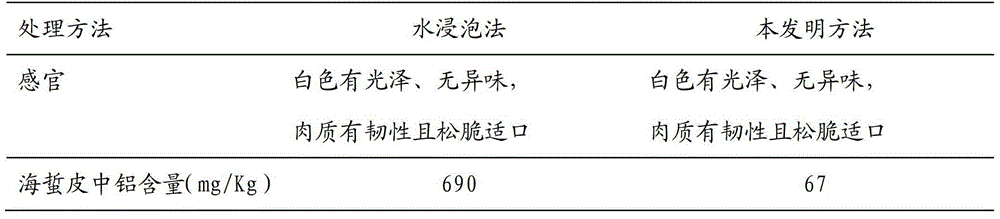
[0013] The technical scheme of the present invention is used to process the salted jellyfish peels purchased from the market with the traditional three-aluminum process, and finally perform sensory evaluation and determine the residual amount of aluminum therein.

[0014] A method for removing aluminum residues in salted jellyfish skins. The steps include cleaning, soaking in a mixed solution of acetic acid and calcium acetate and blanching in hot water. The specific steps are as follows:

[0015] 1) Cleaning: Wash the salted jellyfish skin with water to remove impurities, and cut into 1-5mm wide silk.

[0016] 2) Soaking in the mixed solution of acetic acid and calcium acetate: put 500g of shredded salted jellyfish into a food-grade plastic bucket, add 1 liter of mixed solution of acetic acid and calcium acetate to soak, the preparation method of the mixed solution of acetic acid and calcium acetate is 1L of the mixed solution contains 5ml of food additive acetic acid and 10g...

Embodiment 2

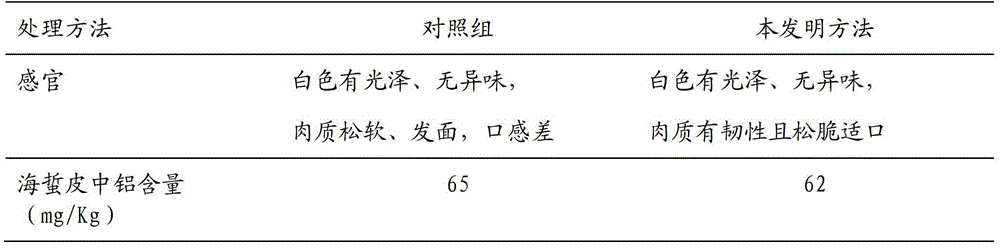
[0022] One of the key points of the present invention is that calcium acetate is added while soaking in acetic acid. Since the salted jellyfish skin swells in the acetic acid solution, the mouthfeel of the salted jellyfish skin is seriously reduced, and the commercial value of the salted jellyfish skin is lost. Therefore, adding calcium acetate at the same time can effectively prevent the swelling of the salted jellyfish skin in the acid solution soaking process, and keep it crispy, palatable and tough, which will be verified by experiments below.

[0023] Process the salted jellyfish with the following different technical schemes to the salted jellyfish that is purchased from the market and processed with the traditional three alum process:

[0024] 1) Cleaning: Take the salted jellyfish skin and wash it with water to remove impurities.

[0025] 2) Soaking in the mixed solution of acetic acid and calcium acetate: put 500g of salted jellyfish skin into a food-grade plastic buc...

the structure of the environmentally friendly knitted fabric provided by the present invention; figure 2 Flow chart of the yarn wrapping machine for environmentally friendly knitted fabrics and storage devices; image 3 Is the parameter map of the yarn covering machine
Login to View More

PUM

No PUM Login to View More

Abstract

The invention relates to a method for removing residual aluminum in salted jelly fish, belonging to the technical field of manufacture of aquatic food. The method comprises the following steps of washing, soaking in a mixed solution of acetic acid and calcium acetate, and scalding with hot water. The method for soaking the salted jelly fish in the mixed solution of acetic acid and calcium acetate substitutes the traditional method for soaking the salted jelly fish in water, so that alums is greatly promoted to be dissolved out, the residual aluminum in the salted jelly fish is greatly reduced, and the food safety is improved; the quality of the treated salted jelly fish is the same as that of the jelly fish treated by the traditional soaking method.

Description

Technical field: [0001] The invention belongs to the technical field of aquatic food processing, and in particular relates to a method for removing residual aluminum in salted jellyfish skin Background technique: [0002] Fresh jellyfish has high water content and is easily spoiled. Therefore, the processing method of jellyfish is to salt and dehydrate the jellyfish with a large amount of salt and alum. For example, the patents "Salted jellyfish skin and production method" (application number 97118761, publication number: CN1214205A), "processing method of jellyfish" (application number 200910096393.X, publication number: CN101502277A) disclose the method of processing jellyfish with three alums , that is, use salt and alum to carry out salting and dehydration treatment on jellyfish through a three-step method. Because salted jellyfish contains a large amount of salt and alum, it needs to be washed and soaked with water before eating, but even after washing and soaking with...

Claims

the structure of the environmentally friendly knitted fabric provided by the present invention; figure 2 Flow chart of the yarn wrapping machine for environmentally friendly knitted fabrics and storage devices; image 3 Is the parameter map of the yarn covering machine
Login to View More

Application Information

Patent Timeline
no application Login to View More
Patent Type & Authority Patents(China)
IPC IPC(8): A23L1/015A23L1/325A23L5/20A23L17/00
Inventor 王联珠刘淇殷邦忠郭莹莹朱文嘉曹荣
Owner YELLOW SEA FISHERIES RES INST CHINESE ACAD OF FISHERIES SCI
Features
  • R&D
  • Intellectual Property
  • Life Sciences
  • Materials
  • Tech Scout
Why Patsnap Eureka
  • Unparalleled Data Quality
  • Higher Quality Content
  • 60% Fewer Hallucinations
Social media
Patsnap Eureka Blog
Learn More