
Application of cinnamic acid on preparation of medicines for treating cancers
A technology of cinnamic acid and medicine, applied in the field of cinnamic acid
- Summary
- Abstract
- Description
- Claims
- Application Information
AI Technical Summary
Problems solved by technology
Method used
Image

Examples
Embodiment 1
[0027] Example 1: Effect of cinnamic acid on apoptosis of malignant tumor cells
[0028] 1. Experimental materials and grouping
[0029] 1.1 Experimental cells
[0030] Human malignant glioblastocytes (U87MG cells, malignant tumor cells of glioblastoma), human prostate cancer cells (PC-3 cells, malignant tumor cells of prostate cancer), human ovarian cancer cells (SKOV -3 cells, malignant tumor cells of ovarian cancer), human colorectal cancer cells (HCCT-116 cells, malignant tumor cells of colorectal cancer) and non-Hodgkin's lymphoma cells (Raji cells, non-Hodgkin Malignant tumor cells of gold lymphoma) were routinely cultured according to the characteristics of various cells.
[0031] 1.2 Experimental drugs and equipment
[0032] Cinnamic acid (Aladdin), Annexin-FITC / PI double staining kit (Beyond), high-speed centrifuge, flow cytometer, etc.
[0033] 1.3 Experimental grouping and steps
[0034] For each malignant tumor cell, three groups were set up, respectively name...
Embodiment 2
[0048] Example 2: Effects of cinnamic acid on the proliferation cycle of malignant tumor cells
[0049] 1. Experimental materials and grouping
[0050] 1.1 Experimental cells
[0051] Human malignant glioblastocytes (U87MG cells, malignant tumor cells of glioblastoma), human prostate cancer cells (PC-3 cells, malignant tumor cells of prostate cancer), human ovarian cancer cells (SKOV -3 cells, malignant tumor cells of ovarian cancer), human colorectal cancer cells (HCCT-116 cells, malignant tumor cells of colorectal cancer) and non-Hodgkin's lymphoma cells (Raji cells, non-Hodgkin Malignant tumor cells of gold lymphoma) were routinely cultured according to the characteristics of various cells.
[0052] 1.2 Experimental drugs and equipment
[0053] Cinnamic acid (Aladdin), PI dye (Beiyuntian), 70% ethanol, high-speed centrifuge, flow cytometer, etc.
[0054] 1.3 Experimental grouping and steps
[0055] For each malignant tumor cell, three groups were set up, respectively n...
Embodiment 3
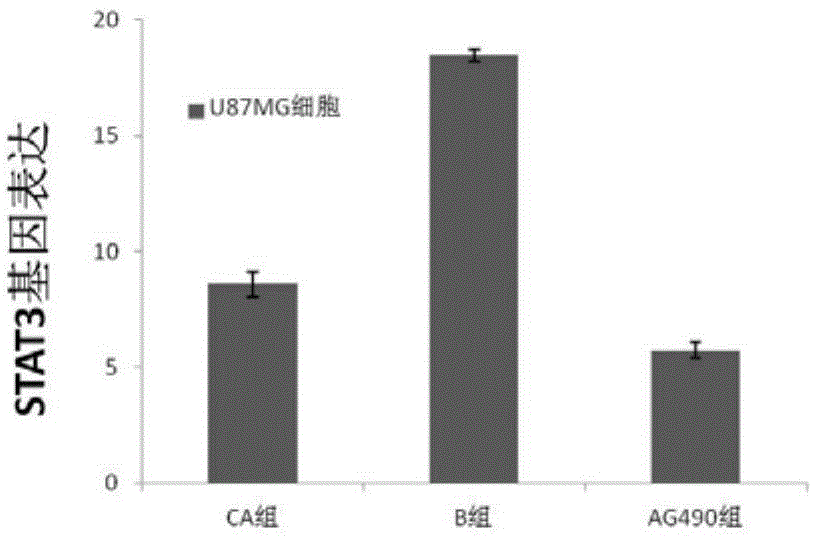
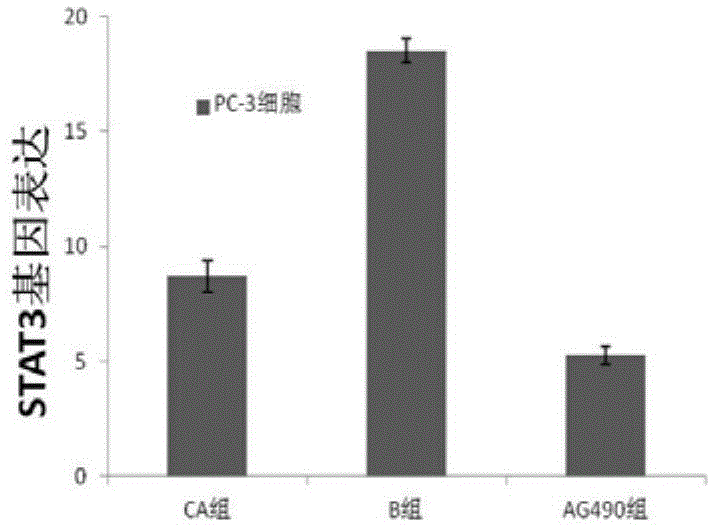
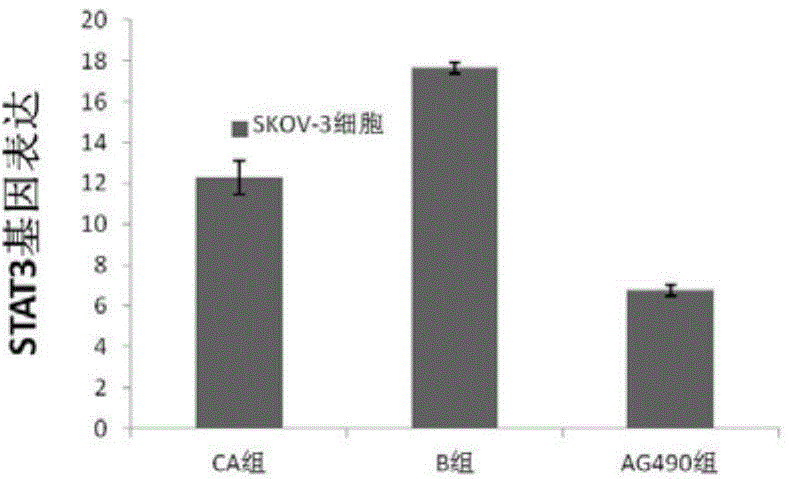
[0068] Example 3: Effect of cinnamic acid on STAT3 signaling pathway
[0069] 1. Experimental materials
[0070] 1.1 Experimental materials
[0071] Human malignant glioblastocytes (U87MG cells, malignant tumor cells of glioblastoma), human prostate cancer cells (PC-3 cells, malignant tumor cells of prostate cancer), human ovarian cancer cells (SKOV -3 cells, that is, malignant tumor cells of ovarian cancer), human-derived colorectal cancer cells (HCCT-116 cells, that is, malignant tumor cells of colorectal cancer), were routinely cultured according to the characteristics of various cells.
[0072] 1.2 Experimental drugs and equipment
[0073] Cinnamic acid (Aladdin), AG490 (Gene operation), mRNA extraction kit (Tiangen), cDNA first-strand synthesis kit (Tiangen), PCR instrument, etc. Among them, in this example, α-cyano-(3,4-hydroxy)N-benzyl styrylamine (AG490) was used as a positive control drug to investigate the effect of cinnamic acid on the STAT3 signaling pathway. A...
PUM
 Login to View More
 Abstract
Description
Claims
Application Information
 Login to View More