Preparation method for after-treatment hydrocracking catalyst
What is AI technical title?
AI technical title is built by Patsnap AI team. It summarizes the technical point description of the patent document.
A hydrocracking and catalyst technology, which is applied in the field of catalysis, can solve the problem that the active metal cannot reach a high accumulation layer, and achieve the effects of high selectivity, high hydrogenation activity, and high hydrogenation selectivity
Active Publication Date: 2015-12-30
CHINA NAT OFFSHORE OIL CORP +2
View PDF9 Cites 26 Cited by
Summary
Abstract
Description
Claims
Application Information
AI Technical Summary
This helps you quickly interpret patents by identifying the three key elements:
Problems solved by technology
Method used
Benefits of technology
Problems solved by technology
This method is mainly to achieve uniform dispersion of active metals, but uniformly dispersed active metals cannot achieve a high number of stacked layers, which is quite different from the formation of highly active hydrogenation active centers
Method used
the structure of the environmentally friendly knitted fabric provided by the present invention; figure 2 Flow chart of the yarn wrapping machine for environmentally friendly knitted fabrics and storage devices; image 3 Is the parameter map of the yarn covering machine
View more
Image
Smart Image Click on the blue labels to locate them in the text.
Viewing Examples
Smart Image
Click on the blue label to locate the original text in one second.
Reading with bidirectional positioning of images and text.
Smart Image
Examples
Experimental program
Comparison scheme
Effect test
Embodiment 1
[0030] (1) Carrier preparation
[0031] The method is the same as the preparation method in Comparative Example 1.
[0032] (2) Catalyst preparation
[0033] Take 10g of nickelnitrate and 29g of ammonium metatungstate, dissolve them in 70ml of aqueous solution, and then use the equal volume dipping method to immerse the W-Ni co-dipping solution on 80g of carrier A for 2 hours, dry at 110 °C for 6 hours, and bake at 350 °C for 2 hours. hours, the catalyst catC was prepared.
[0034] (3) Catalyst post-treatment
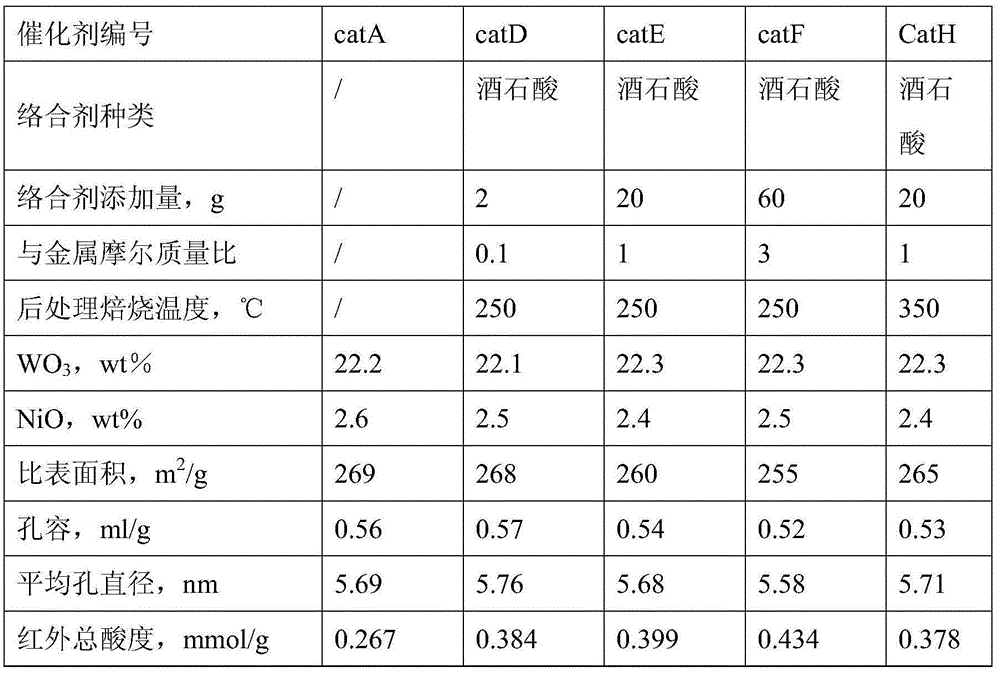
[0035] Dissolve 2g of tartaric acid in 15ml of water, then dilute to 70ml, and impregnate it onto 110g of catalyst catC by the equal volume dipping method, dry in the shade after 2 hours, dry at 100°C for 2 hours, and calcinate at 250°C for 2 hours to obtain catD.
Embodiment 2
[0037] (1) Carrier preparation
[0038] The method is the same as the preparation method in Comparative Example 1.
[0039] (2) Catalyst preparation
[0040] The method is the same as the preparation method in Example 1
[0041] (3) Catalyst post-treatment
[0042] Dissolve 20g of tartaric acid in 15ml of water, then dilute to 70ml, and impregnate it onto 110g of catalyst catC by the equal volume dipping method, dry in the shade after 2 hours, dry at 100°C for 2 hours, and calcinate at 250°C for 2 hours to obtain catE.
Embodiment 3
[0044] (1) Carrier preparation
[0045] The method is the same as the preparation method in Comparative Example 1.
[0046] (2) Catalyst preparation
[0047] The method is the same as the preparation method in Example 1
[0048] (3) Catalyst post-treatment
[0049] Dissolve 60g of tartaric acid in 15ml of water, then dilute to 70ml, and impregnate it on 110g of catalyst catC by the equal volume dipping method, dry in the shade after 2 hours, dry at 100°C for 2 hours, and calcinate at 250°C for 2 hours to obtain catF.
the structure of the environmentally friendly knitted fabric provided by the present invention; figure 2 Flow chart of the yarn wrapping machine for environmentally friendly knitted fabrics and storage devices; image 3 Is the parameter map of the yarn covering machine
Login to View More
PUM
Login to View More
Abstract
The invention discloses a preparation method for an after-treatment hydrocracking catalyst. The method includes the steps that 1, a hydrocracking catalyst carrier is prepared; 2, the catalyst carrier is steeped in steeping liquid containing active metal components and then dried and calcined at low temperature; 3, after matter capable of changing the arrangement of active metals is dissolved in a solvent according to a certain proportion, the catalyst obtained from the step 2 is steeped in the mixture; 4, materials obtained from the step 3 are dried and calcined for 1-10 hours at the low temperature of 150-400 DEG C, and the final after-treatment hydrocracking catalyst is obtained. The matter capable of changing the arrangement of the active metals is one or more of a phosphoric acid complexing agent, an alcohol amine complexing agent, an aminocarboxylic acid complexing agent, a hydroxy carboxylic acid complexing agent, an organic phosphonic acid complexing agent and a polyacrylic acid complexing agent. The after-treatment hydrocracking catalyst prepared through the method is higher in hydrogenation activity and hydrogenation selectivity, higher in selectivity for middle distillate, and suitable for treating the hydrocracking catalysts composed of various different metals.
Description
technical field [0001] The invention relates to the technical field of catalysis, in particular to a method for preparing a post-treatment type hydrocracking catalyst, in particular to processing high aromatic and heavy hydrocarbon raw materials, and can adjust the distribution of hydrogenation active components in the hydrocracking catalyst and Existing forms, in turn, methods for increasing the activity of hydrocracking catalysts. Background technique [0002] As the main solution to solve the problem of poor crude oil quality and relieve environmental pressure, hydrocracking technology has been paid more and more attention by refining and chemical enterprises. The core of hydrocracking is the hydrocracking catalyst, and the hydrocracking catalyst is a bifunctional catalyst that contains both an acidic component and a hydrogenation component. The hydrogenation activity is generally provided by metals from Group VIB and Group VIII in the periodic table; while the source of...
Claims
the structure of the environmentally friendly knitted fabric provided by the present invention; figure 2 Flow chart of the yarn wrapping machine for environmentally friendly knitted fabrics and storage devices; image 3 Is the parameter map of the yarn covering machine
Login to View More
Application Information
Patent Timeline
Application Date:The date an application was filed.
Publication Date:The date a patent or application was officially published.
First Publication Date:The earliest publication date of a patent with the same application number.
Issue Date:Publication date of the patent grant document.
PCT Entry Date:The Entry date of PCT National Phase.
Estimated Expiry Date:The statutory expiry date of a patent right according to the Patent Law, and it is the longest term of protection that the patent right can achieve without the termination of the patent right due to other reasons(Term extension factor has been taken into account ).
Invalid Date:Actual expiry date is based on effective date or publication date of legal transaction data of invalid patent.



 Login to View More
  Login to View More