
air propelled amphibious tidal boat
An air propulsion and tidal flat technology, applied in air propulsion components, ship propulsion, amphibious vehicles, etc., can solve problems such as unreliable work, affecting work efficiency, affecting cleaning, etc., to reduce resistance and wave slamming, and reduce viscosity Frictional resistance, the effect of increasing the contact area
- Summary
- Abstract
- Description
- Claims
- Application Information
AI Technical Summary
Problems solved by technology
Method used
Image

Examples
Embodiment Construction
[0031] The specific implementation manner of the present invention will be described below in conjunction with the accompanying drawings.
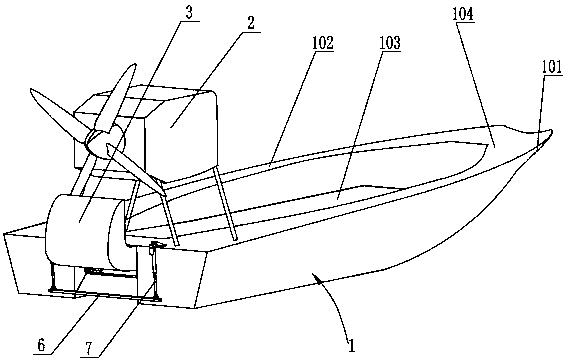
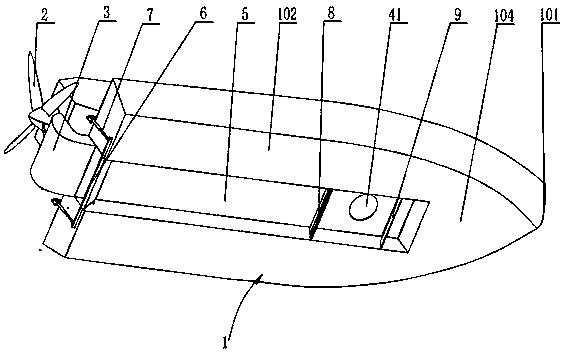
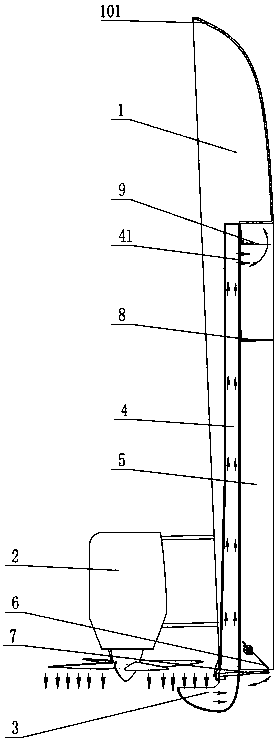
[0032] See figure 1 , figure 2 , image 3 , Figure 4 , the present invention includes a hull 1, an air propeller power unit 2 installed on the deck of the hull 1, the hull 1 is a single bow and double stern structure, and the bow 101 is a tapered bow with a "V" shape in cross section. The rear part of 101 is connected with two longitudinal monoliths 102 through a transition section 104 to form the hull 1. The two monoliths 102 are arranged symmetrically with a transverse interval between them. At the stern, the two monomers 102 are connected by the connecting bridge 103 on the upper part, and the two monomers 102, the connecting bridge 103 and the transition ship section 104 form a longitudinal cushioning channel 5 with both the bottom and the tail open, and the cushioning The rear opening of the channel 5 is provided with a movable ...
PUM
 Login to View More
 Abstract
Description
Claims
Application Information
 Login to View More