Yellow-green LED epitaxial structure with optimized reflective layer and preparation method thereof
What is AI technical title?
AI technical title is built by Patsnap AI team. It summarizes the technical point description of the patent document.
An epitaxial structure, yellow-green light technology, applied in the field of optoelectronics, can solve the problems of reducing the internal stress of the reflective layer, which has not been raised, and achieve the effects of reducing internal stress, improving light output rate, and high reflectance
Active Publication Date: 2019-09-06
Shandong Huaguang Optoelectronics Co. Ltd.
View PDF7 Cites 0 Cited by
Summary
Abstract
Description
Claims
Application Information
AI Technical Summary
This helps you quickly interpret patents by identifying the three key elements:
Problems solved by technology
Method used
Benefits of technology
Problems solved by technology
This invention mainly uses the doped wide barrier structure layer to improve product light efficiency and chip yield, but its DBR material is AlGaAs / AlAs, and no better material composition is proposed to reduce the internal stress of the reflective layer.
Method used
the structure of the environmentally friendly knitted fabric provided by the present invention; figure 2 Flow chart of the yarn wrapping machine for environmentally friendly knitted fabrics and storage devices; image 3 Is the parameter map of the yarn covering machine
View more
Image
Smart Image Click on the blue labels to locate them in the text.
Viewing Examples
Smart Image
Click on the blue label to locate the original text in one second.
Reading with bidirectional positioning of images and text.
Smart Image
Examples
Experimental program
Comparison scheme
Effect test
Embodiment 1
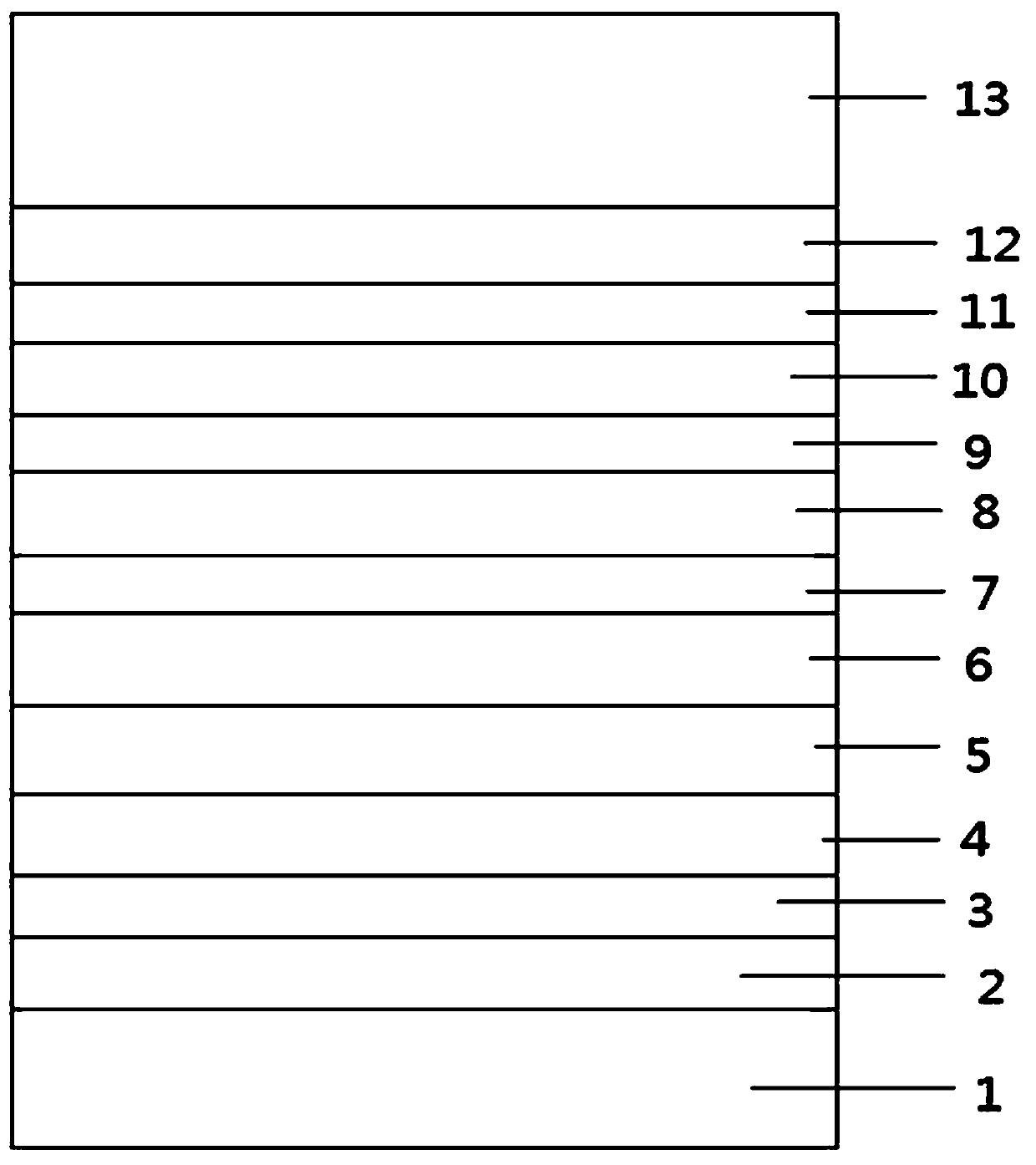
[0032] Preferably, the wavelength of AlGaAsP / AlAsP DBR layer I 4 is 600 nm, the wavelength of AlGaAsP / AlAsP DBR layer II 5 is 580 nm, and the wavelength of AlGaAsP / AlAsP DBR layer III 6 is 570 nm.
[0033] The present invention also relates to a method for preparing a yellow-green LED epitaxial structure with an optimized reflective layer, comprising the following steps:
[0034] a) Put the GaAs substrate (1) into the reaction chamber, and grow a layer of Al material in the temperature range of 300-800°C n Ga 1-n Al of As n Ga1 buffer layer (2), where the value of n is ≤0.99, and the carrier concentration is 1E17cm -3 -5E18cm -3 ;
[0035] b) Keep the temperature at 300-800°C, turn off the Al source, and turn on the pH 3 , at Al n A GaAsP buffer layer (3) is grown on the Ga1 buffer layer (2);
[0036] c) Adjust the temperature to 700-500°C, and feed the pH 3 , adjust the growth thickness growth reflection 600nm spectrum 1-30 pair material is Al x Ga 1-x AlAsP / AlGaAsP...
Embodiment 2
[0050] Preferably, the carrier concentration in step b) is 1E18cm -3 -5E18cm -3 , the carrier concentration in step c) is 1E17cm -3 -5E18cm -3 , the carrier concentration in step d) is 1E17cm -3 -5E18cm -3 , the carrier concentration in step e) is 1E17cm -3 -5E18cm -3 , the flow carrier concentration in step f) is 5E17cm -3 -1E18cm -3 , the carrier concentration in step k) is 1E18cm -3 -5E18cm -3 , the carrier concentration in step l) is 1E19cm -3 -9E19cm -3 .
Embodiment 3
[0052] Preferably, pH in step b) 3 The flow rate is 0.1-100sccm, and the pH in step c) 3 The flow rate is 0.1-100sccm, and the pH in step d) 3 Flow rate is 0.1-100sccm, pH in step e) 3 The flow rate is 0.1-100sccm.
the structure of the environmentally friendly knitted fabric provided by the present invention; figure 2 Flow chart of the yarn wrapping machine for environmentally friendly knitted fabrics and storage devices; image 3 Is the parameter map of the yarn covering machine
Login to View More
PUM
Login to View More
Abstract
The invention discloses a green-yellow light LED epitaxial structure with an optimal reflecting layer and a preparation method thereof. The green-yellow light LED epitaxial structure is provided witha GaAs substrate, an AlGaAs buffer layer, a GaAsP buffer layer, an AlGaAsP / AlAsP DBR layer I, an AlGaAsP / AlAsP DBR layer II, an AlGaAsP / AlAsP DBR layer III, an AlInP / AlGaInP DBR layer, an N-AlInP limiting layer, an AlGaInP N waveguide layer, an AlGaInP quantum well active layer, an AlGaIn P waveguide layer, an AlIn P limiting layer and a GaP window from bottom to top in sequence, the AlGaAsP / AlAsPDBR layers consist of an AlAsP / AlGaAsP DBR layer I, an AlAsP / AlGaAsP DBR layer II and an AlAsP / AlGaAsP DBR layer III to form a compound Bragg reflector layer, the light, reflected to a substrate, ofan active layer is reflected and emitted out from the top by using a periodic stratified structure consisting of two materials with different refractive indexes, so that the light extracting rate is greatly improved, the inner stress of the reflector layer is effectively reduced through the intervention of micro PH3, the green-yellow light LED epitaxial structure has relatively high reflectivity,and long-time electrification reliability of a diode is realized.
Description
technical field [0001] The invention relates to the field of optoelectronic technology, in particular to a yellow-green LED epitaxial structure with an optimized reflection layer and a preparation method thereof. Background technique [0002] LED is the abbreviation of Light Emitting Diode (Light Emitting Diode). [0003] In the PN junction of some semiconductor materials, the energy released during the recombination of carriers will be emitted in the form of light, which directly converts electrical energy into light energy. Light-emitting recombination is formed by injecting carriers, and diodes made using this injection-type electroluminescent principle are light-emitting diodes, commonly known as LEDs. The AlGaInP material in the red LED can be lattice-matched with the GaAs substrate and with the change of the Al composition, the direct bandgap can be changed from 1.9cV to 2.3cv, and the wavelength can be changed from 560nm to 650nm, thereby realizing the emission from ...
Claims
the structure of the environmentally friendly knitted fabric provided by the present invention; figure 2 Flow chart of the yarn wrapping machine for environmentally friendly knitted fabrics and storage devices; image 3 Is the parameter map of the yarn covering machine
Login to View More
Application Information
Patent Timeline
Application Date:The date an application was filed.
Publication Date:The date a patent or application was officially published.
First Publication Date:The earliest publication date of a patent with the same application number.
Issue Date:Publication date of the patent grant document.
PCT Entry Date:The Entry date of PCT National Phase.
Estimated Expiry Date:The statutory expiry date of a patent right according to the Patent Law, and it is the longest term of protection that the patent right can achieve without the termination of the patent right due to other reasons(Term extension factor has been taken into account ).
Invalid Date:Actual expiry date is based on effective date or publication date of legal transaction data of invalid patent.


 Login to View More
  Login to View More