Population distribution spatial-temporal evolution and cognition considering urban pattern characteristics

A technology of population distribution and time-space evolution, applied in complex mathematical operations, instruments, computer components, etc., can solve problems such as inconsistency and uncertainty between demographic data and driving factor indicators, and achieve the effect of optimizing the model structure

CN110458048AInactive Publication Date: 2019-11-15NANJING FORESTRY UNIV
6 Cites 26 Cited by

Patent Information

Authority / Receiving Office
CN · China
Patent Type
Applications(China)
Current Assignee / Owner
Publication Date
2019-11-15
Estimated Expiration
Not applicable · inactive patent

Smart Images

  • Figure 1
    Figure 1
  • Figure 2
    Figure 2
  • Figure 3
    Figure 3
Patent Text Reader

Abstract

The invention relates to a population distribution spatial-temporal evolution and cognition method considering urban pattern characteristics. The population distribution spatial-temporal evolution andcognition method comprises the following steps: 1) carrying out scale conversion of multi-source and multi-scale remote sensing images; 2) extracting urban information based on the multi-source remote sensing image; 3) analyzing a multi-scale urban pattern-structure-function spatial-temporal relationship; 4) carrying out spatial-temporal correlation and coupling analysis on population distribution and urban characteristics; 5) constructing a population distribution simulation and prediction system considering urban pattern characteristics; and 6) carrying out spatial-temporal monitoring and cognition on population distribution in different scenes. The population distribution spatial-temporal evolution and cognition method has the advantages that population general survey and statistical data, multi-scale remote sensing data and multi-source land utilization / coverage data are used as data sources; the spatial-temporal characteristics and the evolution rule of the multi-scale urban spatial pattern are studied, and the population distribution spatial-temporal evolution model considering the town characteristic pattern is constructed, and the boundary of the population distribution density is finely described from the multi-level spatial scale, and a theoretical basis and a technical support are provided for population resource utilization and policy adjustment and social and economic resource allocation.
Need to check novelty before this filing date? Find Prior Art

Description

technical field

[0001] The invention relates to the spatial-temporal evolution and cognition of population distribution in consideration of urban pattern characteristics, and belongs to the technical field of environmental monitoring and protection. Background technique

[0002] Under the long-term combined effect of multiple factors such as natural geographical environment, social history, and economic development, it is crucial to clarify the current population distribution pattern in China and its temporal-spatial coupling with the natural environment and the characteristics of temporal-spatial evolution to solve many human-land conflicts and social problems. role. At the same time, as a country with a large population, the rational development of human resources and the redistribution of population space have become topics of common concern to the general public. Changes in the urban pattern continue to affect the spatial distribution of the urban population. It is an ...

Examples

Embodiment Construction

[0107] Below in conjunction with accompanying drawing, technical scheme of the present invention is further described

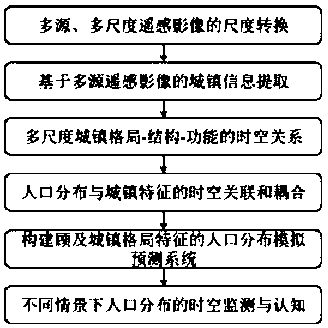
[0108] The temporal and spatial evolution and cognition of population distribution taking into account the characteristics of the urban pattern include the following steps:

[0109] (1) Scale conversion of multi-source, multi-scale remote sensing images;

[0110] (2) Urban information extraction based on multi-source remote sensing images;

[0111] (3) Spatio-temporal relationship analysis of multi-scale urban pattern-structure-function;

[0112] (4) Time-space correlation and coupling analysis of population distribution and urban characteristics;

[0113] (5) Build a population distribution simulation and prediction system that takes into account the characteristics of the urban pattern;

[0114] (6) Spatio-temporal monitoring and cognition of population distribution under different scenarios.

[0115] (1) Scale conversion of multi-source and multi-scale...