Compensation method of Damman raster splitting beam and angle dispersion of laser pulse

A Daman grating and femtosecond laser technology, applied in the field of femtosecond laser, can solve the problems of different diffraction angles and so on

CN1564401AInactive Publication Date: 2005-01-12SHANGHAI INST OF OPTICS & FINE MECHANICS CHINESE ACAD OF SCI
0 Cites 6 Cited by

Patent Information

Authority / Receiving Office
CN · China
Patent Type
Applications(China)
Current Assignee / Owner
Publication Date
2005-01-12
Estimated Expiration
Not applicable · inactive patent

Smart Images

  • Figure 1
    Figure 1
  • Figure 2
    Figure 2
  • Figure 3
    Figure 3
Patent Text Reader

Abstract

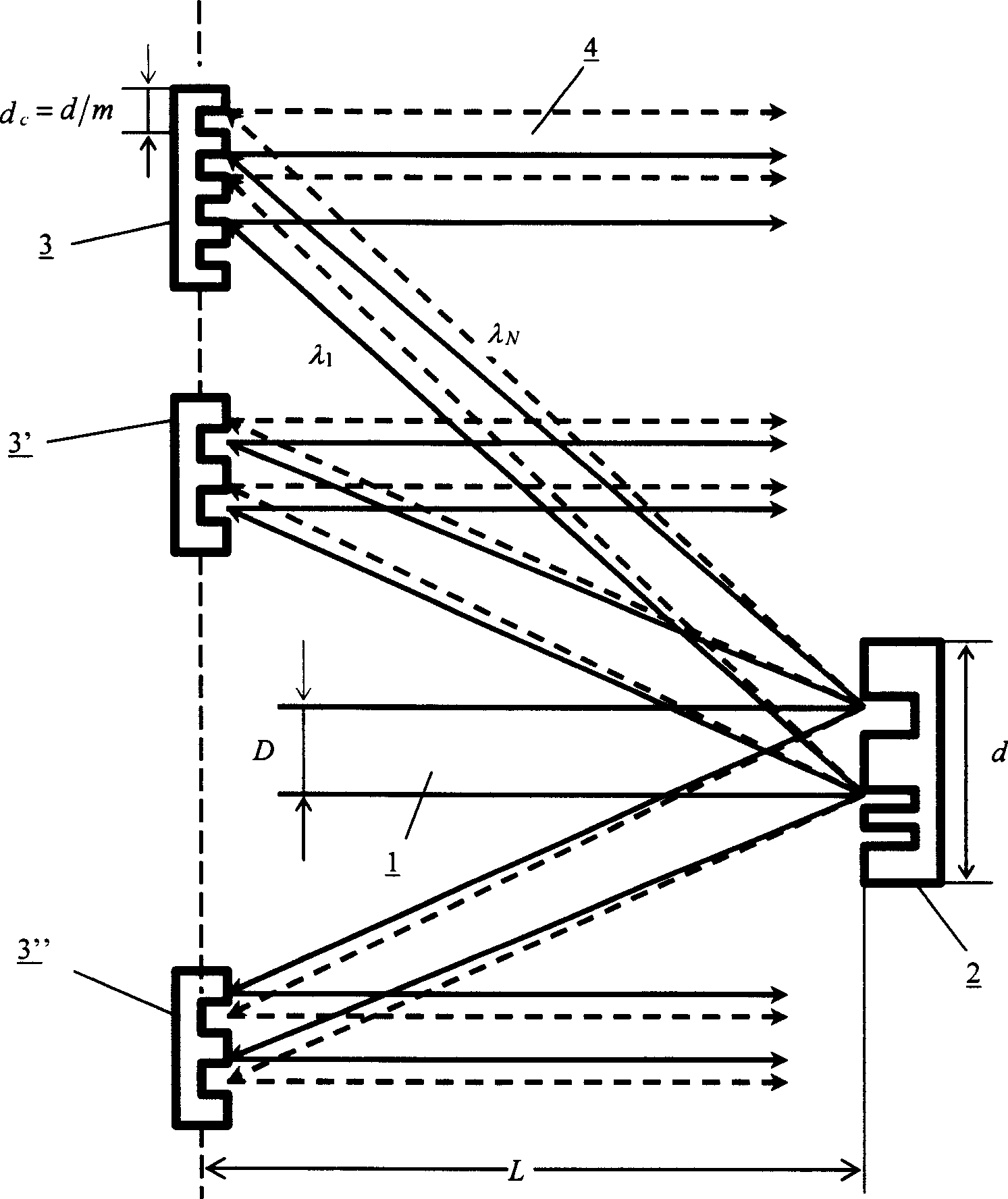
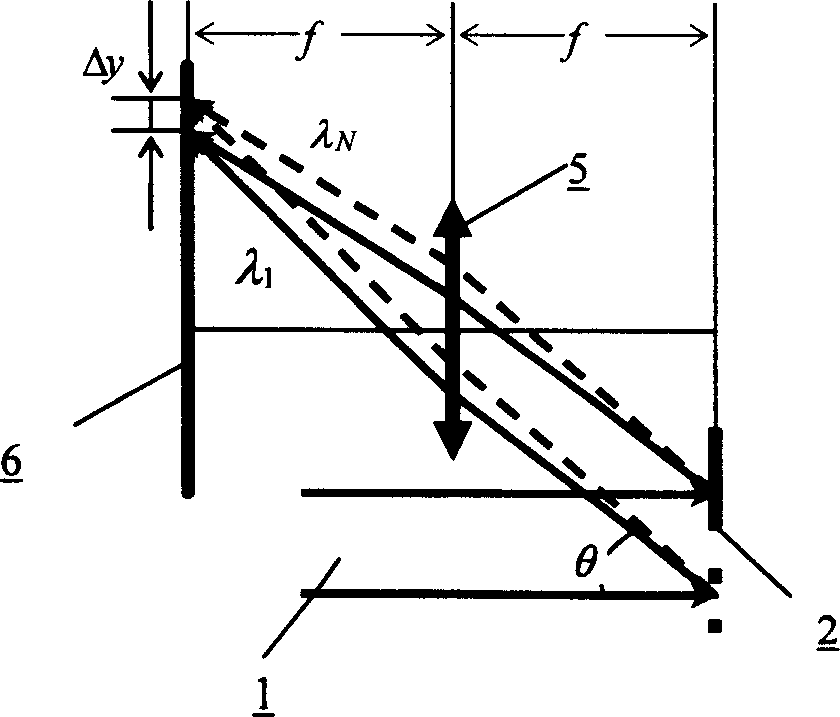
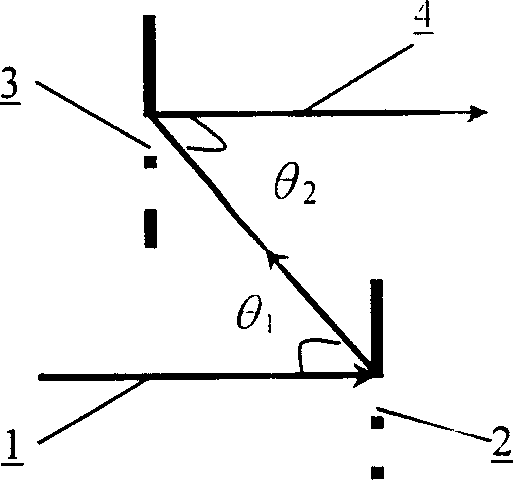
The method includes following steps: (1) based on need of beam-splitting number, selecting a piece of Daman grating to split laser pulse in femtosecond in order to guarantee vertical incidence of light beam; split diffracted beam in m order of diffraction passing through a compensation grating, whose space cycle is 1 / m of space cycle of Daman grating, arranged in parallel in order to eliminate difference of different diffraction angle of each components of frequency spectrum at the order of diffraction; (2) vertical distance between compensation grating and Daman grating is ensured to separate light beams in each order of diffraction thoroughly; (3) repeating step (2) in order to compensate all diffracted beams split. The method eliminates angular dispersion of each light beam split. Thus, pulse width and shape of light beam are kept in about 100fs range.
Need to check novelty before this filing date? Find Prior Art

Description

Technical field:

[0001] The invention relates to a femtosecond laser, in particular to a Damman grating beam splitting and angular dispersion compensation method of a femtosecond laser pulse. Background technique:

[0002] The Damman grating is a binary phase grating that splits the incident monochromatic light into an array of equal light intensity and equal space distance, and is modulated according to the position of the spatial phase transformation point (see prior art [1, 2] Opt.Commun .3, H. Dammann, 312-315 (1971); Opt. Acta 24, H. Dammann, 505-515 (1977)). The manufacture of this kind of grating introduces large-scale integrated circuit technology into the field of optics and lays the foundation for the development of micro-optics. The appearance of the even lattice Damman grating (referring to the prior art [3] J.Opt.Soc.Am.A 9 (3), R.L.Morrison, 464-471 (1992)), can remove the zero-order diffracted light, so that Facilitates the use of reflective gratings. [00...

Examples

Embodiment approach example 1

[0062] Using the above compensation principle, compensate each beam after beam splitting with 1×8 even-numbered Damman grating:

[0063] 1. Preparation:

[0064] A 1×8 even-numbered Damman grating with a space period of d=100um is fabricated. The design parameters of the spatial position of the phase transformation point of a Daman grating (100um) are (6.19, 17.654, 20.858, 31.997, 50, 56.19, 67.654, 70.858, 81.997, 100)um; the production space period is 100um, 100 / 3um, 100 / 5um, 100 / 7um compensation grating (multi-step or blazed grating). Both types of gratings can be manufactured as transmissive or reflective.

[0065] A femtosecond laser beam with a central wavelength of 780nm, a bandwidth of about 10nm, a pulse repetition rate of 89MHz, and a pulse width of about 100fs is used.

[0066] 2. The femtosecond laser beam is vertically incident on a 1×8 even-numbered Damman grating;

[0067] 3. At a distance of 350mm from the Damman grating, place compensation gratings with ...