Supercharge Your Innovation With Domain-Expert AI Agents!

Airborne rooting and callusing of cuttings

a cuttings and airborne technology, applied in the field of airborne rooting and callusing of cuttings, can solve the problems of increasing the risk of damage or loss of products, plants cannot be imported in soil, and the importation of plants is difficul

Active Publication Date: 2022-08-23
DUMMEN GRP BV
View PDF9 Cites 0 Cited by
  • Summary
  • Abstract
  • Description
  • Claims
  • Application Information

AI Technical Summary

Benefits of technology

This method enables cost-effective, large-scale rooting of cuttings, reducing handling risks and space requirements while maintaining high root development efficiency and product quality, even for recalcitrant species, and allows for subsequent planting in a growth medium.

Problems solved by technology

However, U.S. Department of Agriculture regulations limit the importation of plants.
In particular, plants cannot be imported in soil.
Thus, imported flowering ornamentals are typically unrooted cuttings.
This extra step, allowing for root growth prior to commercial sale, is time consuming, requires additional space that could be used for other horticultural purposes, is costly, and the extra handling of cuttings increases the risk of damage or loss of product.
While hydroponics is known, the process can be costly and time consuming, and hydroponic methods can increase susceptibility to and transmission of pathogens.

Method used

the structure of the environmentally friendly knitted fabric provided by the present invention; figure 2 Flow chart of the yarn wrapping machine for environmentally friendly knitted fabrics and storage devices; image 3 Is the parameter map of the yarn covering machine
View more

Image

Smart Image Click on the blue labels to locate them in the text.
Viewing Examples
Smart Image
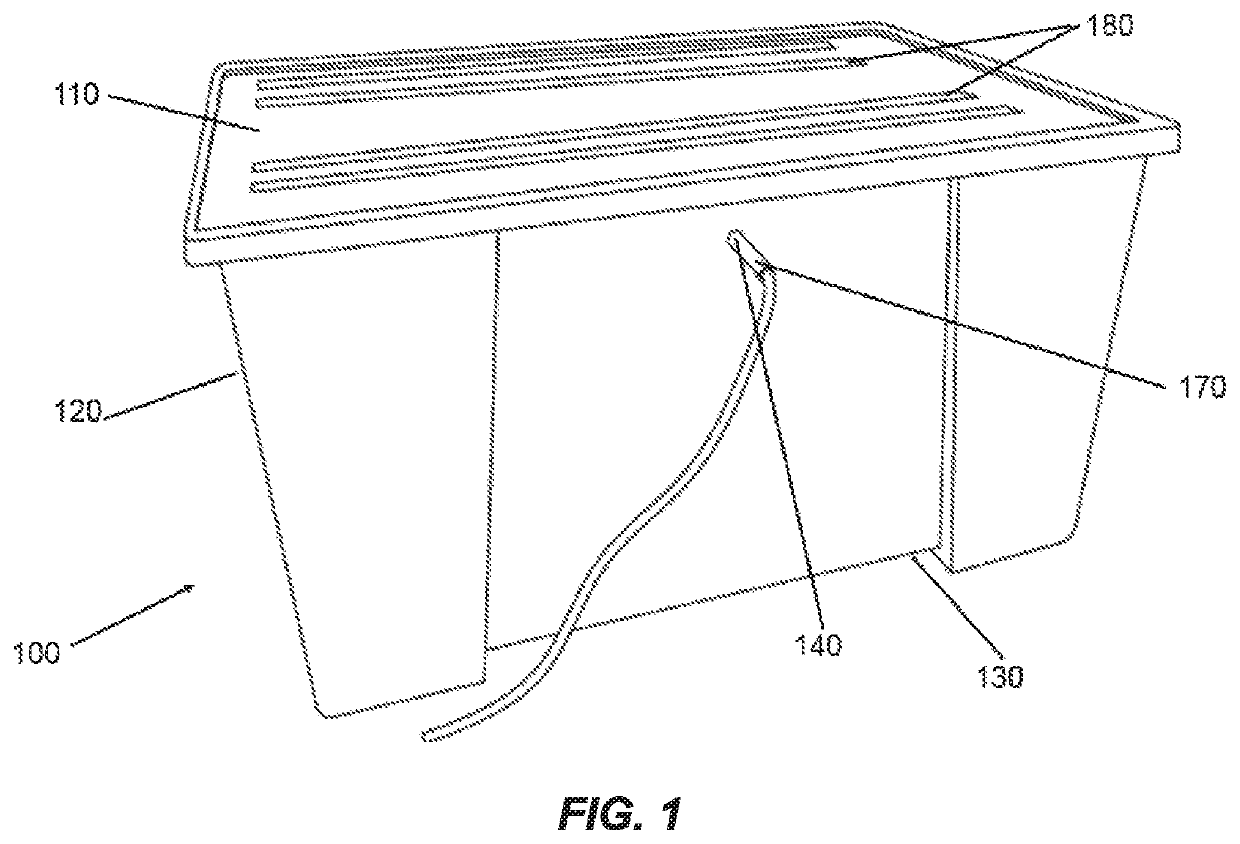
  • Airborne rooting and callusing of cuttings
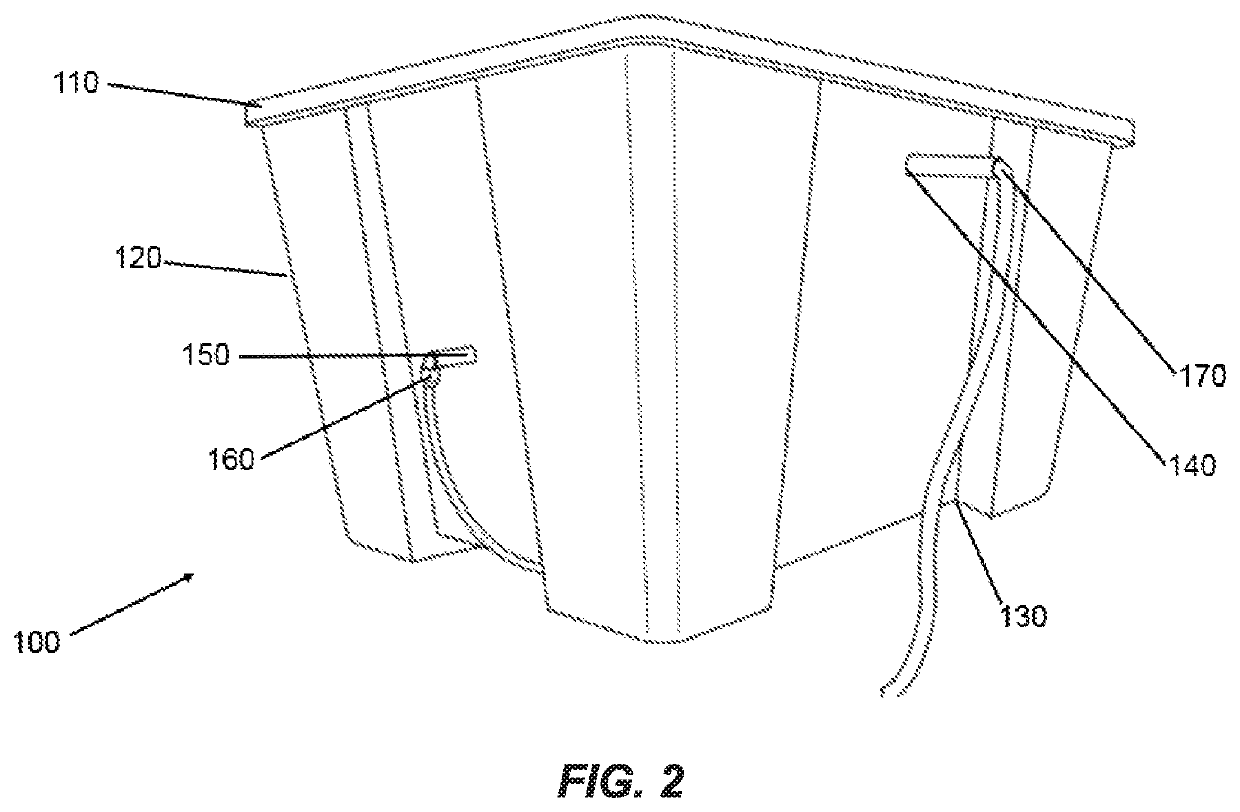
  • Airborne rooting and callusing of cuttings
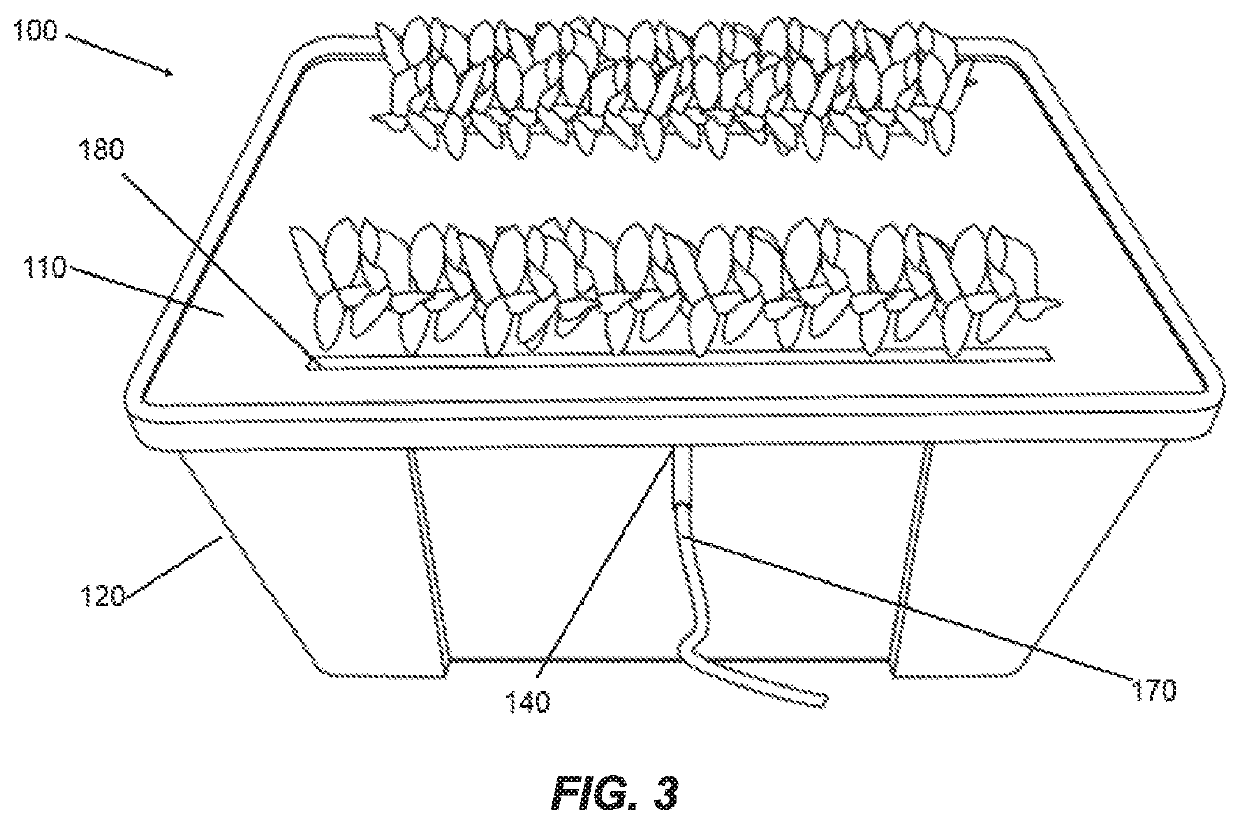
  • Airborne rooting and callusing of cuttings

Examples

Experimental program
Comparison scheme
Effect test

example 2

[0117]Styrofoam plates in which small and deep gutters were formed were used at a production farm in El Salvador. 51-receptacle strips were utilized. The strips had two types of retaining extensions: pointed and rounded. Strips with pointed retaining extensions were generally used for species of the vast majority of genera tested (e.g. Bacopa, Bidens, Coleus, Impatiens, Lobularia, Lobelia, Chamaesyce, Scaevola, Lysimachia, Portulaca, Calibrachoa, Verbena), and strips with rounded retaining extensions were used for Petunia, as the stems of Petunia cuttings are considerably softer. The width of the gutters was similar to the width of the strips. Friction fit maintained the strips in place and well above the bottom of the gutters in which water was retained, which created a sufficiently humid environment to support root development, but also avoided any contact of the basal portion of the unrooted cuttings with water.

[0118]In addition, Petunia were also kept on tables with gutters with...

the structure of the environmentally friendly knitted fabric provided by the present invention; figure 2 Flow chart of the yarn wrapping machine for environmentally friendly knitted fabrics and storage devices; image 3 Is the parameter map of the yarn covering machine
Login to View More

PUM

No PUM Login to View More

Abstract

Provided herein are devices, systems, and methods for airborne rooting and / or callusing of cuttings. The device includes a container defining an interior that can be humidified to allow for development of calluses or roots.

Description

CROSS-REFERENCE TO RELATED APPLICATIONS[0001]This application is the United States national phase of International Application No. PCT / IB2019 / 050495 filed Jan. 21, 2019 and claims priority to U.S. Provisional Patent Application Nos. 62 / 620,206 filed Jan. 22, 2018, 62 / 630,419 filed Feb. 14, 2018, and 62 / 673,314 filed May 18, 2018, the disclosures of which are hereby incorporated by reference in their entirety.BACKGROUND OF THE INVENTIONField of the Invention[0002]Provided herein are devices, systems, and methods for generating calluses and / or roots on unrooted cuttings.[0003]In particular, provided herein are devices, systems, and methods for airborne generation of roots on unrooted cuttings, without the need for or use of a growth medium.Description of Related Art[0004]In the flowering ornamental plant industry, commercial plant products are typically generated through asexual reproductions of a particular plant or plants having desirable traits. These asexual reproductions take the...

Claims

the structure of the environmentally friendly knitted fabric provided by the present invention; figure 2 Flow chart of the yarn wrapping machine for environmentally friendly knitted fabrics and storage devices; image 3 Is the parameter map of the yarn covering machine
Login to View More

Application Information

Patent Timeline
no application Login to View More
Patent Type & Authority Patents(United States)
IPC IPC(8): A01G31/02A01H4/00A01N3/00
CPCA01G31/02A01H4/008A01N3/00A01G31/00Y02P60/21
Inventor WISMANS, PERRY TH. J. G.VAN DEN HEUVEL, J. F. J. M.
Owner DUMMEN GRP BV
Features
  • R&D
  • Intellectual Property
  • Life Sciences
  • Materials
  • Tech Scout
Why Patsnap Eureka
  • Unparalleled Data Quality
  • Higher Quality Content
  • 60% Fewer Hallucinations
Social media
Patsnap Eureka Blog
Learn More