
System and method of assessment of the efficacy of treatment of neurological disorders using the electroencephalogram
a neurological disorder and electroencephalogram technology, applied in the field of neurological and psychological disorders, can solve problems such as the decrease of eeg signal power
- Summary
- Abstract
- Description
- Claims
- Application Information
AI Technical Summary
Benefits of technology
Problems solved by technology
Method used
Image

Examples
Embodiment Construction
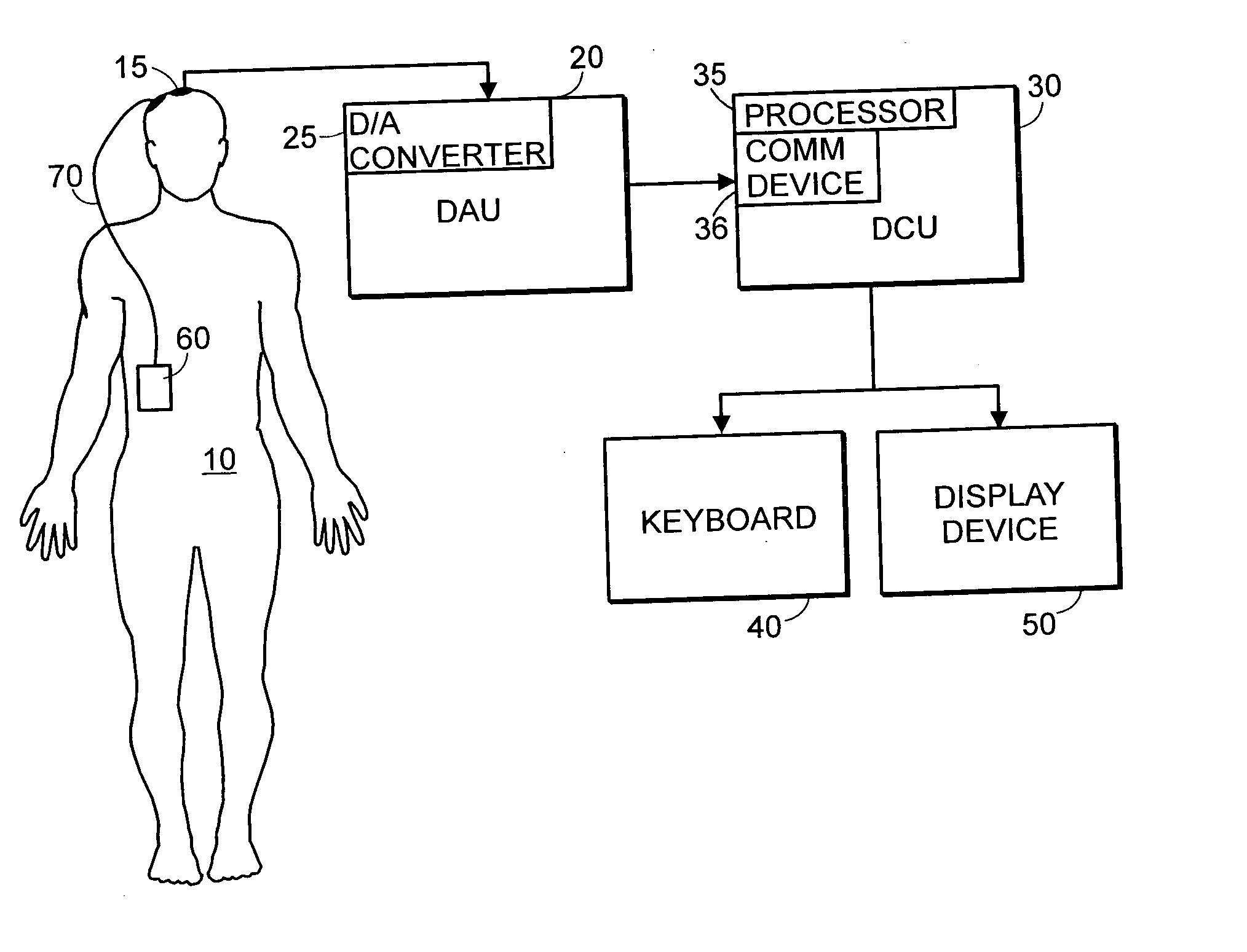
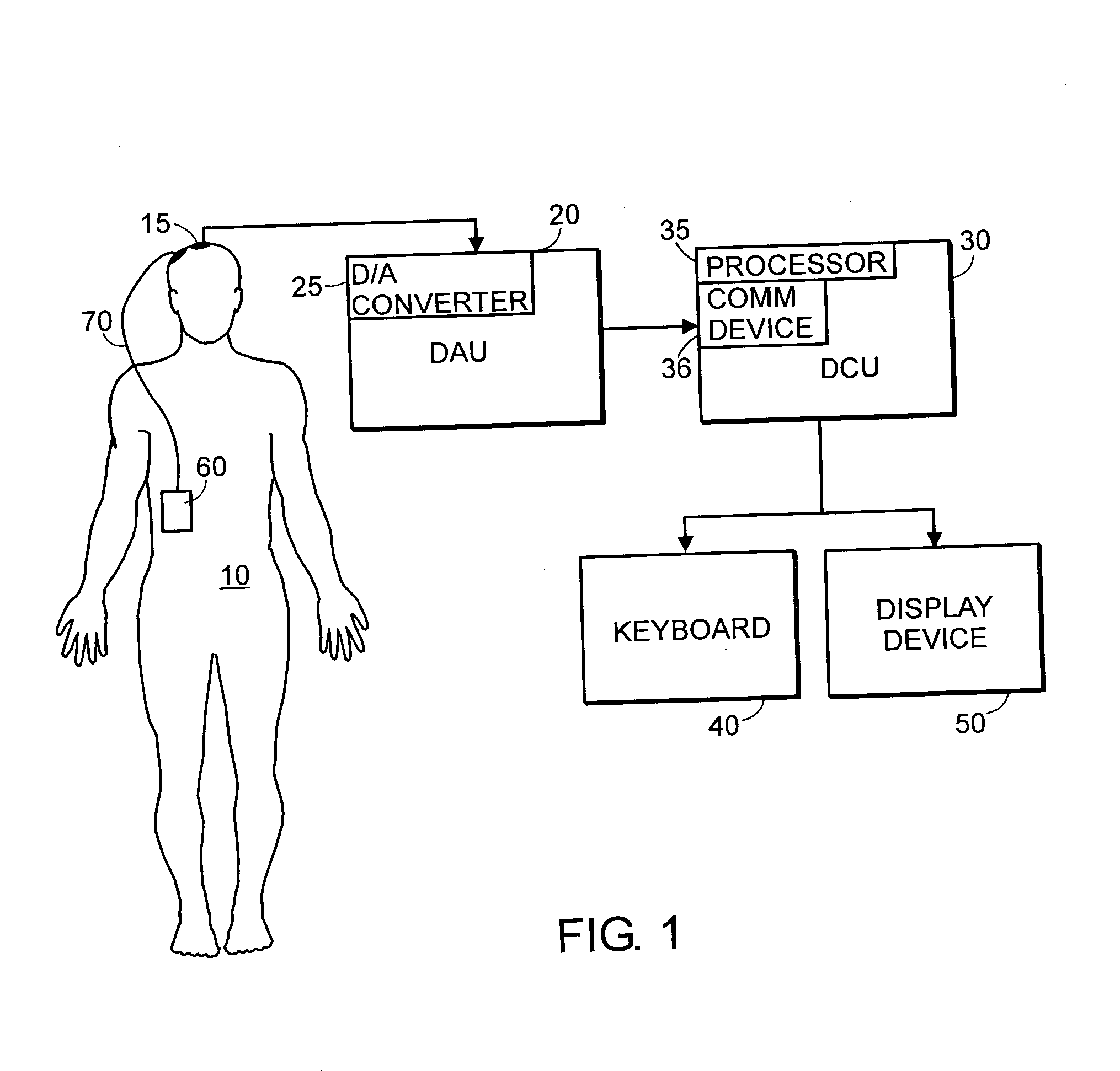
The invention described herein is a method of assessing the efficacy of treatment of neurological and psychiatric disorders by assessing changes in neuronal activity as manifested in the EEG. A particular embodiment of the invention involves a system for assessing the effect of the electrical stimulation provided by a neurostimulator 60 connected to a patient 10 via a stimulating electrode lead 70 (FIG. 1). The system incorporates a Data Acquisition Unit (DAU) 20 used to acquire a subject's EEG signal for subsequent processing. The DAU 20 typically consists of a computer system with an integral analog-to-digital (A-D) converter 25 and a set of electrodes 15 that are placed on the scalp of a subject 10. The A-D converter is used to transform analog EEG signals obtained from a set of surface electrodes into a sampled set of signal values that may then be analyzed by the computer of the Data Computation Unit (DCU) 30. The DCU 30 incorporates a processor 35 and a communications device ...
PUM
 Login to View More
 Abstract
Description
Claims
Application Information
 Login to View More