
Cardiac harness for treating congestive heart failure and for defibrillating and/or pacing/sensing
a heart failure and harness technology, applied in the field of cardiac harnesses, can solve the problems of distressed cells that are less able to deal with the stresses of expansion and contraction, each hinge providing substantially unidirectional elasticity, and cells that are distressed and lose at least some contractility
- Summary
- Abstract
- Description
- Claims
- Application Information
AI Technical Summary
Benefits of technology
Problems solved by technology
Method used
Image

Examples
Embodiment Construction
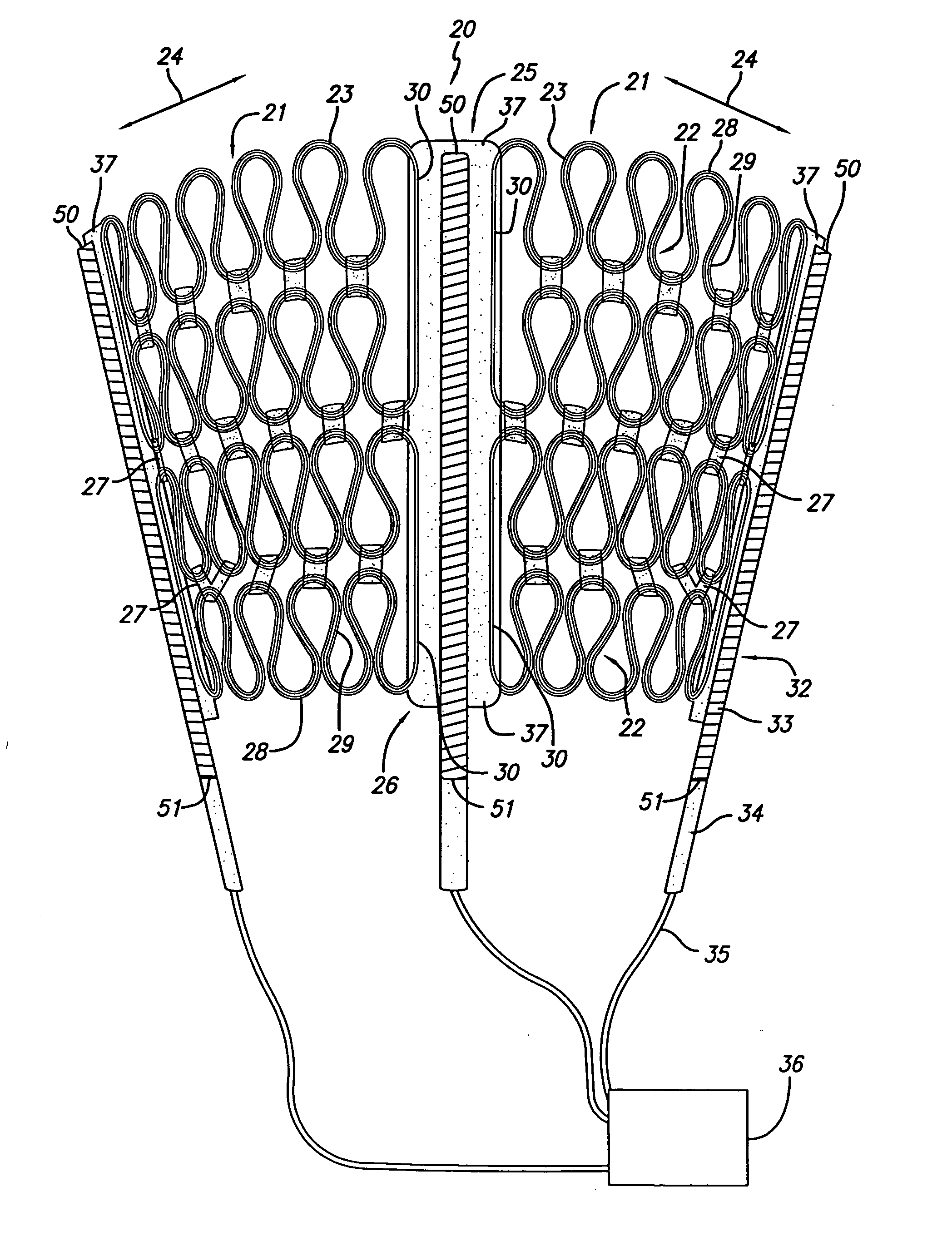
[0076] This invention relates to a method and apparatus for treating heart failure. It is anticipated that remodeling of a diseased heart can be resisted or even reversed by alleviating the wall stresses in such a heart. The present invention discloses embodiments and methods for supporting the cardiac wall and for providing defibrillation and / or pacing functions using the same system. Additional embodiments and aspects are also discussed in Applicants' co-pending application entitled “Multi-Panel Cardiac Harness” U.S. Ser. No. 60 / 458,991 filed Mar. 28, 2003, the entirety of which is hereby expressly incorporated by reference.
Prior Art Devices
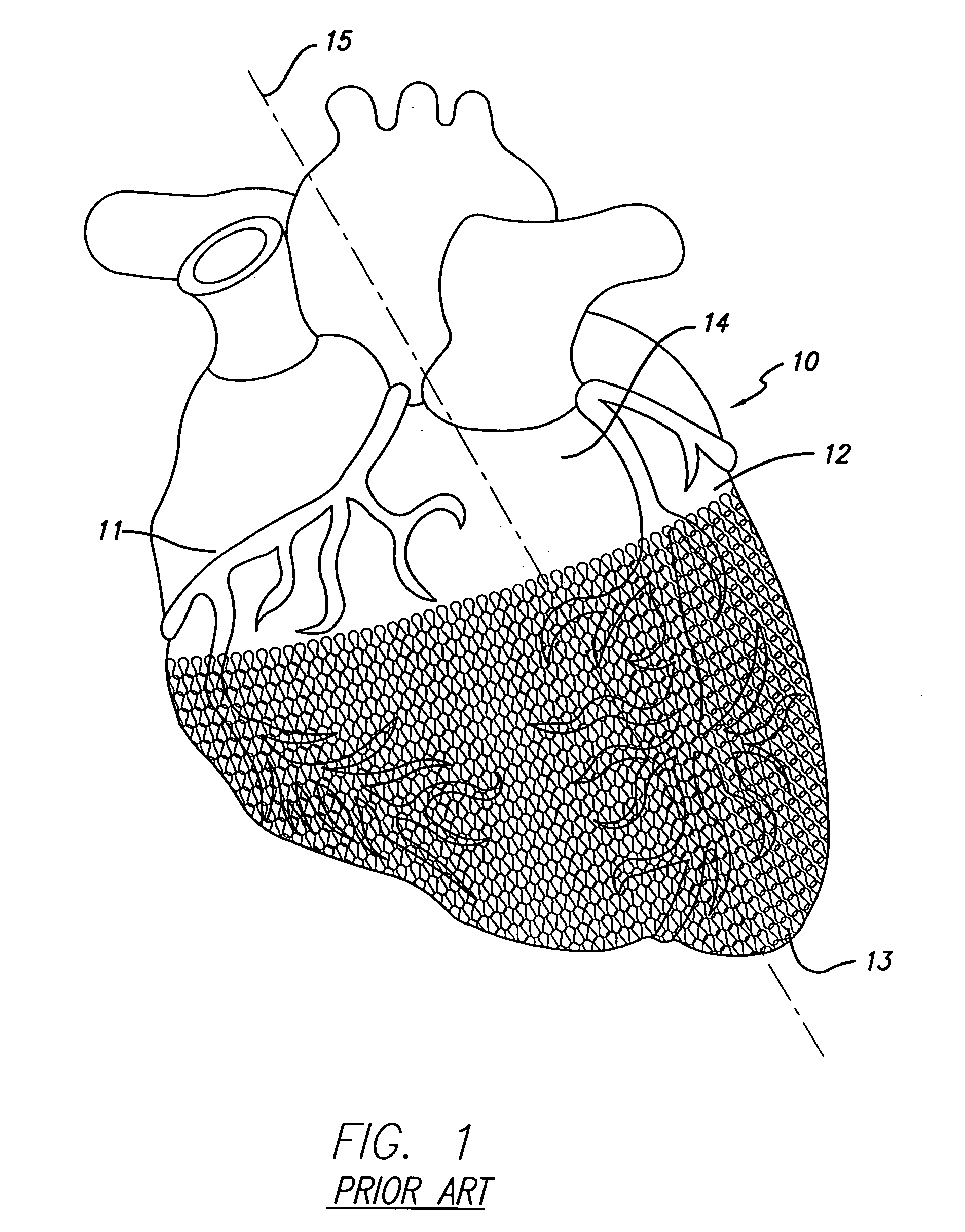
[0077]FIG. 1 illustrates a mammalian heart 10 having a prior art cardiac wall stress reduction device in the form of a harness applied to it. The harness surrounds a portion of the heart and covers the right ventricle 11, the left ventricle 12, and the apex 13. For convenience of reference, longitudinal axis 15 goes through the apex and the ...
PUM
 Login to View More
 Abstract
Description
Claims
Application Information
 Login to View More