
Synergistic Effects of Nuclear Transcription Factor NF-kB Inhibitors and Anti-Neoplastic Agents
a transcription factor and nuclear technology, applied in the field of cancer treatment, can solve the problems of insufficient clinical strategies, ineffective curative therapy for breast cancer patients with advanced metastatic disease, etc., and achieve the effect of potentiating the effect of paclitaxel
- Summary
- Abstract
- Description
- Claims
- Application Information
AI Technical Summary
Benefits of technology
Problems solved by technology
Method used
Image

Examples
example 1
Paclitaxel-Induced NF-κB Activation in Breast Cancer Cell
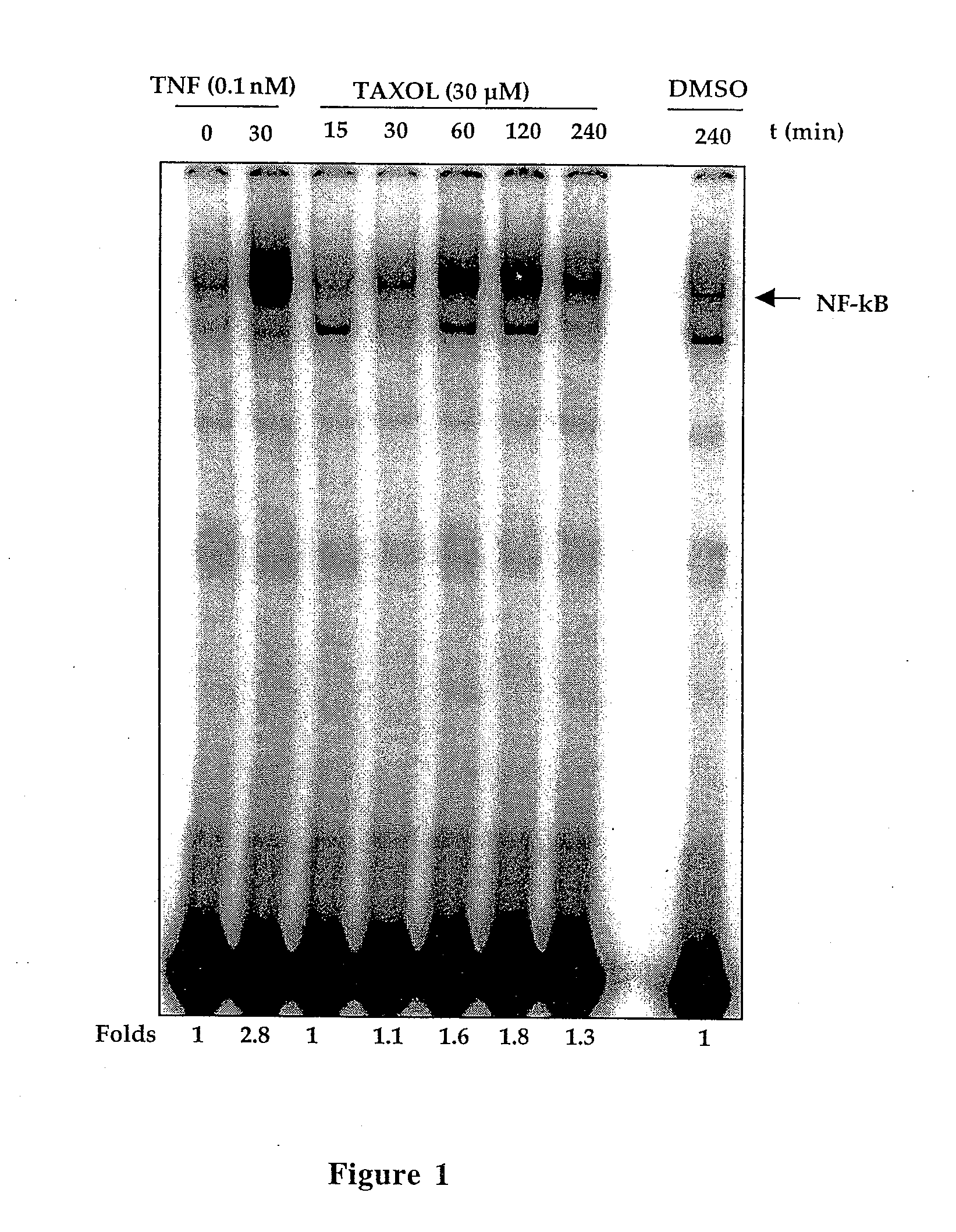
[0043] To demonstrate that curcumin inhibits paclitaxel-induced NF-κB activation in breast cancer cells, it is essential to know how paclitaxel activates NF-κB. Although several reports have demonstrated that paclitaxel activates NF-κB in different cell types, the mechanism is not understood (18-21). While most reports showed NF-κB activation by paclitaxel within 30 minutes (18-20), a recent report showed activation at 12 hours (21). Whether paclitaxel-induced NF-κB activation occurs through the activation of IκBα kinase (IKK) and phosphorylation of IκBα is also not known.
[0044] The upstream signaling elements to IKK through which paclitaxel activates NF-kB are known. TNF-induced NF-κB activation is mediated through sequential recruitment of the TNF receptor, TRADD, TRAF2, NIK and IKK (106). Different agents activate NF-κB through different mechanisms (107). For instance, TNF-induced NFκB activation requires phosphorylation...
example 2
Suppression of Paclitaxel-Induced NF-κB Activation by Curcumin
[0046] Curcumin suppresses NF-κB activation induced by TNF, H2O2 and phorbol ester in myeloid (74) and endothelial cells (84). Different agents activate NF-κB through different mechanisms (106-108). Curcumin blockade paclitaxel-induced NF-κB activation in breast cancer cells has not been shown before.
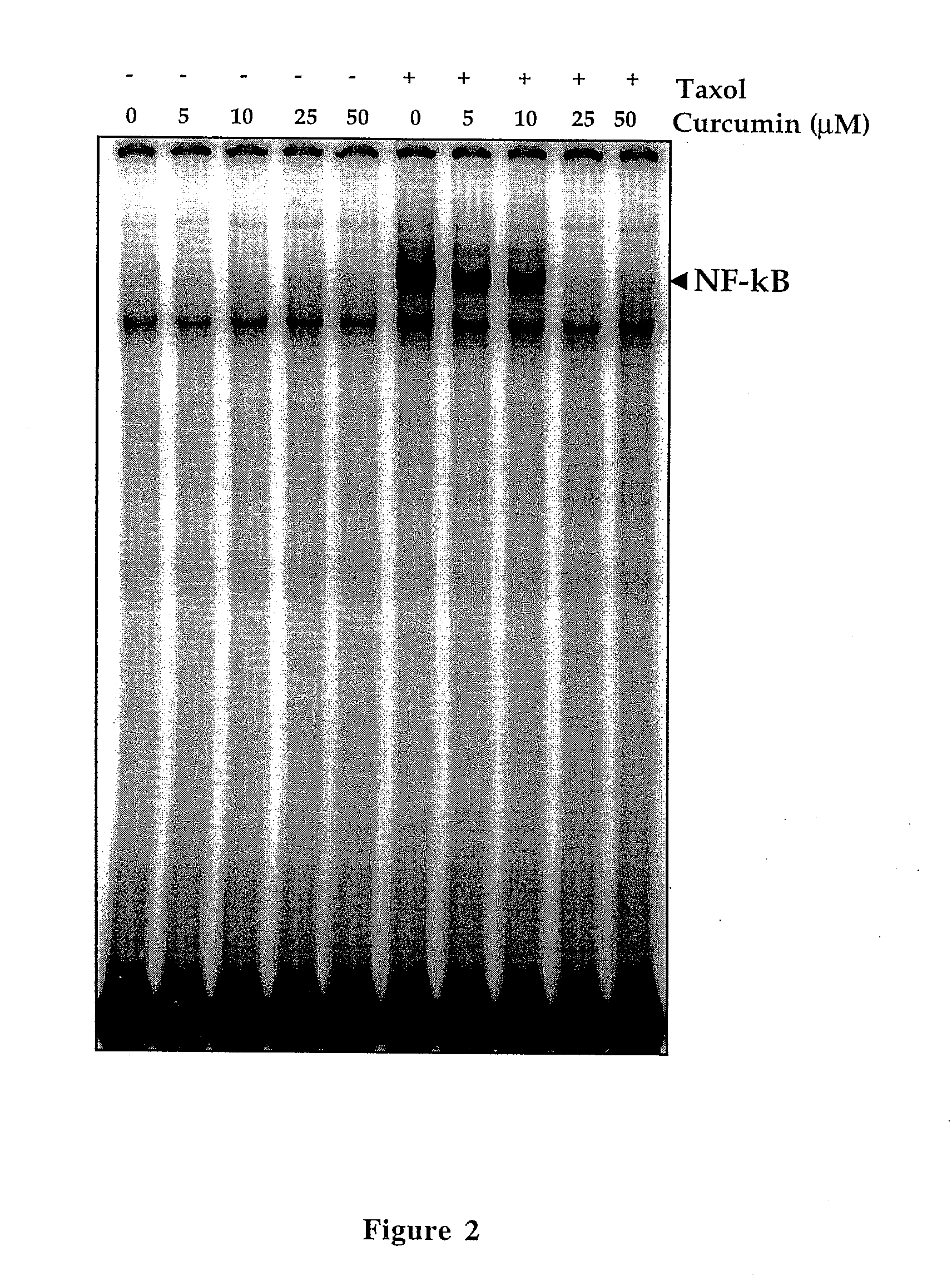
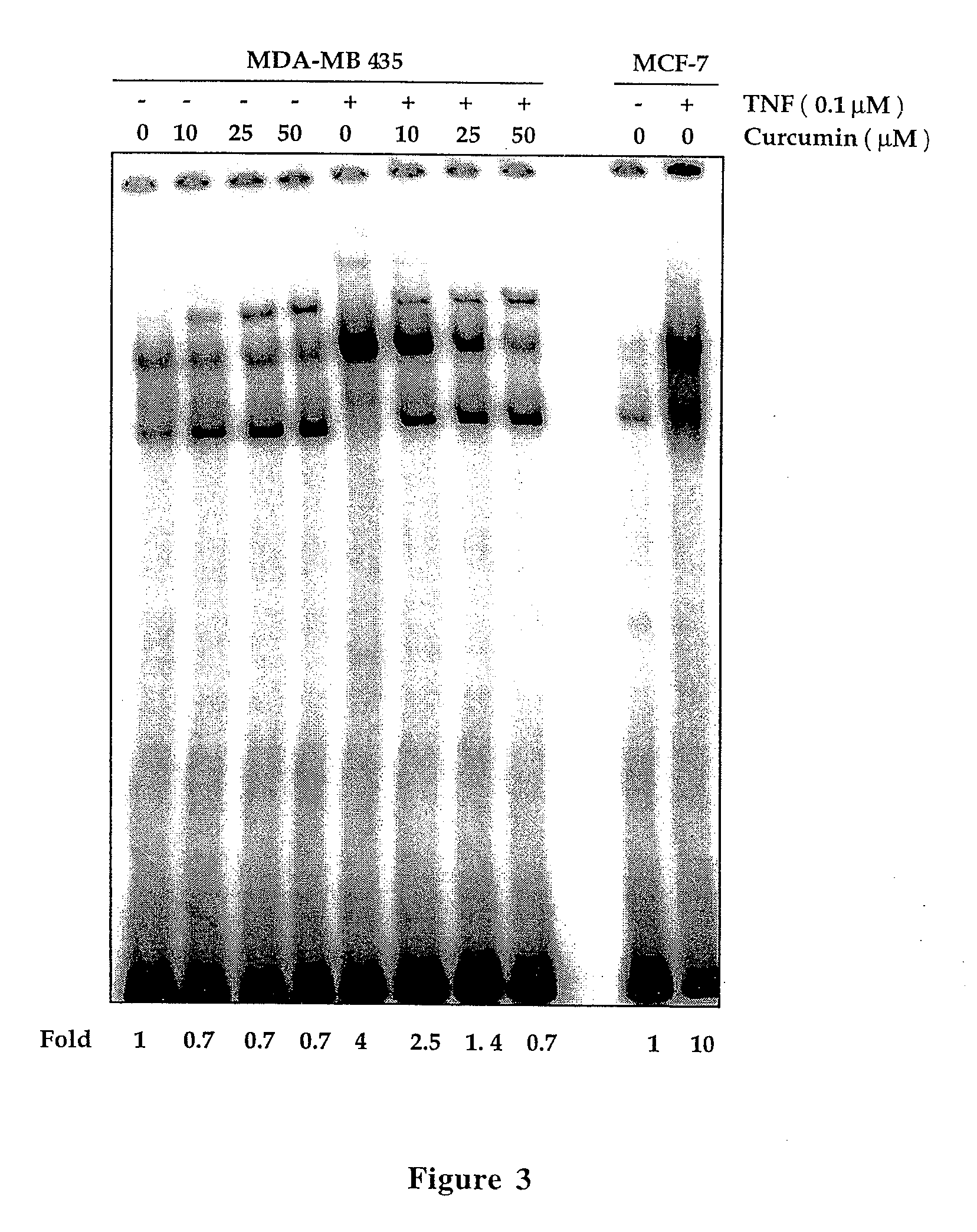
[0047] Human breast adenocarcinoma MCF-7 cells were pretreated with either media or different concentrations of curcumin (1-100 μM) for 2 h and then treated with paclitaxel for NF-κB activation. The nuclear extracts were prepared and analyzed by EMSA. The specificity of NF-κB can be examined by supershift analysis using antibodies against p50 and p65 subunits of NF-κB as described (109). As shown in FIG. 2, curcumin downregulated paclitaxel-induced NF-κB induction in MCF-7 cells in a dose dependent manner. Curcumin also inhibited TNF-dependent NF-κB activation in MDA-MB 435 cells (FIG. 3).
example 3
Suppression of Constitutive NF-κB Activation in Breast Cancer Cell Lines by Curcumin
[0048] Several breast cancer lines are known to express constitutively active NF-κB. These include MDA-MB-436, HBL100, MDA-MB-468, MDA-MB-231 and MDA-MB-435 with highest expression; SK-BR-3 and ZR-75-1 with intermediate expression; and T47D and MCF-7 with lowest constitutive expression (34, 35).
[0049] Curcumin suppression of NF-κB in these cells can be examined by incubating the cells with curcumin at different concentrations and for different times. Their nuclear extracts can then be analyzed for NF-κB by EMSA.
PUM
| Property | Measurement | Unit |
|---|---|---|
| diameter | aaaaa | aaaaa |
| diameter | aaaaa | aaaaa |
| diameter | aaaaa | aaaaa |
Abstract
Description
Claims
Application Information
 Login to View More