
Channel reconfiguration with side information
a channel and side information technology, applied in the field of channel reconfiguration with side information, can solve the problems of may still receive unaltered legacy content that may be played back unaltered, and achieve the effect of fewer processing resources, high quality, and low transmission cost of such upmix side information
- Summary
- Abstract
- Description
- Claims
- Application Information
AI Technical Summary
Benefits of technology
Problems solved by technology
Method used
Image

Examples
Embodiment Construction
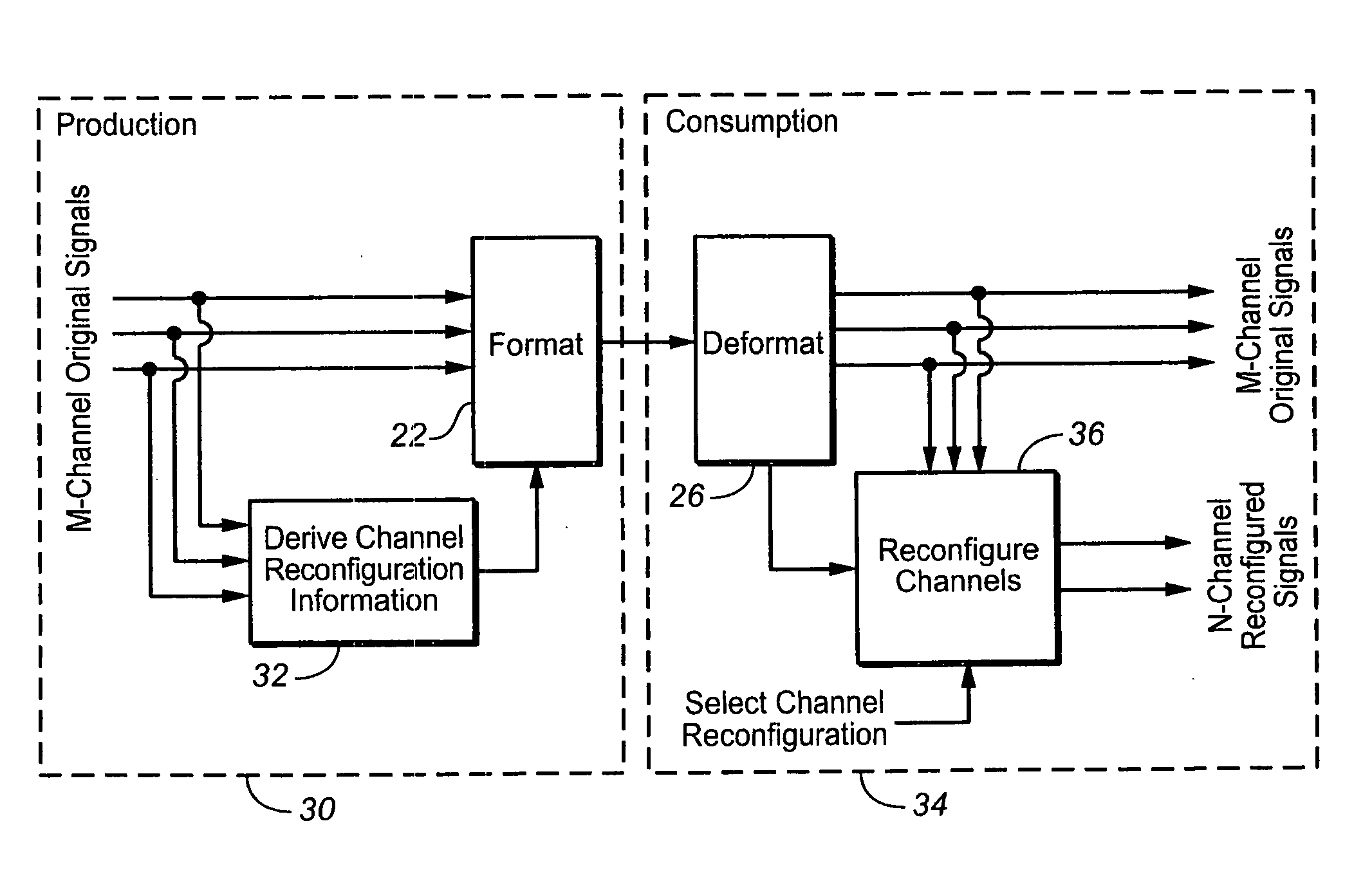
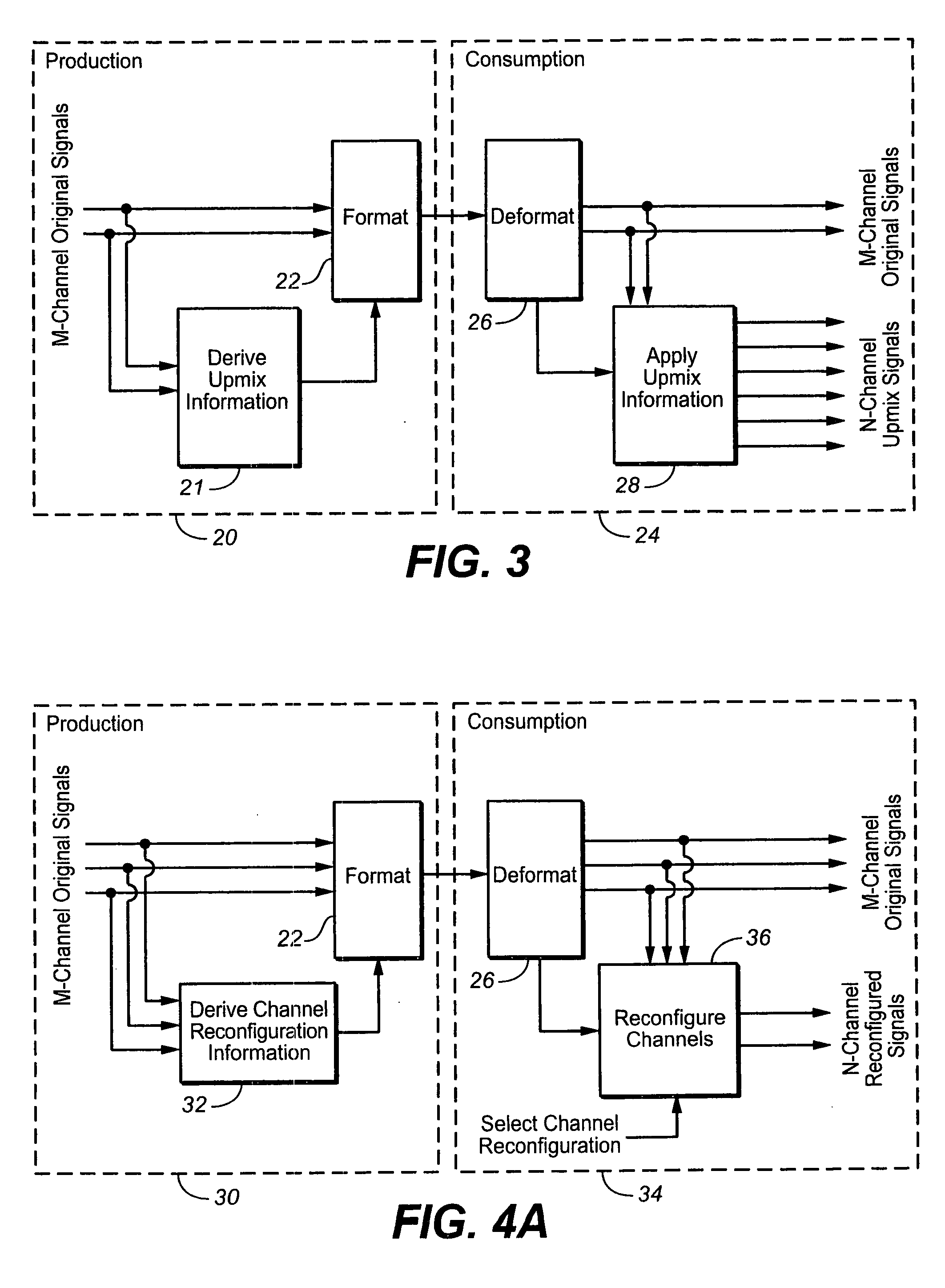
[0039]FIG. 3 depicts an example of aspects of the invention in an upmixing arrangement. In the Production 20 portion of the arrangement, M-Channel Original Signals (e.g., legacy audio signals) are applied to a device or function that derives one or more sets of upmix side information (“Derive Upmix Information”) 21 and to a formatter device or formatting function (“Format”) 22. Alternatively, the M-Channel Original Signals of FIG. 3 may be a modified version of the legacy audio signals, as described below. Format 22 may include a multiplexer or multiplexing function, for example, that formats or arranges the M-Channel Original Signals, the upmix side information, and other data into, for example, a serial bitstream or parallel bitstreams. Whether the output bitstream of the Production 20 portion of the arrangement is serial or parallel is not critical to the invention. Format 22 may also include a suitable data-compression encoder or encoding function such as a lossy, lossless, or a...
PUM
 Login to View More
 Abstract
Description
Claims
Application Information
 Login to View More