Method and system for modeling variable-node finite elements and application to nonmatching meshes

US20090015586A1Inactive Publication Date: 2009-01-15KOREA ADVANCED INST OF SCI & TECH

Image

Smart Image Click on the blue labels to locate them in the text.
Viewing Examples
Smart Image
  • Method and system for modeling variable-node finite elements and application to nonmatching meshes
  • Method and system for modeling variable-node finite elements and application to nonmatching meshes
  • Method and system for modeling variable-node finite elements and application to nonmatching meshes

Examples

Experimental program
Comparison scheme
Effect test

Embodiment Construction

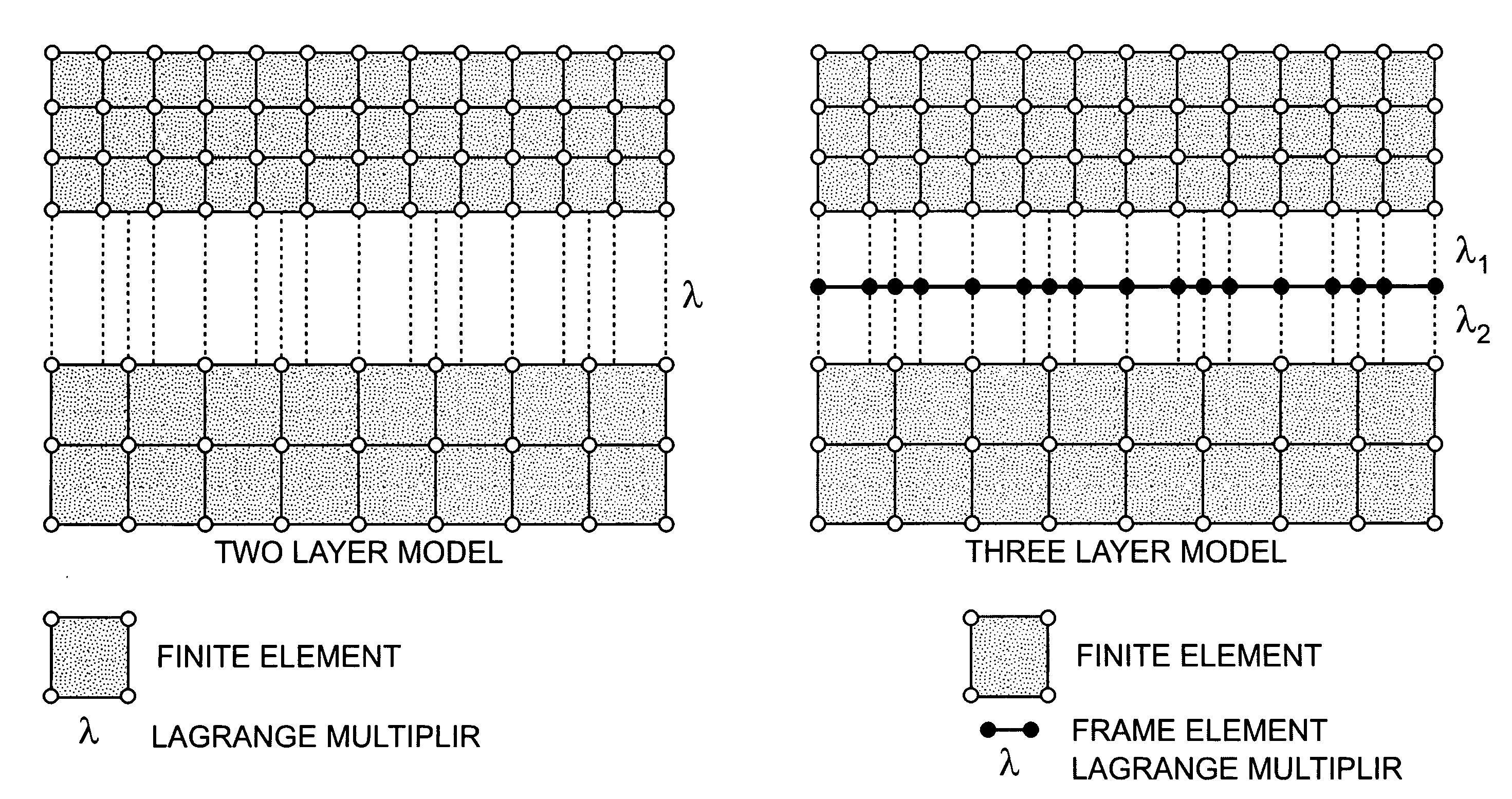
[0021]The present invention relates to a method and system for modeling finite elements using the finite element method. More specifically, the present invention is to solve the following engineering problems caused by the non-matching meshes via a computer. In other words, a method and recording medium for modeling variable-node finite elements for application to non-matching meshes using the finite element analysis method using the existing four-node linear quadrangular element, eight-node or nine-node secondary quadrangular element, and eight-node hexahedral element, wherein the finite element analysis method includes: a first step of confirming the number of nodes added to boundary surfaces of the non-matching meshes; a second step of dividing the boundary surfaces of the non-matching meshes by means of the added nodes; a third step of dividing the non-matching meshes into partial regions based on the boundary surfaces of the non-matching meshes divided in the second step; a fou...

the structure of the environmentally friendly knitted fabric provided by the present invention; figure 2 Flow chart of the yarn wrapping machine for environmentally friendly knitted fabrics and storage devices; image 3 Is the parameter map of the yarn covering machine
Login to View More

PUM

No PUM Login to View More

Abstract

The present invention relates to a method and system for modeling non-matching finite element meshes using variable-node finite elements in the finite element method. More specifically, a method and recording medium for modeling a variable-node finite element for application to non-matching meshes using the finite element method performed via a computer and using the existing four-node linear quadrangular element, eight-node secondary quadrangular element, nine-node secondary quadrangular element, and eight-node hexahedral element, wherein the finite element analysis method includes: a first step of confirming the number of nodes added to boundary surfaces of the non-matching meshes; a second step of dividing the boundary surfaces of the non-matching meshes into partial boundary surfaces divided by means of the added nodes; a third step of dividing the non-matching meshes into partial regions based on the partial boundary surfaces divided in the second step; a fourth step of performing a point interpolation based on the nodes affecting each partial region divided in the third step; and a fifth step of integrating each of the partial regions through numerical integration.

Description

[0001]This application claims priority to Korean Patent Application No. 10-2007-68830, filed on Jul. 9, 2007, in the Korean Intellectual Property Office, the entire contents of which are hereby incorporated by reference.BACKGROUND OF THE INVENTION[0002]1. Field of the Invention[0003]The present invention relates to new variable-node finite elements in a finite element method and their application to modeling non-matching meshes.[0004]2. Description of the Related Art[0005]Generally, in a field of intensively studying a structural analysis of an object such as in mechanical engineering, a finite element method (FEM), which is one of numerical analysis methods using differential equations, has widely been used. Such a finite element method is mainly applied to an analysis of strength and deformation of machine / structure, an analysis of fluid flow, an analysis of electromagnetic field, etc. To this end, a region to be analyzed is divided into small area or volume with the aid of mesh g...

Claims

the structure of the environmentally friendly knitted fabric provided by the present invention; figure 2 Flow chart of the yarn wrapping machine for environmentally friendly knitted fabrics and storage devices; image 3 Is the parameter map of the yarn covering machine
Login to View More

Application Information

Patent Timeline
15 Jan 2009
Publication
US20090015586A1
IPC
G06T15/30
CPC
G06F17/5018; G06F30/23; G06F9/455; G06F17/10
Inventors
IM, SEYOUNG; LIM, JAE HYUK