

Diagnosis of Conditions Associated with Decreased Arginine Bioavailability
a technology of arginine bioavailability and diagnostic imaging, which is applied in the direction of instruments, peptide/protein ingredients, drug compositions, etc., can solve the problems of allergen-induced bronchoconstriction increase, and achieve the effect of reducing arginine bioavailability
- Summary
- Abstract
- Description
- Claims
- Application Information
AI Technical Summary
Benefits of technology
Problems solved by technology
Method used
Image



Examples
example 1
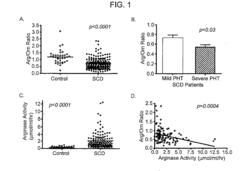
Analysis of Amino Acid Levels in Asthmatics, Sickle Cell Disease, and PHT Patients
Methods and Materials
[0117]Asthma patients. Patients with asthma presenting to the emergency department and clinics at Children's Hospital and Research Center at Oakland were recruited. Blood samples and exhaled nitric oxide levels (in patients old enough to perform peak flow) are obtained at presentation to the emergency department or clinic, and followed daily during hospitalization for those patients ill enough to require admission.
[0118]Baseline blood was obtained at least 4 weeks after resolution of the acute exacerbation. Blood samples were analyzed for arginine and amino acid levels, arginase activity, and arginine-to-ornithine ratio.
[0119]Sickle cell patients. Seventeen sickle cell disease patients with documented pulmonary hypertension at steady-state were enrolled in the study. All known patients with pulmonary hypertension receiving care at the Northern California Comprehensive Sickle Cell C...
example 2
Decreased Arginine Bioavailability Contributes to the Pathogenesis of Pulmonary Arterial Hypertension
[0128]Alterations in amino acid metabolism occurring in pulmonary artery hypertension (PAH) that could be impacted by elevated arginase activity were investigated. Plasma amino acids were determined in normal (NL) controls and patients diagnosed with primary pulmonary hypertension (PH) or PAH associated with scleroderma or systemic lupus erythematosis. These data are provided in Table 4 below.
TABLE 4NL ControlPAHVariable(n = 36)(n = 20)P*Arginine (μM)67 ± 1850 ± 15Ornithine (μM)62 ± 22102 ± 30 Arg / Orn ratio1.2 ± 0.50.6 ± 0.4Glutamic acid (μM)38 ± 15127 ± 75 Proline (μM)161 ± 48 202 ± 65 Citrulline (μM)25 ± 1138 ± 14
[0129]Plasma Arg levels were low, Orn levels were high, and the Arg-to-Orn ratio was low in PAH as compared to normal controls. Consistent with a shift in Arg metabolism away from NO production and towards the ornithine-dependent pathways, both glutamic acid and proline le...
example 3
Decreased Arginine Bioavailability and Elevated Arginase Activity in Thalassemia
[0131]Data on the levels of amino acids and arginase activity in plasma samples obtained from thalassemia (“thal”) patients was collected (8 thal-major, 4 E-beta that, 2 Hb H alpha thal). All but 3 patients were on chronic transfusion therapy. Echo results were available on 9 patients and demonstrated 6 / 9 with a tricuspid regurgitant jet velocity≧2.5 m / s. The data are provided in Table 5.
TABLE 5NL ControlThalassemiaVariable(n = 36)(n = 14)p*Arginine (μM)67 ± 1857 ± 26 (50)0.15Ornithine (μM)62 ± 2285 ± 680.05Arg / Orn ratio1.2 ± 0.50.79 ± 0.4 Arg / Orn + Cit0.82 ± .27 0.50 ± .4 Proline (μM)161 ± 48 258 ± 116Citrulline (μM)25 ± 1142 ± 17Arginase (μmol / cc / hr)0.33 ± 0.2 (n = 45)0.71 ± 0.3
[0132]Plasma arginine concentration trended lower in patients with thalassemia, with values ranging from normal to very low (19.5 to 122 μM, median 50 μM). Ornithine levels were high, and the arginine-to-ornithine ratio low in ...
PUM
 Login to View More
 Abstract
Description
Claims
Application Information
 Login to View More